2025 Retrospective
What worked, what broke, what we would do differently, and what we plan for 2026. An open and frank letter to our clients and prospects.
By Matthew Clarkson · December 9, 2025
Late last week, Nicholas and I sat down and did a full retrospective on the year for Osher Digital. Not a case study but a look in the mirror. What worked, what broke, what we would do differently and what we plan for 2026.
We don’t usually publishing something like this. But we decided you should see it, not the polished version – the real one.
Partly because many of you have trusted us with critical parts of your business. Partly because if you are going to keep betting on us, you deserve to know how we think, where we have fallen short, and what we are changing in 2026. And partly because our whole vision is about improving Australia’s productivity through ethical AI and automation. That only means something if we are honest about our own performance.
So this is a long, open note from me, rather than a polished marketing piece.
What we are proud of in 2025
If I had to summarise the year in one phrase, it would be: validation.
We have seen enough over the last few years to know this business works. Not just commercially, but in terms of real impact. A few patterns really stood out.
1. Once we deliver, most clients want more
Across sectors, once a project is live, the usual response from clients has been some version of:
“This is great. Here is the next thing I want to automate.”
Roughly 70% of clients who did a project have commissioned a second project, or are in active discussions about what is next.
That tells me two things.
First, we are delivering real value when things get into production. Time saved, errors reduced, and less frustration for staff.
Second, the real challenge is not “does automation work” but “how do we help more organisations take the first step without feeling overwhelmed”. I will come back to that.
2. Quick, focused wins create momentum
Some of the most satisfying work this year has been small, tightly scoped automations. For example, tools that:
- Summarise and extract key data from documents into structured formats
- Integrate disparate systems so simple things like email addresses aren’t input multiple times
- Turn messy email-based processes into structured workflows
- Take boring, repetitive document work and compress it from hours into minutes
None of these projects were flashy. They were simple, practical fixes to annoying problems. But they changed people’s day to day lives. You could feel the relief when someone realised they no longer had to deal with a boring, repetitive manual task.
That matters. Work is more fulfilling when you can see progress and get feedback. In 2026 we want to lean even harder into that philosophy.
3. Internal growth and capability
From a team point of view, there have been some big wins.
Nicholas joined mid-year from BDO and has gone from “learning the ropes” to “solving hard problems independently” very quickly. Our effectiveness as a small team has improved a lot, and I am personally proud that I have managed (most of the time) to get out of the way, delegate and let him own things.
We have also:
- Implemented a proper CRM and marketing system that tracks visits and engages people automatically – yes, our sales and marketing is (ethically) automated 😊
- Grown the osher.com.au domain rating from essentially zero to the low 40s (which is a pretty significant achievement and takes many brands years, if ever, to achieve)
- Launched a new website that looks and feels like the standard we want to hold ourselves to
- Set up lean, isolated infrastructure for each client using Docker containers and private servers
- Introduced Osher Sentinel for monitoring and error alerting, plus a customer support centre and system status page so you know you are in safe hands (note: only our systems are displayed publicly – all client monitoring is private)
Objectively, for an intentionally small team, we now run quite a sophisticated and reliable stack in the background. Not because we like shiny tools, but because we want you to know that your systems are in safe hands.
4. Building our own RAG and document understanding capability
We learned the hard way that relying on third party “black box” tools for retrieval and document understanding is painful. After weeks of frustration with an off the shelf platform, we made the call to build and run our own retrieval augmented generation infrastructure.
That decision hurt in the short term and it nearly broke poor Nicholas. But long term it is a foundation we are glad we laid. It means we can control quality, tune things properly, and run knowledge assistants that do not spray your content through random SaaS tools.
Where we fell short in 2025
This part is less comfortable to write, but it is important.
1. One big project failed
There was a manufacturing related project where we needed to interpret complicated hand drawn diagrams to automate the ordering process. Bluntly, we did not get to a solution that worked well enough within the client’s budget and the constraints of current technology.
They were pragmatic, and we were transparent, but it’s a failure on my part.
Sure, I am in this business to make money, but I genuinely want to make businesses more efficient and less painful to run. In that instance, we fell short.
We are actively keeping an eye on the technology landscape in that area. If and when we find a solution that is genuinely viable, I will go back to that client and fix it at our cost. Some things matter more than short term margins.
2. Some projects took too long
Several projects that were scoped as “quick wins” stretched out far longer than any of us would have liked. In almost every case the reasons were the same:
- Slow or complex system access, especially into legacy platforms
- Clunky vendor APIs and security models that require countless tickets and emails with support teams (for one project Nicholas sent 50 emails to get basic system access!)
- Internal bottlenecks and competing priorities on the client side
- Scope changes that crept in without being properly repriced
We are very good at “figuring it out”. That is one of our strengths, and one of our core values. The downside is that we pushed through obstacles that should have been handled differently at a commercial and process level.
The big lesson for us is simple. We cannot let system access delays block you from seeing value.
Going forward, our default approach will be:
- Build something that works in our environment first.
- Use forms and email monitoring much more aggressively as the first interface.
- Only integrate into core systems once the value is demonstrated and there is clear access.
This is better for you and better for us. You see value in weeks. We are not sitting and waiting for an overseas support desk to press a button to give us the permissions we need (which would often take us 2 minutes to setup ourselves).
3. Commercially, we left opportunities on the table
We’re _really good _at online marketing and over the year we had a steady stream of very strong inbound enquiries. Smart founders, CFOs and COOs. People who clearly “got it” in theory.
But we only converted 35% of those into paid projects.
In absolute terms, that is not terrible. In relative terms, given the quality of conversations and the outcomes we have achieved for existing clients, I think it should be much higher.
We very rarely (but sometimes do) lose to a direct competitor. What happens instead is:
- The project gets pushed inside to an internal IT or data team.
- The organisation decides to “come back later” and nothing happens.
- People feel overwhelmed once they see how much is possible, and retreat to the status quo.
To be very candid, it is frustrating. Not because we feel entitled to the work, but because we have seen what happens once a project actually goes live. In most cases, those businesses would be in a much stronger position today if they had just started.
There is also a bit of feedback for me here.
Nicholas very kindly pointed out that I can be “a little intense” in some conversations. I am passionate about this space. I can see the compounding value clearly. Sometimes that spills over.
No one has ever said “you do not know what you are talking about”. If anything, the comment we hear is “you have really opened our eyes”.
Our challenge is to make that insight feel actionable and safe, rather than overwhelming.
That will be a big focus for me in 2026. Clearer, calmer articulation of value. Smaller starting points. Less pressure to make a giant decision on a first engagement.
What we are changing in 2026
Retrospectives are only useful if they lead to concrete changes. These are the key shifts we are making that affect you.
1. Quick wins will be truly quick
We have talked about “quick wins” all year. If I am honest, some of them were still too big.
From now on:
- A quick win means something we can build and put in your hands in 1 to 2 weeks.
- Initial wins will not depend on deep integration into your legacy stack.
- Wherever possible we will use forms, email monitors or a very thin interface hosted in our environment to speed things up.
The goal is simple. You should be able to feel the impact of automation within a fortnight of kicking off. Not see a Gantt chart. Feel the result in your day.
Once that is in place and adopted, we can have a better informed discussion about deeper integration and larger programs of work.
2. A more structured handover and adoption process
We realised that we were sometimes declaring a project “done” in our heads without giving you a clear, formal sense of what had been delivered (and the magnitude).
That is on us.
Going forward every substantial project will end with a simple but thorough handover pack. Things like:
- What the system does and does not do
- How it is hosted and its dependencies
- How errors are monitored through Osher Sentinel (check out our uptime monitoring)
- How to request changes or report issues (hint: use our support centre)
- Who internally owns adoption and training
We will also pay more attention to the human side. A good system that no one uses is not success. Part of our work in 2026 will be helping you think through “who needs to change what they do on Monday morning” when an automation goes live.
3. Being clearer about scope and pricing
We will stay premium relative to low cost “one click AI tools”, because what we do is bespoke, robust and hosted properly. At the same time, we need to reduce the perceived risk for you.
You will see us:
- Being much more explicit about what is in scope and what is not
- Charging promptly for out of scope work rather than absorbing it silently (we love to please but too much sometimes)
- Packaging smaller, fixed price starter projects that do not require board level approval
- Exploring more flexible payment structures for some engagements, where that makes sense
The aim is not to squeeze more out of you. It is to avoid the situation where scope creeps silently, projects drag, and everyone feels stressed.
Clear structure is kinder for both sides.
4. Doubling down on our points of difference
A lot of people can “build a workflow” now. Very few can give you a combination of:
- Ethical, pragmatic use of AI that respects both your staff and your customers
- Secure, private, isolated infrastructure where each client environment is ring fenced
- A very lean, senior team that actually does the work, not a chain of juniors and account managers
- A focus on automation first, AI second, so you are not paying for generative models where a simple rule or integration would do the job better.
In line with our philosophy of ‘Ethical AI’ there are some types of work we simply will not do. For example:
- High volume spammy outbound sales and marketing where the goal is to flood inboxes
- AI driven “bots” that pretend to be people
- Anything where the core premise is “let us trick more people faster”
We will use AI to summarise, extract, route, prioritise, enrich and guide.
We will not use it to mislead or dehumanise. If you share that view, we are probably a good fit.
5. Becoming the people you call for document understanding and knowledge assistants
One area where almost every organisation struggles is getting value out of the documents it already has. Policies, procedures, contracts, clinical notes, support tickets, FAQ content, you name it.
Our own RAG and document understanding stack is now in a good place. In 2026 we plan to make this a real specialty. Think:
- Internal knowledge assistants that actually understand your content
- Tools that read long documents and output clean, structured data
- Assistants that help staff answer questions accurately, with clear citations back to your source material
All running in environments that are yours, not shared with the world.
How we will show this, not just say it
Talking about capability is easy. Demonstrating it is harder.
Over the quieter period between now and late January we will be putting more live, interactive examples on the website. Small agents and tools you can try in your browser using safe, sample data, to get a feel for what is possible.
We will also continue to publish real case studies (with details de-identified where appropriate) that show before and after states, not just vague claims. If you are reading this and thinking “our story would be useful to share”, I would love to hear from you.
Where this is heading
My vision for Osher Digital has never been “a big agency with a big office and 100 people”. I’ve been there.
I want a lean, very capable team of A players, supported by automation and strong systems, serving a group of clients who value quality, privacy and long-term partnership.
The kind of small but powerful firm that can realistically grow to eight figures of revenue without turning into a bureaucratic mess.
I also care a lot about the bigger picture. Australia has a productivity problem. We waste huge amounts of human energy on low value work. I believe ethical AI and smart automation can change that without grinding people into the ground.
If we do our job well, your staff should spend less time on repetitive rubbish and more time on judgment, relationships and creativity.
A simple invitation
If you have read this far, thank you. I know this is a long email.
Whether we have worked together already, or you are still on the fence, I am genuinely grateful that you are in our world. The trust you place in us is not taken lightly.
Here is to a calmer, smarter and more automated year ahead!
Last updated on July 4, 2026
Free tool · 2 minutes
Automation ROI Calculator
See what a manual process is really costing you, and the payback on automating it.
Continue Reading
View all
Rented software was always a compromise. AI has ended it.
Off-the-shelf software made sense when custom cost $250,000. AI-assisted development changed the maths. Why we now build software around the business, AI-first, and connected to Claude and ChatGPT, starting at $15k.
Aug 6, 2026
n8n Outlook Automation: Where the Node Stops and Graph Begins
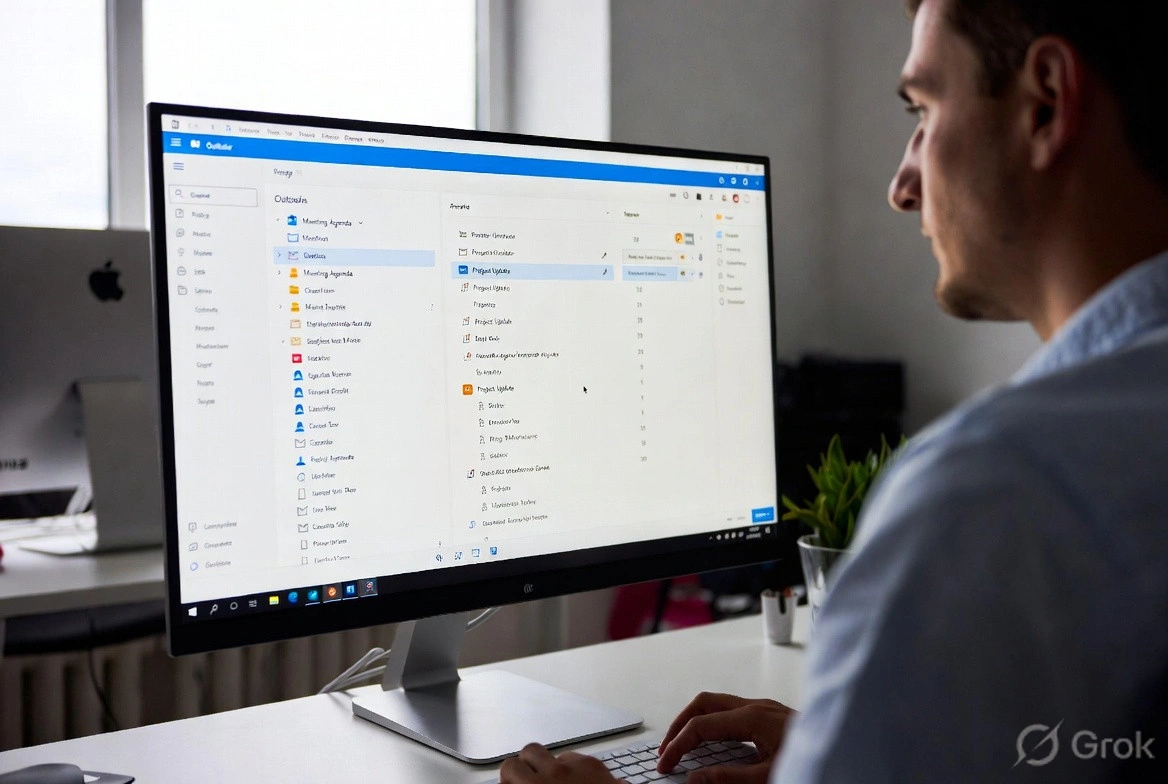
n8n Outlook automation breaks in predictable places: subfolders, attachments, shifting email IDs, plus the Graph API workarounds we run in production.
Mar 16, 2026

What Is a Workflow? Definition, Parts, and What Breaks
A workflow is the repeatable set of steps that takes a task from start to finish. Here is what a workflow is made of, and the parts that quietly break.
Mar 1, 2026
Sick of reading about automation?
Book a free 15-minute intro call. We’ll talk through what you’re trying to automate and whether we’re a good fit.