AI Predictions for 2026: 10 Shifts to Act on Now
The AI predictions for 2026 that change how you operate: agentic systems, specialised open-source models, AI-native security, and the moves to make now.
By Matthew Clarkson · December 10, 2025
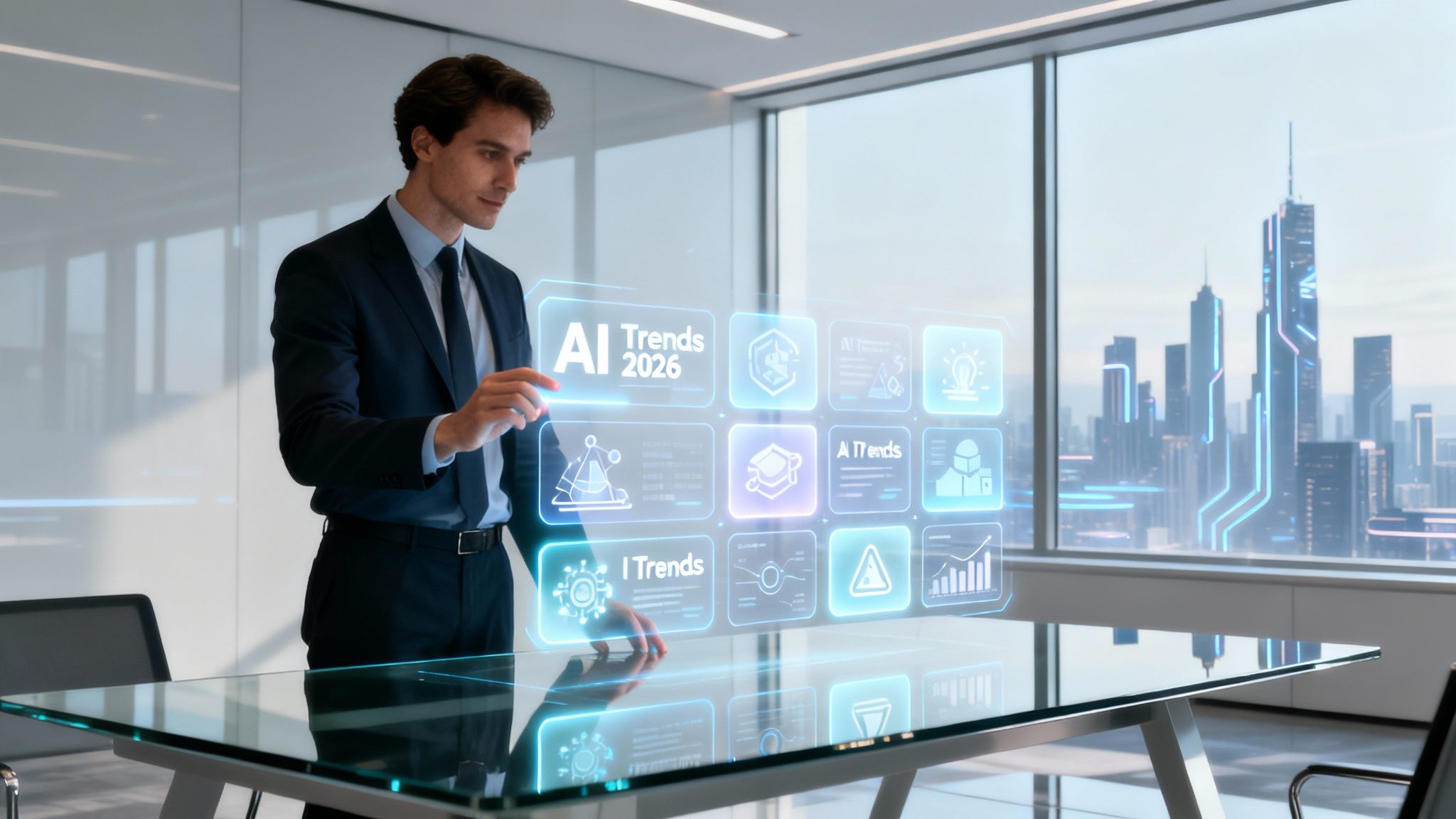
Imagine if your AI wasn’t just a handy tool, but a truly proactive teammate. By 2026, this idea will jump from science fiction movies straight into your daily business operations. Think about it like this: today, we use sat nav in our cars without even thinking. In a couple of years, businesses will use AI to navigate tricky market decisions, automate whole chunks of their workflow, and even speed up scientific discoveries with that same level of ease. The change will be that big.
But getting ready for this future isn’t about chasing every new AI gadget that pops up in the news. The real advantage comes from understanding the big shifts coming our way and setting up your business to ride the wave, not get swamped by it. Success will come down to smart preparation and investing in the tech that will actually help, rather than taking a punt on every new trend. This means you need a clear picture of where things are heading.
That is exactly what this article gives you. We are not just listing off vague, futuristic ideas. Instead, we are breaking down the most important 2026 predictions for AI that will directly affect your business. For each trend, we will explain what it means for your day to day, look at the potential impact, and give you a straightforward plan to get ready. We will cover everything from AI “agents” that act on your behalf, to how AI will become a standard part of business software, and why bigger isn’t always better when it comes to AI models. Let’s look at what’s on the horizon and how you can make it work for you.
1. Agentic AI Systems Becoming Mainstream
By 2026, we reckon AI will go way beyond the simple chatbots we use today. The next big thing is “agentic AI”. Think of these as clever digital helpers that can plan, reason, and handle complex jobs with very little help from you. They are not just tools you tell what to do; they are more like digital team members who can manage entire workflows on their own.
These systems will connect deeply with your business software to manage calendars, analyse market data to make trades, or even handle tricky supply chain logistics. Unlike simple automation that just follows a strict set of rules, an AI agent can adapt when things go wrong, make its own decisions, and learn from what it does to get better over time. This move from a simple “doer” to a “process owner” is a massive part of our 2026 predictions for AI.
https://www.youtube.com/embed/VN8_LWeYlHk?feature=oembed
Business Impact and Actions
The main benefit here is a huge jump in how efficiently things get done. An agentic AI can take care of complex, high-volume tasks that currently need a lot of human supervision. This frees up your team to focus on the big-picture stuff that helps your business grow. For example, an agent could handle the entire accounts payable process, from getting an invoice to checking the details, getting approvals, and scheduling the payment, all while flagging any oddities for a human to look at.
To get ready, IT leaders should:
- Start Small: Begin by giving agents lower-risk, high-value jobs like sorting data or creating first-draft reports before you let them handle critical operations.
- Establish Guardrails: It is like putting up fences. You need to have strong monitoring, audit trails, and even a “kill switch” to stay in control and make sure you can see and undo any decisions the AI makes.
- Combine Oversight: Use a “human-in-the-loop” model. The agent does most of the heavy lifting, but a person has to sign off on the most important decisions. Getting a feel for how this works in practice is key, so checking out diverse agentic AI use cases is a great idea.
How Osher Digital Can Help
Using agentic AI successfully means you need a solid foundation of connected systems and a clear plan for automation. Our AI consultants can help you find the best uses for this tech in your business, design the right safety nets, and fit these smart agents into your current workflows. We make sure you can use this powerful technology safely and effectively.
2. Multimodal AI Models Reaching Parity with Specialist Systems
By 2026, AI models will stop being one-trick ponies. We predict we will see unified, “multimodal” systems that can understand and create text, images, audio, and video all at once. Imagine an AI that can watch a product demo video, listen to what the presenter is saying, and instantly write a detailed technical manual, complete with diagrams.
These powerful models, like Google’s Gemini or OpenAI’s GPT-5, are getting so good they are starting to match or even beat systems trained on just one type of data. It is like having a Swiss Army knife instead of a toolbox full of separate tools. This change means you will not need to patch together different AIs for different jobs, making everything much more natural and efficient. This merging of abilities is a key part of our 2026 predictions for AI , promising more intuitive and powerful tools.

Business Impact and Actions
The biggest plus here is being able to make sense of complex, messy data that was previously too hard to deal with. For example, a multimodal AI could analyse a customer support call by processing the customer’s words, their tone of voice, and any screenshots they share to figure out the problem with amazing accuracy. This unlocks deeper insights and helps create super-personalised customer experiences.
To get your business ready, IT leaders should:
- Audit Your Data: Figure out where your most valuable information is stored across different formats like videos, audio files, images, and documents. A unified model can finally connect all these dots.
- Prototype Cross-Functional Use Cases: Start with small projects that need different data types, like creating marketing summaries from video testimonials or generating safety reports from site photos and audio notes.
- Validate Each Modality: When testing, make sure the model is reliable across every format. Check that the text is accurate, the images it creates are relevant, and the audio it understands is correct.
How Osher Digital Can Help
Bringing multimodal AI into your business requires a plan that connects your different data sources and points them toward clear goals. Our AI consultants can help you build the right data infrastructure and find high-impact projects. We will guide you in using these versatile models to solve tough challenges and find new sources of value.
3. AI-Powered Drug Discovery Reaching Clinical Trials
By 2026, the pharmaceutical industry is set for a massive breakthrough. AI-designed drug candidates will regularly start entering human clinical trials. This is a huge leap from AI’s current role, which is mostly just analysing existing data. Instead, powerful models will design brand new medical compounds from scratch. It is like going from being a lab assistant to being the lead scientist, and it will completely change how we create medicines, making this a key part of our 2026 predictions for AI.

This process involves training AI on huge amounts of data about molecular biology, chemical reactions, and how diseases work. The AI can then find new targets for drugs and create molecular structures that are likely to be effective against them. Companies like Atomwise and Exscientia already have AI-discovered compounds in trials, showing the potential to cut drug discovery timelines from over a decade down to just two or three years.
Business Impact and Actions
The main benefit is a massive speed-up in research and development, along with a big drop in costs. AI can explore millions of potential molecules on a computer, weeding out the unpromising ones before any expensive and time-consuming lab work even starts. This lets biotech and pharmaceutical companies focus their resources on the most likely winners, increasing the chance of success.
To take advantage of this trend, R&D leaders should:
- Validate and Verify: Use traditional lab experiments to rigorously test and confirm the predictions made by AI models. This builds trust and ensures safety.
- Prioritise Explainability: Build AI models that can explain their thinking. It is not enough for the AI to give you an answer; regulators will want to see clear documents showing why a particular compound was chosen for trials.
- Focus on High-Need Areas: Aim AI discovery efforts at diseases where new treatments are desperately needed to maximise the impact and clear the path to market.
How Osher Digital Can Help
Putting complex AI models into sensitive R&D workflows requires deep expertise in managing data and systems. Our AI consultants can help your organisation build the secure, scalable data infrastructure needed to power these advanced discovery platforms. We work with you to make sure your AI initiatives are both scientifically sound and commercially successful.
4. AI-Generated Content Regulation and Authentication Standards
As AI models get better at creating realistic text, images, and video, the line between what a human creates and what a machine creates is getting blurry. By 2026, we predict that governments and industry groups will respond with firm rules for identifying and proving that AI-generated content is what it says it is. This is not about stopping innovation; it is about building trust in the digital world.
We expect to see widespread laws requiring clear labels when AI is used. Think of it like a “Made with AI” sticker for digital content. Technologies like cryptographic watermarking and digital signatures, pushed by groups like the Coalition for Content Provenance and Authenticity (C2PA), will become standard. This move towards transparency is a critical part of our 2026 predictions for AI , driven by the need to fight misinformation and protect creative work.
Business Impact and Actions
The biggest impact for businesses will be a new layer of rules and procedures to follow. Companies that create or use AI content, from marketing materials to internal reports, will need to prove where it came from and that it is authentic. Not following the rules could lead to big fines and damage to your reputation, especially as regulations like the EU AI Act come into full force.
To get ready for this change, IT leaders should:
- Implement Standards Proactively: Do not wait for the government to force you. Start adopting industry standards like C2PA for digital watermarking in all AI-generated assets your organisation produces.
- Create an AI Usage Log: Keep a record of which AI tools, models, and settings are used for specific projects. This creates a clear trail for compliance and authenticity checks.
- Train Your Teams: Teach your content, marketing, and legal teams about the new rules and the importance of clearly labelling AI-generated content. For a deeper dive, looking into the principles of effective AI governance is a great first step.
How Osher Digital Can Help
Finding your way through the changing rules for AI can be tricky. Our AI consultants can help your organisation develop and put in place a solid content authentication strategy. We will help you integrate the necessary watermarking technologies and set up clear governance policies to make sure you meet the standards while keeping your customers’ trust.
5. Specialized Open-Source Models Outperforming Proprietary Systems
By 2026, the big, all-purpose AI models from major tech companies will face a new challenge from a wave of highly specialised open-source models. Instead of a one-size-fits-all approach, these models are fine-tuned on specific data for industries like medicine, law, or finance. The result is that they perform better and are more accurate for specific jobs than their big-name, proprietary cousins.
This trend makes powerful AI available to everyone, allowing businesses to build a competitive edge without relying on expensive, closed systems. We are already seeing models like Mistral 7B beating much larger proprietary models on certain tasks. This shift towards tailored, open-source solutions is a key part of our 2026 predictions for AI , giving businesses the power to control their own AI destiny.
Business Impact and Actions
The main benefit is getting highly accurate, cost-effective AI that is a perfect fit for your business needs. A specialised model like LegalBERT can analyse legal documents with more precision than a general-purpose AI, while FinBERT can pull out financial insights much more effectively. This focused approach means fewer errors, better efficiency, and a lower cost to get started with sophisticated AI.
To get ready for this change, IT leaders should:
- Evaluate Open-Source Options: Compare leading open-source models against proprietary ones for your specific needs to see where the performance and cost benefits are.
- Invest in Fine-Tuning: The real magic happens when you train these models on your own private data. Set aside resources to create a secure environment for this customisation.
- Start with Well-Maintained Projects: Focus on models with active communities and strong support, like those from Meta (Llama) and Mistral AI, to make sure they will be around for the long haul. For more detail, you can explore the strategic advantages of leveraging open-source LLMs for SME AI solutions.
How Osher Digital Can Help
Navigating the open-source world and getting fine-tuning right requires deep expertise. Our AI consultants can guide you in choosing the right foundational model, setting up the infrastructure for secure fine-tuning, and fitting your custom AI into your existing business processes. We help you build a powerful, proprietary AI asset without the proprietary price tag.
6. AI-Assisted Scientific Research Accelerating Discovery
By 2026, AI’s role in scientific research will have grown from a simple data-crunching tool to an essential partner in discovery. We predict that AI systems will actively take part in the scientific method by coming up with new ideas, designing experiments, and finding patterns in huge datasets that are invisible to human researchers. Think of it less like a microscope and more like a fellow research scientist.
This technology is already making a difference. Systems like DeepMind’s AlphaFold can predict the structure of proteins with incredible accuracy, a job that used to take years. In other fields, AI is identifying new materials for next-gen batteries and discovering potential antibiotics from existing molecular data. This fundamental shift towards AI-powered science is a key part of our 2026 predictions for AI , as it promises to dramatically speed up innovation.
Business Impact and Actions
The main benefit for industries that rely on R&D is a massive acceleration in the pace of discovery. Businesses in pharmaceuticals, materials science, and advanced manufacturing can cut the time and cost of bringing new products to market. An AI research partner could analyse thousands of scientific papers to suggest a new chemical compound, then simulate its properties, saving millions in lab-based trial and error.
To get ready for this shift, R&D leaders should:
- Establish Validation Protocols: Create clear procedures to test and confirm AI-generated ideas using traditional experiments. Human oversight is still essential.
- Invest in Quality Data: Make sure your research data is clean, well-organised, and easy to access. The quality of the AI’s insights depends directly on the quality of the data it learns from.
- Integrate AI into Workflows: Start by using AI to help with specific research steps, like reviewing literature or analysing data, before expanding its role to more complex jobs like generating hypotheses.
How Osher Digital Can Help
Using AI for scientific discovery requires a solid data infrastructure and a clear plan for integrating these advanced tools into your research workflows. Our AI consultants can help you build the foundational data systems and develop a roadmap for using AI to boost your R&D efforts. We make sure your team can leverage this technology to stay at the cutting edge of innovation.
7. Enterprise AI Integration Becoming Standard Practice
By 2026, we predict that AI will no longer be a separate tool but a basic part of the core business software you use every day. Instead of being an optional add-on, powerful AI features will be deeply woven into platforms from providers like Microsoft, Salesforce, and SAP. This integration will make AI a standard part of doing business.
This shift means that AI-powered features will become the norm, not a special advantage. Think of Microsoft Copilot helping you write documents in Microsoft 365 or Salesforce Einstein automatically scoring leads right inside your CRM. This trend is one of the most practical 2026 predictions for AI because it makes sophisticated technology available to businesses of all sizes without needing special development teams.
Business Impact and Actions
The biggest impact will be on productivity and data-driven decisions. AI-enhanced systems will automate routine tasks, provide predictive insights, and personalise customer interactions at a massive scale. A key technology making this possible is Retrieval-Augmented Generation (RAG). This lets the AI pull real-time, specific information from your company’s own data, making sure its answers are accurate and relevant.
To prepare for this new standard, IT leaders should:
- Audit for Readiness: Check your current business systems to see which ones already have AI features or are on the vendor’s roadmap to get them.
- Prioritise Data Governance: Make sure your data is clean, organised, and accessible. The quality of AI outputs depends entirely on the quality of the data it is fed.
- Plan for Upskilling: Train your teams to work with AI. The focus should be on how to use these new tools to make their jobs better, not replace them.
How Osher Digital Can Help
Figuring out the world of AI-enabled business software can be complex. Our AI consultants can help you assess your current technology, develop a solid data strategy, and create a plan for integrating these powerful new capabilities. We make sure your business is ready to take advantage of the built-in intelligence of your core platforms.
8. AI Cybersecurity Becoming Arms Race Priority
By 2026, the world of cybersecurity will have turned into a high-speed arms race driven by artificial intelligence. We predict that AI-powered cyberattacks will become clever enough to get past traditional defences, while defensive AI systems will be scrambling to keep up. It is like a high-tech game of cat and mouse where both attackers and defenders will use AI to find new weaknesses, launch complex attacks, and set up automated defences at a speed humans cannot possibly match.
This shift will completely change how we think about cybersecurity, moving from a reactive model that looks for known threats to a proactive, AI-first strategy. This is a critical part of our 2026 predictions for AI , as businesses will need to fight machine-led threats with equally smart machines.

Business Impact and Actions
The main impact is that old-school cybersecurity measures will not be enough. AI can create new types of malware, run super-personalised phishing campaigns, and find security holes in real time. On the other hand, defensive AI like Darktrace or CrowdStrike’s Falcon platform can analyse network behaviour to spot and stop threats before they cause damage, often without a human lifting a finger. The speed of both attack and response will be measured in milliseconds.
To prepare, IT leaders should:
- Implement a Layered AI Defence: Do not just rely on one solution. It is like having multiple locks on your door. Combine AI-driven network monitoring, endpoint protection, and threat intelligence to create a strong security setup.
- Maintain Human Oversight: Use a “human-on-the-loop” approach. The AI handles the immediate threat response, but all its actions are logged and checked by security professionals to fine-tune the system and avoid mistakes.
- Invest in Continuous Training: Get your incident response teams ready for AI-era attacks. This includes understanding how to analyse AI-driven threats and how to work alongside your own defensive AI systems during a crisis.
How Osher Digital Can Help
Navigating the AI cybersecurity arms race requires a proactive and integrated plan. Our AI consultants can help you assess your current security weaknesses and design a future-proof, AI-native defence. We help you choose and implement the right AI security tools and fit them into your existing infrastructure, making sure your organisation is ready for the next generation of cyber threats.
9. Personalized Learning AI Transforming Education
By 2026, AI-driven education platforms will go beyond one-size-fits-all digital lessons. The next wave of learning tools will act like dynamic personal tutors. They will be clever enough to understand and adapt to an individual’s unique learning style, pace, and knowledge gaps in real time. These systems will be as good as, and in many subjects, even better than human tutors at providing immediate, tailored support.
This change is driven by huge advances in AI’s ability to understand language and learning science. Platforms like Khan Academy’s Khanmigo and Squirrel AI are already showing how these systems can pinpoint where a student is struggling and generate custom explanations, exercises, and encouragement. This trend is a key part of our 2026 predictions for AI because it signals a huge shift in how we develop skills, both in schools and in corporate training.
Business Impact and Actions
For businesses, the main benefit is the ability to deliver highly effective and scalable employee training programs. Instead of generic workshops, AI can create personalised learning paths for each team member, speeding up their development in key areas like software skills, compliance, or leadership. An AI tutor could guide a new sales hire through complex product knowledge, changing the difficulty based on their quiz results and how fast they learn.
To get ready for this change, training and IT leaders should:
- Pilot and Validate: Start by using AI learning tools in specific, measurable training programs, like new employee onboarding, to see how effective they are compared to traditional methods.
- Prioritise Data Privacy: Make sure any platform you use has strong data security and privacy rules to protect sensitive employee performance and learning data.
- Integrate, Don’t Replace: Use AI to support the role of human trainers. Think of AI as a tool for personalised practice, freeing up your corporate trainers to focus on mentoring, coaching, and complex problem-solving workshops.
How Osher Digital Can Help
Successfully adding personalised AI learning into your corporate training requires a clear plan and the right technical setup. Our AI consultants can help you evaluate and choose the best AI-driven learning platforms for your specific business needs. We will help you design pilot programs, ensure they work smoothly with your existing systems, and create a framework that helps your team learn more effectively.
10. AI Model Size and Cost Plateauing, Leading to Specialisation
By 2026, the race for ever-larger AI models will hit a wall. The idea that bigger is always better will be challenged by the real-world limits of training data, computing power, and cost. We are already seeing that the returns are diminishing, where doubling a model’s size only gives a tiny improvement. This is a critical turning point and a key part of our 2026 predictions for AI.
Instead of a brute-force approach, the focus will shift to creating smaller, highly specialised models that are fine-tuned for specific jobs. It is like swapping a bulky multi-tool for a precise surgical scalpel. These efficient models, like Mistral’s 7B which beats much larger models on certain tasks, prove that smart design can win over sheer size. This move towards efficiency will make powerful AI more accessible and cheaper.
Business Impact and Actions
The main benefit of this trend is that it will be easier and cheaper for businesses to adopt AI. You will no longer need a massive budget to get access to high-performing models. Specialised AI can be run on smaller hardware, including devices like smartphones or factory sensors, allowing for real-time decisions without needing to connect to the cloud. This means faster, more private, and more reliable AI applications across your operations.
To get ready for this change, IT leaders should:
- Evaluate Smaller Models: Do not automatically pick the biggest model available. Test smaller, task-specific models to see if they meet your performance needs at a fraction of the cost.
- Focus on Efficiency: Look into techniques like quantisation (which shrinks the model size) and distillation (training a small model to act like a big one) to get the best performance without sacrificing quality.
- Build a Specialised Portfolio: Instead of relying on one giant, general-purpose AI, think about creating a collection of smaller models. Each one can be an expert in a specific area like customer service, financial analysis, or logistics.
How Osher Digital Can Help
Navigating the new world of specialised AI requires a strategic approach. Our AI consultants can help you find the right models for your specific business needs, making sure you get maximum performance without unnecessary cost. We help you build and integrate a portfolio of efficient AI solutions that deliver targeted results and a strong return on investment.
2026 AI Predictions: 10-Point Comparison
| Trend | Implementation complexity | Resource requirements | Expected outcomes | Ideal use cases | Key advantages |
|---|---|---|---|---|---|
| Agentic AI Systems Becoming Mainstream | High — complex planning, integrations, safety controls | High — compute, engineering, monitoring, security | Autonomous multi-step workflows, reduced supervision | Workflow automation, scheduling, trading, enterprise ops | 24/7 autonomy, speed, lower human error, cost savings |
| Multimodal AI Models Reaching Parity with Specialist Systems | Very high — multi-modality training and alignment | Very high — diverse datasets, massive compute | Unified handling of text/image/audio/video/code with natural interactions | Creative tools, diagnostics, multimodal assistants, AR/VR | Simplified pipelines, better context, richer interfaces |
| AI-Powered Drug Discovery Reaching Clinical Trials | Very high — bio modeling, validation, regulatory work | High — compute plus wet-lab resources and domain experts | Faster candidate discovery, shortened R&D timelines, clinical entries | Pharma R&D, rare diseases, targeted therapeutics | Rapid discovery, cost reduction, personalized treatment potential |
| AI-Generated Content Regulation and Authentication Standards | Medium-high — technical and legal coordination | Moderate — cryptography, metadata systems, compliance teams | Widespread provenance, watermarking, clearer disclosure rules | Journalism, social platforms, media publishers, legal compliance | Increased trust, attribution, reduced misinformation, legal clarity |
| Specialized Open-Source Models Outperforming Proprietary Systems | Medium — fine-tuning and domain expertise required | Moderate — focused compute, community tooling, ML talent | Superior domain performance with on-prem or bespoke deployments | Healthcare, legal, finance, privacy-sensitive deployments | Transparency, lower vendor lock-in, customization, cost control |
| AI-Assisted Scientific Research Accelerating Discovery | High — lab integration, hypothesis generation pipelines | High — compute, data, experimental validation, experts | Faster discoveries, automated literature synthesis, novel insights | Materials science, biomedicine, climate modeling, quantum research | Accelerated cycles, pattern discovery, improved reproducibility |
| Enterprise AI Integration Becoming Standard Practice | Low–Medium — vendor integrations and change management | Moderate — vendor services, data governance, training | AI-enabled core apps by default; productivity and UX improvements | CRM, HR, analytics, business process automation | Faster ROI, democratized AI access, simplified deployment |
| AI Cybersecurity Becoming Arms Race Priority | High — adversarial techniques, real-time automation | High — specialized teams, threat intel, continuous investment | More sophisticated attacks and defenses; AI-native security needed | Critical infrastructure, enterprise SOCs, incident response | Faster detection/response, predictive defense, reduced analyst load |
| Personalized Learning AI Transforming Education | Medium — pedagogy alignment and personalization engines | Moderate — student data, content, privacy safeguards | Adaptive tutoring, higher engagement, faster competency gains | K-12, higher education, tutoring, language learning | Customized pacing, wider access to tutoring, data-driven insights |
| AI Model Size and Cost Plateauing, Leading to Specialization | Medium — designing efficient, task-specific models | Lower — smaller models, edge-friendly compute, optimization tools | Shift to smaller specialized models with efficient inference | Edge devices, real-time apps, domain-specific deployments | Lower cost/energy, faster inference, broader deployability |
Your Next Move: Turning Predictions into a Plan
Looking into the future can feel a bit like gazing into a crystal ball, but the 2026 predictions for AI we have explored are not just wild guesses. They are the logical next steps in a technological revolution that is already happening. From AI agents independently managing complex workflows to the rise of specialised open-source models that make powerful tools available to everyone, the signs are all there. The era of AI as a novelty or a side project is over. By 2026, using AI will be the standard, not the exception, for any competitive business.
Think of it like the early days of the internet. The businesses that waited for a perfect, fully-formed strategy were left behind by those who just started experimenting, building, and learning. The same idea applies now. The common thread connecting all these predictions is a shift from passive tools to active, intelligent partners. AI is becoming less of a calculator and more of a collaborator. It is one that can secure your networks, speed up scientific discovery, and create highly personalised experiences for your customers and staff.
Distilling the Future into Action
Navigating this new world means moving from theory to practice. The key takeaways from our trip to 2026 are not just about knowing what is coming, but about understanding what to do about it.
Here are the most important themes to focus on:
- Automation on Autopilot: The arrival of agentic AI means you can start thinking about automating entire business functions, not just single tasks. Think about your supply chain management or your customer support system. These are perfect candidates for autonomous systems that can run with strategic oversight rather than constant manual help.
- Specialisation is the New Superpower: The trend towards smaller, highly specialised AI models is a game-changer. Instead of looking for one giant AI to solve every problem, the winning strategy will be to create an ecosystem of specialised AIs. These models, often open-source, can be fine-tuned to master specific areas, from analysing legal documents to optimising manufacturing, delivering better results more efficiently.
- Integration is Everything: Your AI tools are only as good as their connection to your existing systems. The biggest wins will come from seamlessly embedding AI into your core operations. This means breaking down data silos and making sure your CRM, ERP, and other key platforms can talk to your new intelligent tools. A solid integration strategy is the foundation of a successful AI-powered future.
Building Your 2026 Roadmap Today
The gap between knowing and doing is where most strategies fail. Understanding these 2026 predictions for AI is the first step, but building a real plan is what will set your business apart. Do not fall into the trap of waiting for the future to happen. Start by asking practical questions. Where do repetitive tasks cause the most headaches in your business? Which departments are drowning in data they cannot properly analyse? The answers will point you to your best starting points.
Your goal should be to build momentum through small, measurable wins. Begin with a pilot project, automate a single well-defined workflow, and measure the impact. Use that success to build confidence and get support for more ambitious projects. This step-by-step approach makes AI less mysterious and shows its real value, turning it from a distant idea into a practical tool for growth. The future is not something that happens to you; it is something you build. The time to start laying the foundation is now.
Ready to turn these predictions into your strategic advantage? At Osher Digital , we specialise in creating practical AI and automation roadmaps that connect directly to your business goals. We help you integrate intelligent systems and build the automated workflows that will define the leaders of 2026. Get in touch with our team of AI consultants today.
Last updated on July 1, 2026
Free tool · 3 minutes
AI Readiness Assessment
Score how ready your business is for AI in a few minutes, with tailored next steps.
Continue Reading
View all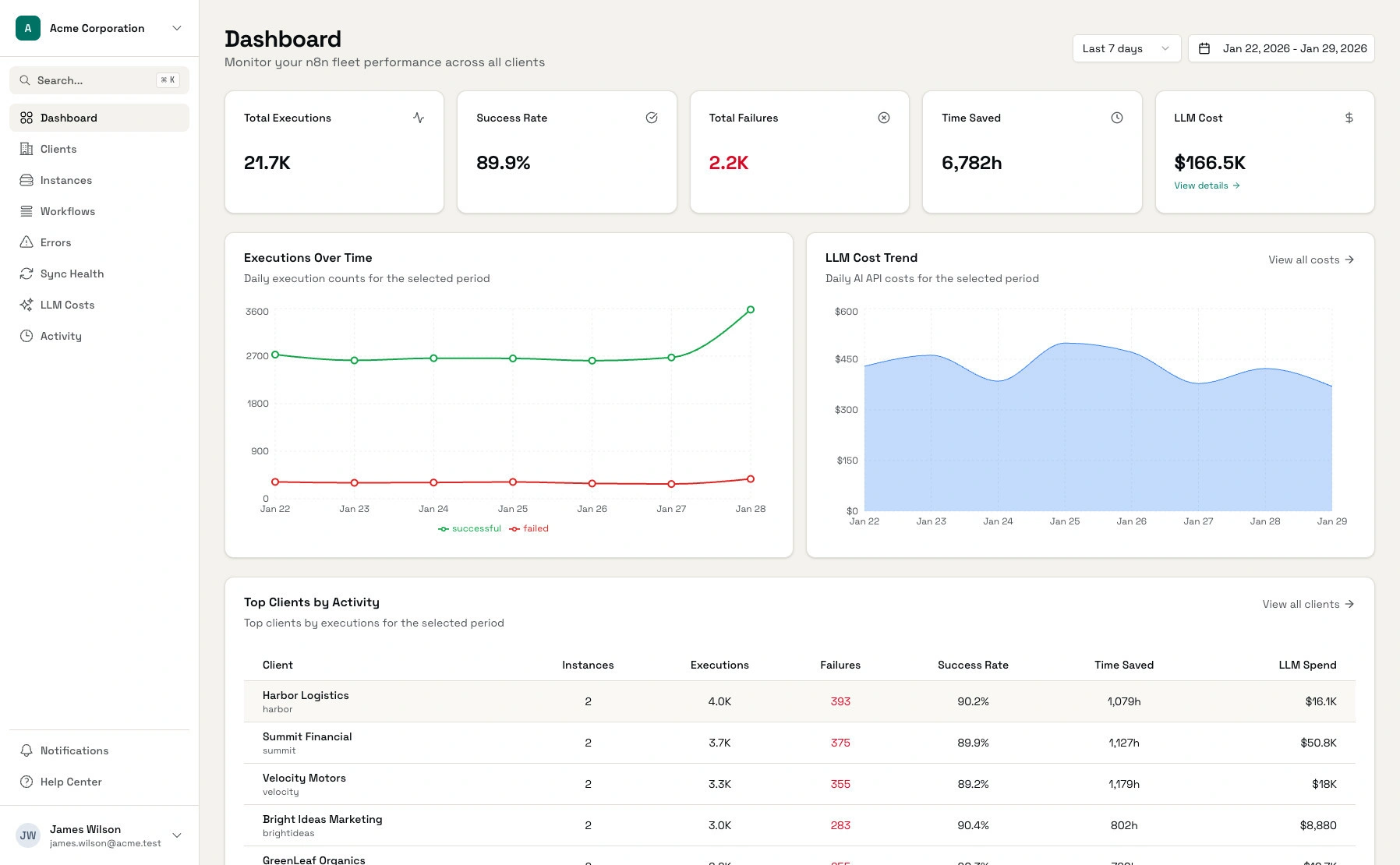
AI Agency Software
We have productized our own internal AI agency software – administrate.dev
Jan 31, 2026
AI in Mining Uncovered: How Smart Tech Boosts Safety and Profit
Imagine having a partner for your operations team who never sleeps. A partner who can sift through endless streams of data from your drills, trucks, and sensors, spotting tiny clues that signal a million-dollar problem is just around the corner. That’s the real value of AI in mining. It is not about sci-fi robots; it […]
Jan 30, 2026
A Plain English Guide to AI in Logistics
Artificial intelligence in logistics is about giving your supply chain a brain. It is not about self-aware robots taking over the warehouse floor, but rather about using smart systems to make your entire operation more efficient, predictive, and resilient. Think of it as the ultimate co-pilot for your logistics team. It is an assistant that […]
Jan 22, 2026
Sick of reading about automation?
Book a free 15-minute intro call. We’ll talk through what you’re trying to automate and whether we’re a good fit.