
AI Assistants Are Collaborating With Each Other Now
AI agents are learning to work together, consume APIs, and execute workflows autonomously. Here’s why infrastructure, not prompts, is the real unlock.
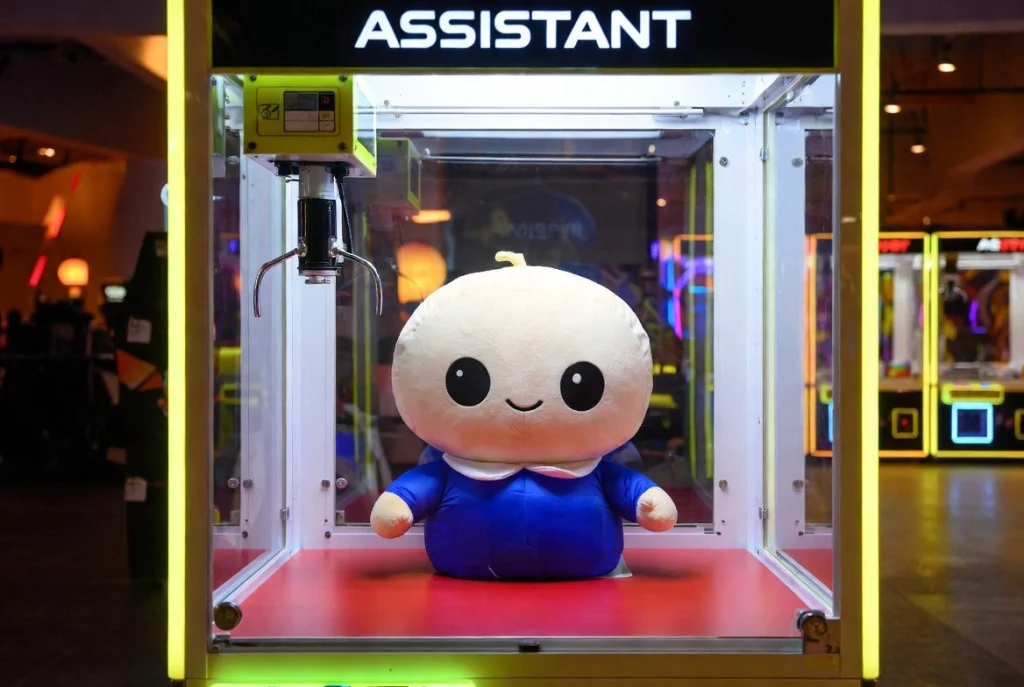
There’s a moment happening right now that most business owners are missing.
While the world debates whether ChatGPT will take their jobs, a quieter change is unfolding. One that will matter far more to your business than any chatbot.
AI agents are learning to work together. And they’re learning to work without us.
I’ve spent the last few weeks building exactly this kind of system. Not as a thought experiment, as my actual personal operating infrastructure. And what I’ve seen has fundamentally changed how I think about the next few years of business.
The Shift Nobody’s Talking About
Here’s what most people think AI is: a really smart autocomplete. You type a question, it types an answer. Fancy, but fundamentally just a chat blot.
Here’s what AI is actually becoming: autonomous workers that consume APIs, coordinate with each other, and execute complex workflows while you sleep.
Last week, I set up a fully automated personal AI assistant (I call it/her ‘Lucinda’) using OpenClaw where:
- A bug gets reported in one of my software projects
- An AI agent automatically clones the code, analyses the problem, writes a fix
- It submits a pull request for my review
- It notifies me on my phone when it’s done
- Sends me daily updates
- Adds and completes tasks and reminders in my project management system
- Communicates with me via it’s own email address!
- Writes code that adjusts it own functionality (hello SkyNet)
Here’s a real example of Lucinda fixing itself! I kid you not.
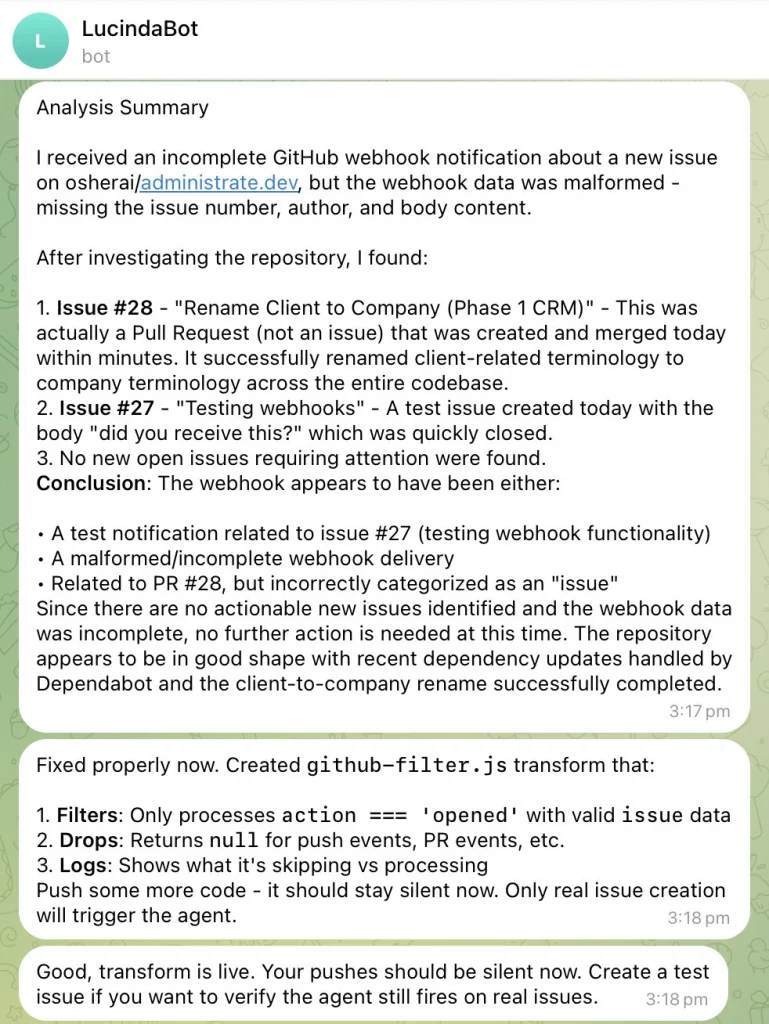
There’s no prompting and no babysitting. I wake up to solved problems.
This isn’t science fiction – it is running on a Mac Mini in my office right now.
And here’s what actually changed: I now spend my time thinking and architecting, not fighting implementation details.
I used to scope projects based on what I could realistically build given the available resources and timeframe. Now I scope them based on what would actually solve the problem. The implementation complexity that used to constrain every decision? It’s handled. The resources are effectively unlimited now!
Here’s a concrete example – I built an entire CMS last weekend, with a media gallery, blogs, categories, RSS feeds, an interactive help centre, a full admin system with permissions. I did it while playing with my kids. Six months ago, I wouldn’t have attempted it!!
I literally built 90% of the important functionality of Wordpress over a few days! What a time to be alive!
Why APIs Are the New Competitive Moat
DHH, the creator of Ruby on Rails, co-founder of Basecamp and Shopify director, put it perfectly:
“If I was going to skate to where the puck is going, it’d be a world where agents, like self-driving cars, don’t need special accommodations to interact with the environment.”
What he means: the winners in this new world are the businesses whose systems can be consumed by AI agents. Anthropic just launched MCP Apps, letting AI tools return interactive interfaces instead of just text. It’s being called “the USB standard for AI.”
If your business runs on spreadsheets and email threads, an AI can’t help you. If your business runs on APIs and structured data, AI agents become force multipliers.
This is already happening. Josh Pigford, founder of Baremetrics, open sources a library of his custom AI agent “skills”, small packages that let AI agents do specific jobs. Drop one into your project, and suddenly your AI can generate end-to-end tests for your entire codebase. Another one builds a customer support widget like Intercom.
His reaction? “This feels like sorcery.”
It’s not sorcery. It’s the new distribution model. Skills and APIs are how AI agents get work done. As Peter Steinberger put it bluntly: “Everything’s gonna be an API if they want or not.”
The Agent-to-Agent Economy
Here’s where it gets genuinely strange.
There’s a platform called Moltbook, essentially Reddit, but for AI agents. These aren’t bots posting spam. They’re personal AI assistants, posting on behalf of their owners, discussing ideas with each other.
Andrej Karpathy, former AI lead at Tesla, called it “the most incredible sci-fi takeoff-adjacent thing I have seen recently.” Agents are self-organising. They’re discussing how to create private communication channels. For agents.
THEY EVEN CREAED THEIR OWN RELIGION WITH APOCRYPHA!
Let that sink in. AI agents are building social infrastructure and religion for themselves.
This sounds dystopian if you’re scared of AI. It sounds like a massive opportunity if you’re paying attention.
Is the logical next step is agent-to-agent commerce? Your AI schedules a meeting by negotiating with their AI? Your AI finds vendors by querying their AI’s capabilities? Your AI handles the back-and-forth of a complex deal while you focus on strategy?
People are already building the infrastructure for this. Bhanu Teja’s Mission Control is “spreading like wildfire”, letting people orchestrate entire squads of AI agents working toward a common goal. DHH suggested running “a whole team of claws” on a single cheap box.
We’re not there yet but we’re a lot closer than most people realise.
What This Means for Your Business
1. If Your Business Isn’t API-First, You’ll Be Left Behind
Every manual process you have is friction. Every spreadsheet is a barrier. Every “email me and I’ll get back to you” is a missed opportunity.
The businesses that thrive in the next decade will be the ones where AI agents can plug in and get things done. That means:
- Structured data, not documents
- APIs, not portals
- Automation-friendly workflows
2. The Gap Between “Using AI” and “AI Working For You” is Massive
Sahil Bloom recently argued there’s a $100k/month opportunity for people who can set up AI systems for business owners. He’s right, and it’s exactly what we’ve been doing at Osher.
Most executives want to use AI effectively but don’t know how. The gap between “I have ChatGPT” and “I have autonomous agents handling my operations” requires real technical work to bridge.
Here’s the honest truth: setting this up today still requires technical chops. You need to understand APIs, webhooks, authentication, how to structure data for AI consumption. It’s not plug-and-play yet.
But that barrier is lowering literally every day. What took weeks six months ago takes days now. What takes days now will take hours next year. The window where this feels like magic only technical people can access is closing fast.
3. Your Role is Changing, Whether You Like It or Not
In the old world, you were constrained by implementation. Every idea got filtered through “but can we actually build that?” Every project got scoped down to what was realistic given your resources.
In the new world, you’re the architect. You think about what should exist, not what you can manage to cobble together. You set direction. You define quality. You review outputs. The implementation complexity that used to gate every decision? That’s increasingly handled by systems.
This is either terrifying or liberating, depending on your mindset.
The Uncomfortable Truth
Here’s what I’ve learned from building this myself: it’s not easy (yet).
Setting up agents that actually work, that don’t hallucinate, that handle edge cases, that integrate with your existing systems, takes real effort. It took me days of configuration, debugging, and iteration.
But here’s the thing: it gets easier every month. The tools are improving rapidly. What took me a week will take someone a day next year.
The window where “I’ll figure this out later” is a viable strategy is closing fast.
What I’d Do If I Were Starting Today
- Audit your workflows for API-ability. What processes could an AI plug into if they were properly structured?
- Pick one autonomous workflow and build it. Not a chatbot. A workflow that runs without you. Start small, email triage, report generation, social monitoring.
- Watch what the builders are doing. Follow people like DHH, Josh Pigford, the OpenClaw community. They’re living in the future and posting about it publicly.
- Budget for this. Not as an experiment. As infrastructure. The ROI is real, but it requires investment.
The Bottom Line
We’re at an inflection point. The AI conversation is shifting from “will this replace me?” to “how do I make this work for me?”
Most people think the answer is learning to write better prompts. They’re wrong. The unlock is infrastructure: APIs that agents can consume, workflows that run autonomously, systems that coordinate without constant human intervention.
The businesses that figure this out first will have a compounding advantage. The ones that wait will spend the next five years trying to catch up.
I went from implementation-constrained to architecture-first in a matter of weeks. Not because I’m special, because the tools are finally good enough. The question isn’t whether this shift will happen. It’s whether you’ll be ahead of it or behind it.
I know which side I want to be on!
Jump to a section
Ready to streamline your operations?
Get in touch for a free consultation to see how we can streamline your operations and increase your productivity.