A Plain English Guide to AI in Logistics
Artificial intelligence in logistics is about giving your supply chain a brain. It is not about self-aware robots taking over the warehouse floor, but rather about using smart systems to make your entire operation more efficient, predictive, and resilient. Think of it as the ultimate co-pilot for your logistics team. It is an assistant that […]
By Matthew Clarkson · January 22, 2026
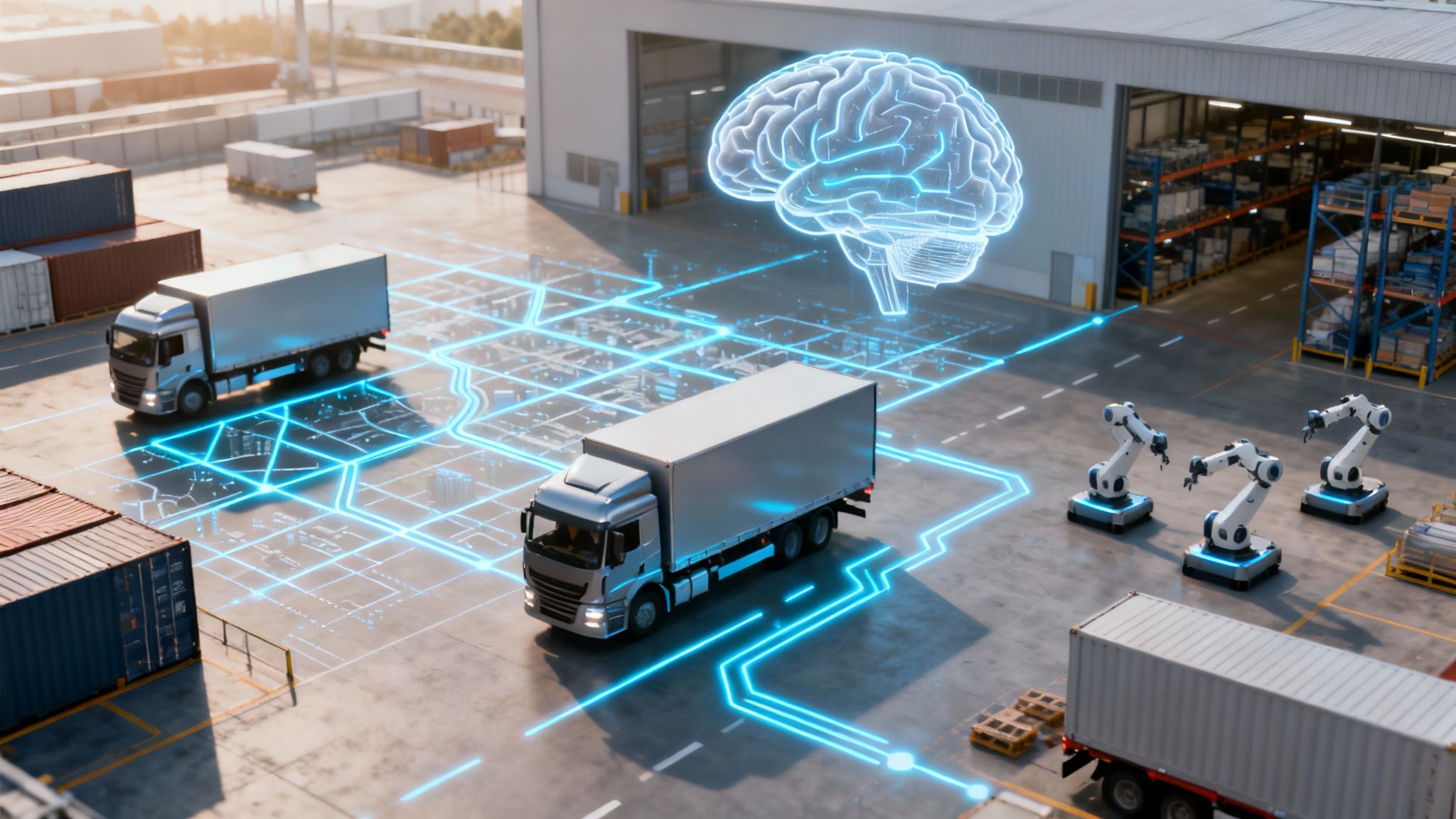
Artificial intelligence in logistics is about giving your supply chain a brain. It is not about self-aware robots taking over the warehouse floor, but rather about using smart systems to make your entire operation more efficient, predictive, and resilient.
Think of it as the ultimate co-pilot for your logistics team. It is an assistant that can sift through mountains of data, identify patterns humans would miss, and recommend smarter ways to get goods from point A to point B.
What Is AI in Logistics Really?
Let’s cut through the jargon. AI in logistics uses the data you’re already generating from shipping manifests, GPS trackers, warehouse sensors, and customer orders to find faster, cheaper, and more reliable ways of doing business.
Imagine your supply chain is like a city’s road network during peak hour. The old way is to react to traffic jams as they form, leading to delays and frustrated customers. AI, on the other hand, acts like a city-wide traffic control centre. It anticipates traffic jams before they happen by analysing live traffic, delivery schedules, and even weather patterns to reroute trucks onto the clearest paths.
Shifting from Reactive to Proactive
This capability allows for a fundamental shift in mindset. Instead of constantly putting out fires, your teams can get ahead of problems before they even start.
- Reactive Operations: This is the old-school model. A forklift breaks down, and you scramble for a replacement. A shipment gets stuck in customs, and you spend hours on the phone. You are always playing catch-up.
- Proactive Optimisation: This is the AI-driven approach. The system analyses maintenance logs and sensor data to schedule a service for that forklift before it fails. It flags a potential customs delay based on real-time port data, giving you time to inform the customer and adjust your schedule.
The goal is to move from fixing problems after the fact to preventing them from happening altogether. This proactive approach is what creates a true competitive advantage, dramatically improving both efficiency and reliability.
The growth in this space is staggering. In Australia alone, the AI in supply chain market was valued at USD 141.5 million in 2023 and is forecast to explode to over USD 1,923 million by 2030. A key driver of this is the application of AI in areas like Advanced Fleet Management, where it is already delivering significant efficiency gains.
By adopting this forward-thinking approach, businesses are unlocking new levels of operational performance. This sets the stage perfectly for the high-impact, practical applications we will explore next.
How AI Is Actually Used in Logistics Today
So, we know AI can act as a smart co-pilot for your operations, but what does that look like day-to-day? Let’s move past the theory and look at the real-world jobs AI is doing right now to make logistics run smoother, faster, and more affordably. It is less about futuristic robots and more about practical tools solving today’s biggest headaches.
We will explore six high-impact ways AI in logistics is already making a difference, breaking down each one with a simple, relatable comparison.
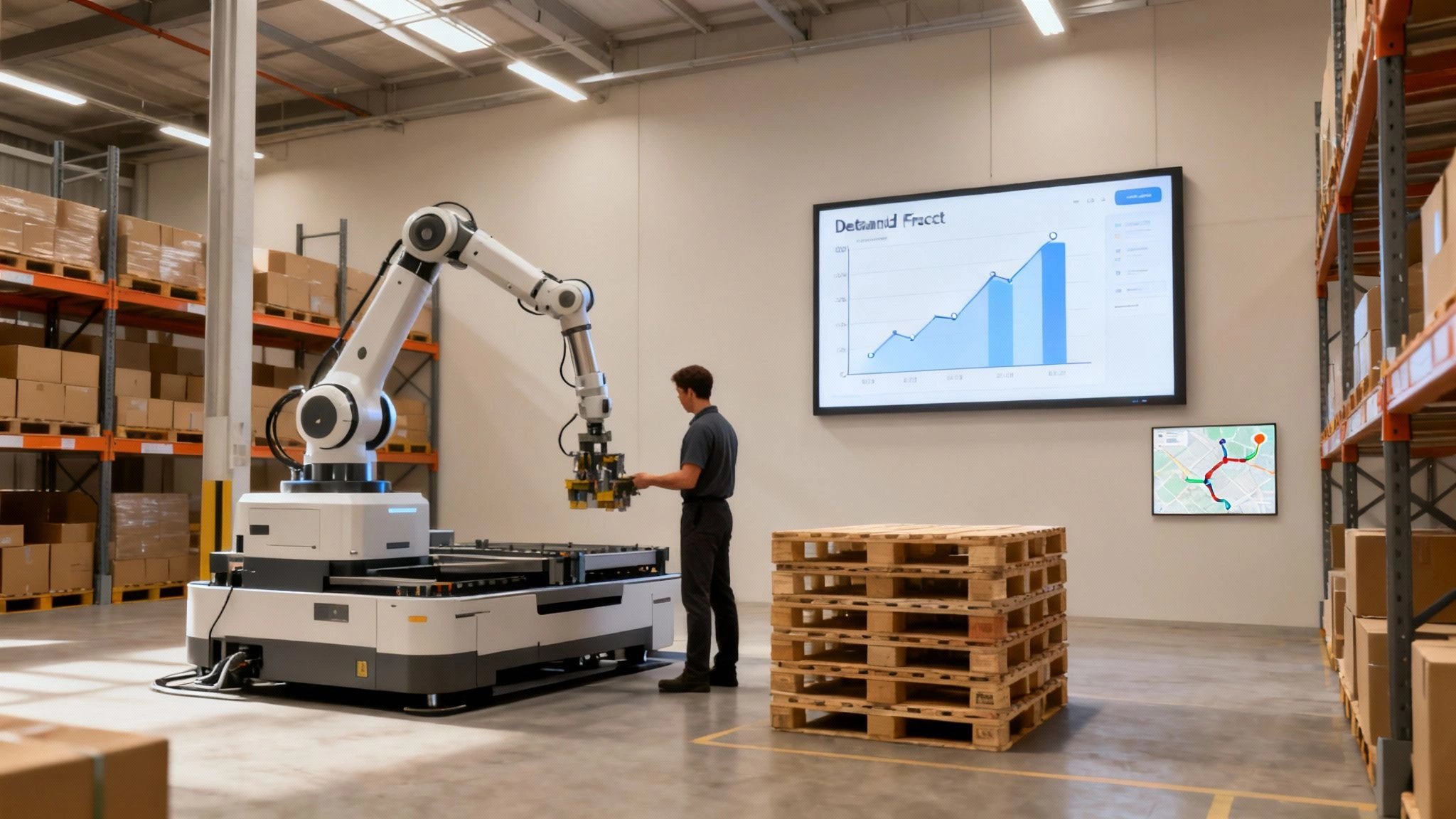
To kick things off, here’s a quick overview of how these AI applications tackle common logistics challenges.
AI Use Cases in Logistics at a Glance
| AI Application | What It Does in Simple Terms | Key Business Benefit |
|---|---|---|
| Demand Forecasting | It’s a “weather report for sales,” predicting what customers will buy and when. | Minimises stockouts and overstocking, optimising inventory costs. |
| Route Optimisation | A super-GPS for your entire fleet, finding the best route for every vehicle. | Slashes fuel costs, shortens delivery times, and boosts efficiency. |
| Warehouse Automation | An expert organiser that directs robots to pick, pack, and sort goods. | Speeds up order fulfilment and makes the best use of warehouse space. |
| Predictive Maintenance | A “health check” for your fleet that spots problems before they happen. | Prevents costly breakdowns and extends the life of your vehicles. |
| Autonomous Vehicles | A tireless 24/7 workforce for moving goods in controlled environments. | Increases operational uptime and frees up human staff for complex tasks. |
| Intelligent Document Processing | A tireless admin assistant that reads and processes paperwork automatically. | Eliminates manual data entry errors and accelerates administrative workflows. |
Each of these applications provides a powerful solution to persistent problems in the supply chain. Now, let’s unpack them one by one.
Demand Forecasting: A Weather Report for Sales
Imagine trying to plan a big outdoor event without checking the weather forecast. You could end up with too much food or not enough shelter. Traditional demand forecasting is a bit like that; it leans heavily on past sales data, which does not always predict future storms.
AI changes this completely. It acts like an advanced weather service for your sales, analysing not just historical data but also market trends, competitor pricing, upcoming holidays, and even social media chatter. It pieces together a far more accurate picture of what customers will want to buy, and when.
This means you can stock up on the right products just before a wave of orders hits, avoiding costly stockouts or the expense of holding onto unsold inventory. It transforms inventory management from a guessing game into a precise, data-driven strategy.
Route Optimisation: The Ultimate GPS
We all use GPS to avoid traffic, but a standard app just finds the best route for one car. Now, picture coordinating a whole fleet of delivery trucks, each with multiple stops, tight delivery windows, and unique vehicle constraints. It is an incredibly complex puzzle.
AI-powered route optimisation is like giving every driver the smartest GPS imaginable, one that communicates with every other GPS in the fleet. It calculates the most efficient route for every single vehicle by considering real-time traffic, weather conditions, fuel costs, and even driver availability.
It is not just about finding the shortest path; it is about finding the cheapest, fastest, and most logical path for the entire network. This dynamic re-routing saves enormous amounts of fuel, reduces delivery times, and ultimately boosts customer satisfaction.
Warehouse Automation: Your Most Organised Helper
Think of a busy warehouse as a massive, slightly chaotic garage. Finding a specific item can take time, and putting things away efficiently is a constant challenge. This is where AI-driven automation steps in to create order from the chaos.
AI acts like a super-organised helper who knows exactly where everything is, where it should go, and the quickest way to get it there. It directs robotic systems, like automated guided vehicles (AGVs), to pick, pack, and sort items with incredible speed and accuracy.
This does not just speed up order fulfilment. It also optimises the entire warehouse layout, ensuring popular items are easily accessible and reducing the time staff spend walking miles of aisles each day.
Predictive Maintenance: A Health Check for Your Fleet
When a delivery truck breaks down unexpectedly, it does not just create repair bills. It causes delays, disrupts schedules, and damages customer trust. The traditional approach is reactive: fix things after they break.
Predictive maintenance flips this model on its head. AI systems monitor data from sensors on vehicles and equipment, listening for tiny changes in performance, temperature, or vibration. It’s like a truck telling you it needs a service before a part fails.
This allows you to schedule maintenance during planned downtime, preventing costly on-road failures and extending the life of your valuable assets.
Autonomous Vehicles: The 24/7 Workforce
While fully self-driving trucks on city streets are still on the horizon, autonomous vehicles are already making a big impact in more controlled environments. Think of them as tireless workers who can operate around the clock without needing a break.
In large distribution centres, ports, and mining sites, autonomous forklifts and haulage trucks are moving goods safely and efficiently 24/7. This increases productivity and allows human workers to focus on more complex, value-adding tasks that require judgment and skill. For example, AI-powered solutions often aim to improve critical operational areas like centralizing driver and dispatch communication for logistics teams.
Intelligent Document Processing: A Tireless Admin Assistant
The logistics industry runs on a mountain of paperwork. Bills of lading, customs forms, invoices, and proof-of-delivery documents all need to be read, verified, and entered into various systems. This is slow, repetitive work that’s prone to human error.
Intelligent Document Processing (IDP) is like having an assistant who can read and understand all this paperwork instantly. It uses AI to extract key information from documents, validate it against your records, and automatically input it where it needs to go. You can learn more about how to clear these operational bottlenecks by understanding the essentials of automated data processing.
This technology is already reshaping Australian freight operations. By 2026, AI is expected to significantly change data-heavy roles, with 81% of supply chain leaders anticipating freight cost reductions of at least 5% by 2030 because of these advancements.
Measuring the Real Return on Your AI Investment
Thinking about an AI project can feel a bit like looking at a restaurant menu with no prices. You know the food will be good, but what’s the final bill going to look like? It’s much the same with AI in logistics. The potential sounds great, but what’s the actual financial payoff for your business? Let’s break down the return on investment (ROI) in real, tangible terms.
The trick is to move beyond vague promises like “improved efficiency” and pin down the hard numbers. We need to draw a straight line from the technology you are implementing to the actual savings or revenue gains that appear on your balance sheet.
Shifting from Abstract Benefits to Concrete Metrics
Instead of thinking in broad strokes, we need to talk about specific, measurable outcomes. A successful AI implementation does not just “make things better”, it delivers results you can actually count.
For instance, this could look like:
- A 15% reduction in fuel costs across your entire fleet, thanks to smarter, AI-driven route optimisation.
- A 20% drop in stockouts because your new AI-powered demand forecasting is genuinely more accurate.
- A 30% faster order processing time in the warehouse, a direct result of automated picking and packing systems.
These are the kinds of solid results that build an undeniable business case. They translate directly into bottom-line improvements, turning what starts as an expense into a profitable, long-term investment.
The goal is to arm your business with the right language and metrics. This lets you clearly demonstrate how the initial costs of an AI project lead directly to significant and measurable financial gains.
Key Performance Indicators to Watch
To track your progress, you have to know which numbers matter most. Think of these as the dials on your company’s operational dashboard. When you introduce AI, you should expect to see these dials move in the right direction. Some of the most critical Key Performance Indicators (KPIs) for AI in logistics include order accuracy, delivery times, and asset health.
For a clearer picture, let’s explore exactly how AI pushes these metrics forward.
Tracking Your AI Success
The table below outlines some core logistics KPIs and demonstrates how AI initiatives can directly improve them, leading to tangible business value.
| KPI | How AI Improves It | Business Impact |
|---|---|---|
| Order Accuracy Rate | AI-driven warehouse systems minimise human error by automating the picking and packing process, ensuring the right items go into every box. | Fewer costly returns, higher customer satisfaction, and reduced labour spent on fixing mistakes. |
| On-Time Delivery Rate | Real-time route optimisation adjusts for traffic and weather, while predictive analytics flags potential delays before they happen. | Increased customer trust and loyalty, plus lower costs associated with failed or late deliveries. |
| Asset Downtime | Predictive maintenance algorithms analyse sensor data from your vehicles to schedule servicing before a breakdown occurs. | Reduced emergency repair costs, longer vehicle lifespan, and a more reliable and predictable fleet. |
| Warehouse Pick and Pack Time | Automated systems and optimised layouts guided by AI drastically reduce the time it takes to get an order ready for dispatch. | Faster order fulfilment, increased warehouse capacity, and the ability to handle higher order volumes without extra staff. |
By closely monitoring these specific KPIs, you create a clear and compelling story of your return on investment. You can see precisely where and how AI is adding value to your operation day in, day out.
Many businesses are already seeing these benefits firsthand, as shown in these detailed logistics case studies that highlight real-world applications. Grasping these metrics is the first step in building a strong business case and securing the buy-in needed to truly modernise your logistics.
Your Practical Roadmap for Implementing AI
So, you can see the potential of AI in logistics. The real question is, how do you actually get started without turning your entire operation upside down? It’s not about flipping a switch and hoping for the best. A successful AI journey is more like a well-planned road trip, with clear stages that build on one another.
Think of it as bringing a new, incredibly smart team member on board. You need to prepare for their arrival, introduce them to your existing crew, give them a small project to start with, and then gradually expand their responsibilities. Let’s walk through what that looks like in practice.
The process below shows how a considered AI implementation directly impacts your core business metrics, driving down costs, boosting time efficiency, and sharpening accuracy.
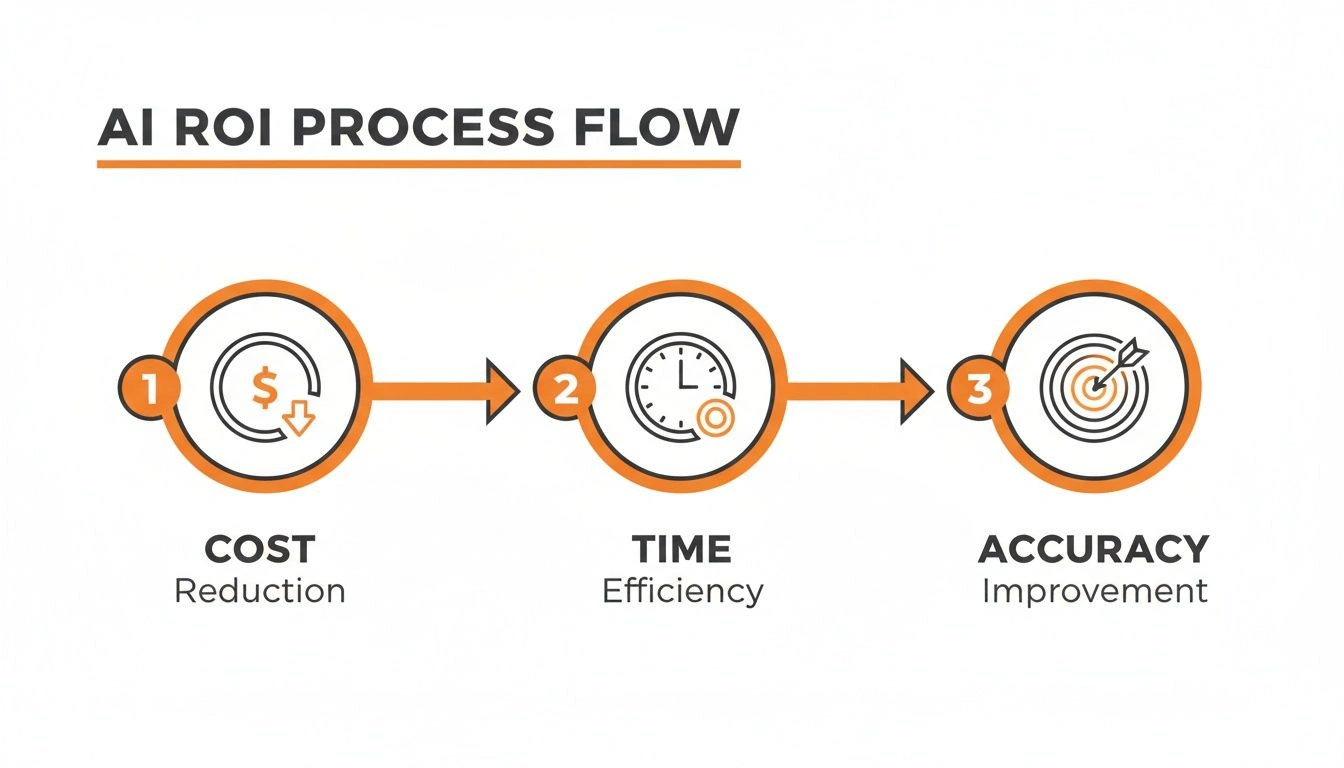
Ultimately, a successful AI project delivers tangible, measurable improvements across your most critical financial and operational areas.
Stage 1: Get Your Data Ready
Before you can even think about AI, you have to look at your data. An AI model is like a brilliant chef. It can create amazing things, but only if you give it quality ingredients. If your data is messy, incomplete, or siloed all over the place, your AI simply will not perform.
This first step is all about getting your house in order. It involves:
- Cleaning up your data to ensure it is accurate and consistent.
- Organising your data so it is easy for an AI system to access and understand.
- Identifying what data you have and, crucially, what you might be missing to solve your target problem.
This isn’t the most glamorous part of the process, but it is absolutely the most important. Getting this right lays the foundation for everything that follows.
Stage 2: Integrate with Your Current Systems
Your business already has a central nervous system. It’s made up of your existing software, your Warehouse Management System (WMS), Transport Management System (TMS), and Enterprise Resource Planning (ERP) platform. You can’t just drop a new AI tool in and expect it to work; it needs to be carefully connected to these existing systems.
This integration is like teaching the new AI “brain” to talk to your company’s operational heart and limbs. It needs a seamless, two-way flow of information to get a real-time view of what’s happening and to send instructions back.
This step often requires specialised expertise. Professional system integration services are crucial here to ensure all your different software platforms can communicate effectively, preventing data silos and operational hiccups.
Stage 3: Design a Smart Pilot Project
You would not renovate your entire house without testing a few paint samples first, right? The same logic applies to AI. Instead of attempting a massive, company-wide overhaul from day one, start with a small, focused pilot project. This is your chance to test the technology in a controlled environment.
A good pilot project has a few key features:
- It targets a specific, high-impact problem , like optimising a single tricky delivery route or automating one part of your document workflow.
- It has clear, measurable goals , such as reducing fuel consumption by 10% on that specific route.
- It’s manageable in scope , allowing your team to learn and adjust without risking your core operation.
The pilot is your proof of concept. It lets you work out any kinks, demonstrate value to stakeholders, and build confidence in the technology before you commit to a larger investment.
Stage 4: Scale Up and Govern
Once your pilot project has delivered the goods, it is time to scale. This means taking the lessons you’ve learned and applying them to other parts of the business. You might roll out route optimisation across your entire fleet or expand automation to more warehouse processes.
But scaling isn’t just about expansion; it’s also about governance. This means setting up clear rules and processes to manage your AI systems responsibly. Think of it as creating an employee handbook for your AI. This includes deciding who has access, how its performance is monitored, and ensuring it complies with all relevant regulations.
Strong governance ensures your AI operates safely, ethically, and continues to deliver value as your business grows. This forward-thinking approach is reflected in market trends. Australia’s logistics automation market, valued at USD 1,642 million in 2024 , is projected to reach USD 4,122.61 million by 2033 , a surge driven by these very implementations.
Navigating the Common Pitfalls of AI Adoption
https://www.youtube.com/embed/qPHqRPih0hU?feature=oembed
Bringing any powerful new tool into your operation comes with its own set of challenges, and AI is no exception. It’s a bit like learning to cook a complex new recipe. You need the right ingredients, a clear plan, and the patience to get it right. This section is a practical guide to the common hurdles in AI in logistics and how you can clear them gracefully.
Jumping into an AI project without preparation can easily lead to frustration. But by understanding the potential speed bumps ahead of time, you can map out a much smoother journey and make sure your investment actually delivers the results you’re looking for. Let’s break down the main challenges and, more importantly, how to solve them.
The Problem of Poor Quality Data
You have probably heard the old saying, “garbage in, garbage out.” When it comes to AI, this is the golden rule. An AI system is only as smart as the data it learns from. If you feed it messy, incomplete, or inaccurate information, you cannot expect it to produce brilliant insights.
Imagine trying to train a new delivery driver using an old, torn map with half the street names missing. They would get lost, make mistakes, and end up being far less efficient. It’s the exact same principle with AI.
To get this right, you have to focus on data readiness before you do anything else. This means:
- Cleaning your data: Hunting down and correcting errors, duplicates, and inconsistencies in your records.
- Organising your data: Ensuring your information is stored in a structured way that an AI system can easily read and understand.
- Consolidating your data: Pulling together information from different systems (like your warehouse and transport software) to create a single, reliable source of truth.
When Your AI Model Becomes Outdated
Another common trap is something called model drift. It sounds technical, but the idea is actually quite simple. An AI model gradually becomes less accurate over time because the real world it operates in has changed since it was first trained.
Think of it like using a travel guide from ten years ago. It might still have some useful tips, but it won’t show the new motorways, updated business hours, or recently closed roads. Your AI model is the same; it was trained on past data, and if market conditions, customer behaviour, or your own operations change, its predictions will become less reliable.
To prevent model drift, your AI needs a regular “health check”. This involves continuously monitoring its performance against real-world results and retraining it with fresh data to keep its knowledge current.
Getting Your Team on Board
Perhaps the biggest hurdle has nothing to do with technology at all. It is about people. Introducing AI can make some team members nervous. They might worry about their jobs or feel overwhelmed by the prospect of learning a completely new system.
This is where change management becomes absolutely essential. It all comes down to communication and support. The goal is to get your team excited about these new tools, not scared of them. You need to explain how AI will act as a helpful assistant, taking over tedious, repetitive tasks so they can focus on more interesting, strategic work.
To manage this change effectively:
- Communicate Early and Often: Explain exactly why you’re bringing in AI and what benefits it will bring to both the team and the company.
- Provide Proper Training: Give everyone the skills and confidence they need to use the new tools effectively, without feeling left behind.
- Highlight the Wins: Share success stories from your pilot projects to show how AI is making everyone’s job easier and more impactful.
Staying on the Right Side of the Rules
Finally, there’s the critical issue of compliance. When you use AI in logistics, you are often dealing with sensitive information, from customer details to commercial shipping data. It is vital that your AI solutions respect privacy laws and industry regulations.
This means ensuring your data is handled securely and that your AI’s decisions are fair and transparent. Working with experienced AI consultants can help you build systems that are not only powerful but also compliant from day one, giving you complete peace of mind.
So, are you ready to get serious about modernising your logistics operation?
Bringing AI into your logistics is not some futuristic fantasy. It’s a set of powerful, practical tools available today, ready to tackle the problems that keep you up at night. Think about the constant pressure of rising fuel costs, the chaos of unexpected delivery delays, or the bottlenecks clogging up your warehouse. AI gives you a direct, effective way to push back and regain control.
It’s about turning those operational headaches into a genuine competitive edge.
The good news? You do not need to rip and replace everything you have built. The journey starts small. Pick one significant pain point and apply a focused AI solution. This is exactly where custom AI agents or Robotic Process Automation (RPA) can deliver an almost immediate impact, taking over the repetitive, soul-crushing tasks and letting your team focus on high-value work.
Your First Move Towards a Smarter Operation
It all begins with understanding. The first step is to simply identify where your biggest opportunities are hiding in plain sight. Start by asking some honest questions:
- Which manual processes are truly slowing us down the most?
- How much could we save on inventory costs with more accurate forecasting?
- What would it mean for our business if we could predict vehicle breakdowns before they strand a driver on the side of the road?
Answering these questions is how you build a business case. It’s how you turn “AI” from an abstract concept into a concrete plan for boosting efficiency and directly improving your bottom line.
This is not about a technological revolution; it is a business evolution. It is about making smarter, data-backed decisions that put you firmly in control of your supply chain.
Ready to see how a solution designed for your specific challenges can deliver measurable results? Chat with our team of expert AI consultants to map out what’s possible.
Frequently Asked Questions About AI in Logistics
Even with a clear picture of what AI can do, a few practical questions always come up. Let’s dig into some of the most common concerns we hear from business leaders as they start thinking about bringing this technology into their logistics operations.
Do I Need a Team of Data Scientists to Use AI?
Not necessarily. Building an AI system from the ground up is a specialist’s job, but accessing its power is not. Think of it like this: you don’t need to be an automotive engineer to drive a high-performance car.
You can tap into AI in logistics without building an in-house data science department. The real goal is to find a technology partner who gets your business inside and out, and who can implement a solution that your current team can actually use.
Is AI Only for Massive Companies?
Absolutely not. That’s one of the biggest myths out there. The technology has become far more accessible, and the trick for any business, regardless of size, is to start small and think strategically.
Instead of a massive, company-wide overhaul, pick a specific, high-impact problem and start there. A focused pilot project is the best way to prove the value.
- You could start by automating how you process shipping invoices to stamp out manual errors.
- Or, you could optimise delivery routes for just one of your most difficult territories.
These targeted projects can deliver a solid return on investment fast. That success gives you a rock-solid business case for expanding AI to tackle your bigger operational headaches.
How Can I Ensure My Company Data Is Secure?
Data security is non-negotiable. In logistics, you’re handling commercially sensitive information and customer data every single day, so this has to be a top priority. Any serious AI partner will put security at the forefront from day one.
A robust security plan is not just one thing; it is multiple layers of defence. This includes data anonymisation, using secure cloud infrastructure, and putting strict access controls in place to manage who sees what.
When you are vetting potential providers, drill down into their data governance and compliance policies. Make sure they meet the standards your business and your customers expect. This gives you the confidence that your information is properly protected.
Ready to see how these ideas could work for your specific challenges? The team at Osher Digital can help map it out. Get in touch with our expert AI consultants to start the conversation.
Last updated on July 1, 2026
Free tool · 3 minutes
AI Readiness Assessment
Score how ready your business is for AI in a few minutes, with tailored next steps.
Continue Reading
View all
AI Agency Software
We have productized our own internal AI agency software – administrate.dev
Jan 31, 2026
AI in Mining Uncovered: How Smart Tech Boosts Safety and Profit
Imagine having a partner for your operations team who never sleeps. A partner who can sift through endless streams of data from your drills, trucks, and sensors, spotting tiny clues that signal a million-dollar problem is just around the corner. That’s the real value of AI in mining. It is not about sci-fi robots; it […]
Jan 30, 2026

A Business Guide to AI Regulation in Australia
Diving into AI is a bit like getting the keys to a high-performance car. You can feel the power and potential, but you also know you need to learn the rules of the road before you hit the accelerator. That’s pretty much what AI regulation is: the collection of guidelines and laws being drawn up […]
Jan 22, 2026
Sick of reading about automation?
Book a free 15-minute intro call. We’ll talk through what you’re trying to automate and whether we’re a good fit.