AI in Mining Uncovered: How Smart Tech Boosts Safety and Profit
Imagine having a partner for your operations team who never sleeps. A partner who can sift through endless streams of data from your drills, trucks, and sensors, spotting tiny clues that signal a million-dollar problem is just around the corner. That’s the real value of AI in mining. It is not about sci-fi robots; it […]
By Matthew Clarkson · January 30, 2026
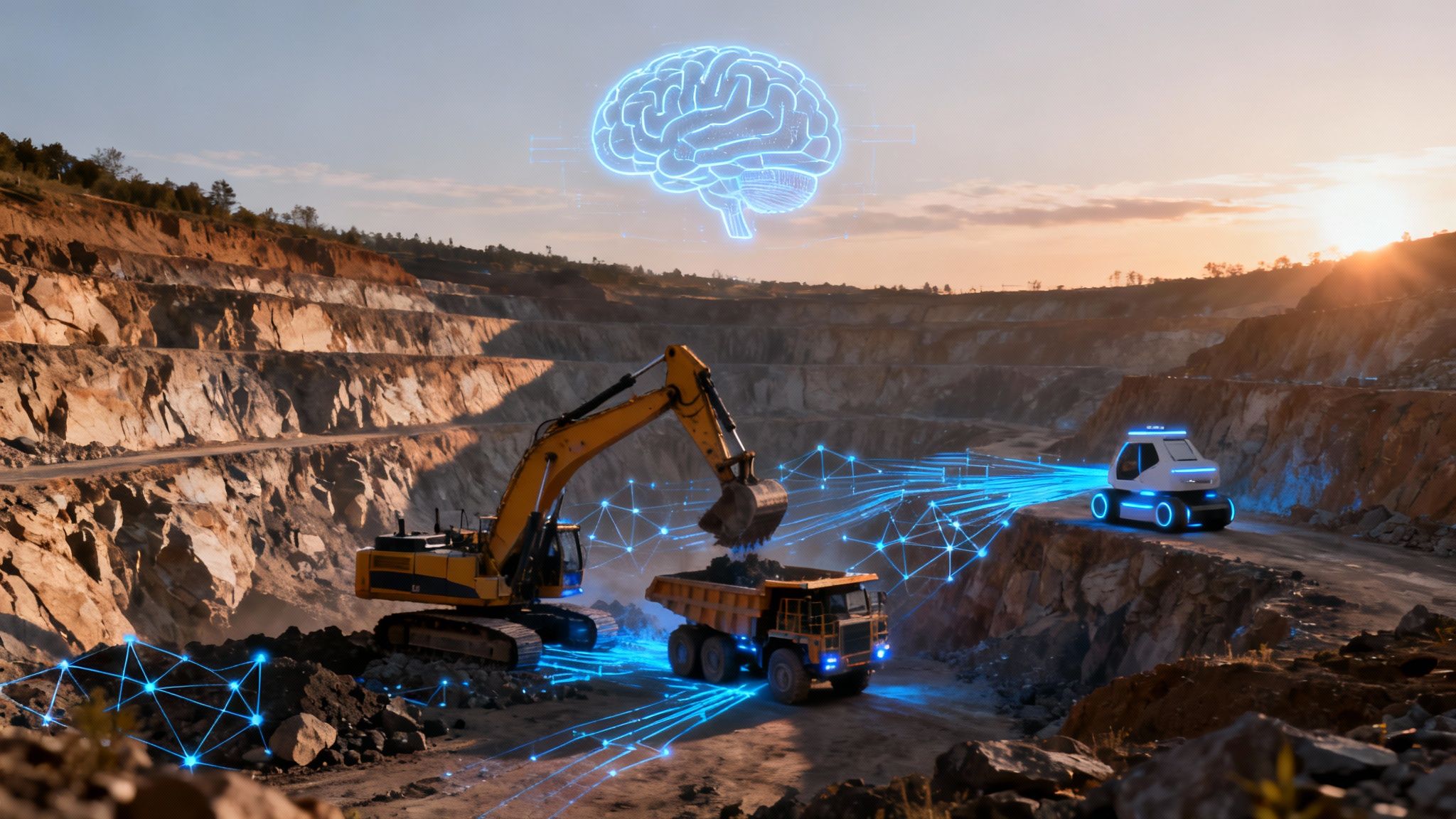
Imagine having a partner for your operations team who never sleeps. A partner who can sift through endless streams of data from your drills, trucks, and sensors, spotting tiny clues that signal a million-dollar problem is just around the corner. That’s the real value of AI in mining. It is not about sci-fi robots; it is about using intelligent software to make sharp, data-backed decisions.
What Is AI in Mining and Why Is It a Game Changer?
At its core, artificial intelligence in mining acts as a digital expert, capable of finding complex patterns that the human eye might miss. This is not just about processing information faster; it is about connecting dots across hundreds of data sources at the same time. For instance, an AI model could predict a critical failure in a haul truck weeks before it happens, or it could analyse geological surveys to pinpoint the most promising location for new deposits.
This kind of insight is arriving at a critical moment for the industry. With operational costs climbing and high-grade ore becoming scarcer, mining companies need to work smarter, not just harder. AI provides a clear path forward by turning raw operational data into better, faster, and safer decisions on the ground. The goal is not to replace people, but to give them a new kind of superpower.
The Shift Towards Smarter Operations
Australia’s mining sector, which contributes over 10% to the national GDP , is already well into this transition. The Australian government has thrown its weight behind this shift, notably with its Artificial Intelligence Action Plan, which allocated $124.1 million a few years back to boost national AI capabilities. You can learn more about how AI is reshaping mining and other heavy industries across the country.
This move toward data-driven efficiency and safety is not isolated to mining. It reflects a broader industrial evolution where information has become the most valuable commodity.
The real value of AI is not in the technology itself, but in how it empowers your team. It gives geologists a sharper lens to find resources and maintenance crews the foresight to prevent breakdowns, making the entire operation more resilient.
Why Now Is the Perfect Moment
So, why the sudden urgency? The mining industry is facing a perfect storm of challenges, a set of problems that AI is uniquely equipped to address. The pressure to improve productivity, enhance safety, and manage costs has never been more intense.
Here are the key drivers speeding up AI adoption today:
- Declining Ore Grades: Discovering high-quality, easily accessible deposits is becoming a thing of the past. AI helps exploration teams interpret vast geological datasets with greater accuracy, significantly improving their discovery success rate.
- Rising Operational Costs: From fuel and labour to parts and maintenance, expenses are on an upward trend. AI-driven predictive maintenance and route optimisation for vehicle fleets directly attack these costs, reducing expensive downtime and waste.
- Safety Imperatives: Getting people out of harm’s way remains a top priority. AI is the engine behind autonomous vehicles, remote operations, and real-time hazard detection, creating a safer work environment.
By turning operational data into a strategic asset, AI helps mining companies navigate these headwinds. It unlocks new levels of productivity and profitability that were simply out of reach before.
Five Real-World AI Applications Reshaping Mining
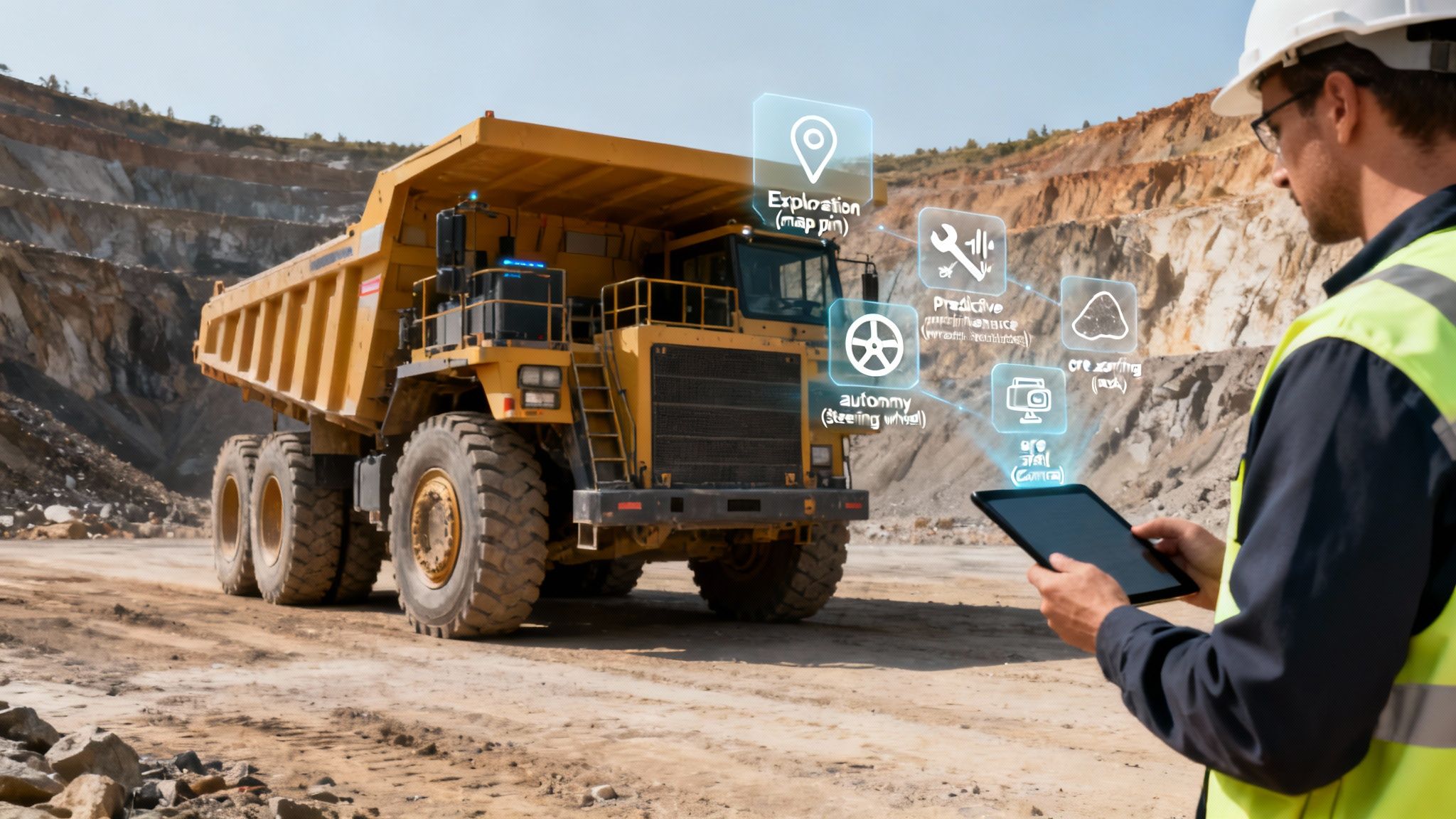
It is one thing to discuss artificial intelligence in theory, but it is far more compelling to see how AI in mining is already delivering results on the ground. These are not just concepts on a whiteboard; they are practical tools solving some of the industry’s oldest and most expensive problems right now.
Think of AI as a team of highly specialised digital experts, each trained for a specific, high-stakes job. From pinpointing hidden ore bodies to keeping workers out of harm’s way, these applications are fundamentally changing how a modern mine operates.
Let’s dig into five of the most significant ways AI is making an impact today.
1 Finding New Deposits with Digital Prospecting
Exploration has always been a mix of solid geology, hard-won experience, and a bit of luck. AI tilts the odds heavily in favour of the mine operator. It acts like a digital prospector with a photographic memory, able to process decades of geological data in the time it takes to drink a coffee.
AI models sift through enormous datasets like seismic surveys, drill hole logs, and soil sample results to uncover subtle patterns that point to new mineral deposits. It is like having a geologist who can see faint connections across a thousand different maps at once, predicting where valuable resources are likely buried with a much higher degree of confidence. This focused approach cuts down the time, cost, and guesswork of exploration.
2 Predicting Breakdowns Before They Happen
Unexpected equipment failure is one of the biggest drains on a mine’s bottom line. A single broken-down haul truck or a snapped conveyor belt can halt production for hours, costing a fortune in lost revenue and emergency repairs. Predictive maintenance flips this reactive scramble into a proactive strategy.
Sensors on critical machinery constantly stream performance data to an AI system. The AI effectively learns the unique “heartbeat” of each machine, its normal vibrations, temperatures, and power draw. It then detects tiny deviations that are often the first sign of a future breakdown.
This early warning system gives maintenance crews a heads-up, sometimes weeks in advance, letting them schedule repairs during planned downtime. It is the difference between a quick, scheduled check-up and a costly, disruptive emergency room visit.
This simple shift from “fix it when it breaks” to “fix it before it breaks” is a massive driver of operational efficiency and asset longevity.
3 Operating Safely with Autonomous Vehicles
Some of the most dangerous jobs in mining involve operating heavy machinery in unpredictable and often remote environments. Autonomous haulage systems use AI to take people out of the driver’s seat and, more importantly, out of the line of fire.
Self-driving trucks and drills can operate around the clock, guided by a sophisticated network of sensors, LiDAR, and GPS. They follow optimised routes with millimetre precision, work tirelessly without fatigue, and are programmed with safety as their non-negotiable priority. The technology delivers two huge wins:
- Improved Safety: It removes human operators from potentially hazardous open-pit and underground environments.
- Greater Productivity: Autonomous fleets can run 24/7 , significantly increasing material movement and overall site output.
These are not just remote-controlled vehicles. They are intelligent agents that navigate complex sites, communicate with each other to avoid bottlenecks, and adapt to changing conditions in real time.
4 Sorting Valuable Ore from Waste Rock
Once material is blasted and hauled, the next challenge is to separate the high-grade ore from worthless rock as efficiently as possible. Traditional methods are often slow and imprecise, meaning valuable minerals can easily end up in the waste pile. AI-powered ore sorting is fixing that.
Imagine a conveyor belt moving tonnes of rock at high speed. As each fragment passes a sensor, an AI system instantly analyses its composition. In a fraction of a second, it decides if the rock is valuable or not and triggers a targeted jet of compressed air to knock the waste rock off the belt.
This instant, precise sorting ensures that the processing plant only receives the best material, which leads directly to:
- Higher mineral recovery rates.
- Reduced energy and water consumption in the mill.
- Increased overall profitability per tonne.
5 Monitoring for a Safer Workplace
A safe mine is a productive mine, period. AI is now acting as a tireless digital safety officer, constantly watching over the site to prevent accidents before they can happen. Intelligent video analytics, for instance, can monitor live feeds from cameras across the entire operation.
These systems are trained to recognise specific unsafe behaviours or conditions, like a worker standing too close to moving machinery or not wearing the correct personal protective equipment (PPE). When it spots a potential hazard, it can send an immediate, real-time alert to a site supervisor. By identifying these risks as they happen, AI helps build a stronger safety culture and prevents incidents that could lead to serious injuries.
If you are considering how these applications could fit into your operation, speaking with experienced AI consultants can provide a clear path forward.
The Real-World Business Payoff from AI on Your Mine Site
Bringing new technology into a mining operation is never about chasing the latest trend. For any executive or IT director, it boils down to one simple question: what is the impact on the bottom line? Let’s unpack how the technical capabilities of AI in mining translate into the business results that truly matter to your balance sheet.
Think of it like upgrading the family car. You are not just after a shinier model; you are looking for better fuel economy to save money, advanced safety features to protect your family, and a more reliable engine that will not leave you stranded. In much the same way, AI offers a practical upgrade for your entire mine, delivering measurable improvements in efficiency, safety, and profitability.
These are not just abstract benefits. They show up in the critical numbers you track every day, your key performance indicators (KPIs). We’re talking about tangible uplifts in metrics like Overall Equipment Effectiveness (OEE) and a significant drop in the Lost Time Injury Frequency Rate (LTIFR).
Translating AI Features into Business KPIs
It is crucial to connect the dots between an AI function and its direct commercial outcome. The following table illustrates how specific AI applications solve common mining challenges and directly improve the KPIs that drive your business.
| AI Application | Business Problem Solved | Impacted KPI | Example Outcome |
|---|---|---|---|
| Predictive Maintenance | Unplanned equipment downtime & high repair costs | Overall Equipment Effectiveness (OEE) | A 5-10% reduction in haul truck downtime, increasing annual production tonnage. |
| Autonomous Haulage | Driver fatigue, haulage inconsistencies & safety risks | Lost Time Injury Frequency Rate (LTIFR) | A 24/7 haulage cycle with zero exposure of operators to high-risk environments, cutting LTIFR. |
| AI-Powered Ore Sorting | Ore dilution & inefficient processing of waste rock | Recovery Rate & Cost Per Tonne Milled | Increased metal recovery by 3-5% by rejecting waste before it enters the mill. |
| Geological Exploration AI | High cost & low success rate of drilling programs | Discovery Cost Per Ounce/Tonne | A 15% reduction in exploration drilling costs by more accurately targeting high-potential zones. |
By mapping technology to tangible metrics, the business case for AI becomes undeniable. It moves from a theoretical “nice-to-have” to a core driver of operational excellence.
Boosting Efficiency and Asset Performance
Every minute of unplanned downtime is revenue you can never get back. AI confronts this reality by making your entire operation more predictive and intelligent. For instance, smarter scheduling algorithms ensure haul trucks take the most efficient routes, avoiding queues and burning less diesel.
Predictive maintenance is the star player here. By anticipating when a component is likely to fail, you can schedule repairs during planned shutdowns instead of scrambling to fix a breakdown mid-shift. Even a small reduction in haul truck downtime, say 5% , can translate into millions of dollars in additional revenue over a year for a large-scale mine. The engine for this capability is often a system built for automated data processing, which turns a constant flood of sensor data into clear, actionable maintenance alerts.
Engineering a Safer Work Environment
There is a clear truth in mining: a safer mine is a more productive and profitable one. AI’s most profound contribution to safety is its ability to remove people from hazardous situations and to act as a tireless set of eyes across the entire site.
Autonomous vehicles can take over dangerous tasks in unstable or high-traffic areas, operating around the clock without putting a human driver at risk. At the same time, AI-powered video monitoring can spot an unsafe action in real time, like a worker moving into a restricted zone, and trigger an immediate alert.
This is not about replacing safety officers; it is about giving them a superpower. AI systems can monitor hundreds of locations at once, identifying potential hazards long before they escalate into incidents and helping you drive down your LTIFR.
Driving Profitability from Every Tonne
Ultimately, all these improvements in efficiency and safety funnel down to the most important outcome: greater profitability. When AI helps you extract more value from every single tonne of ore you pull from the ground, the business case writes itself.
This is already happening today with AI-driven ore sorting systems that instantly differentiate high-grade material from waste rock. That seemingly simple action creates a massive positive ripple effect across the value chain:
- Increased Yield: More valuable minerals are recovered instead of being mistakenly sent to the waste pile.
- Lower Processing Costs: The mill consumes less energy and water because it is not wasting resources on processing barren rock.
- Higher Throughput: The entire processing circuit runs more smoothly with a higher-quality, more consistent feedstock.
This is not a far-off vision. Projections show that by 2026 , Australian mines are on track to achieve 60% implementation of AI solutions, shifting the technology from an optional extra to a fundamental part of the toolkit. As you can explore in these insights on Australian mining technologies, this rapid adoption is a direct response to industry pressures like declining ore grades and the complexity of mining deeper orebodies. AI is quickly becoming the essential tool for staying competitive.
Your Practical Roadmap for Implementing AI in Mining
https://www.youtube.com/embed/dbUIjFXIpis?feature=oembed
Knowing that artificial intelligence can deliver huge benefits is one thing; making it work on a real mine site is an entirely different challenge. Bringing AI in mining to life is a journey, not just a matter of flipping a switch. It demands a clear, practical plan that starts with the most valuable resource you already have: your data.
Think of it like building a house. You would not start hammering without a solid foundation and a detailed blueprint. In the world of AI, your data is the foundation, your strategy is the blueprint, and you build one room at a time with small, focused projects before tackling the whole structure. This methodical approach is the key to success.
Start With a Strong Data Foundation
AI is only as smart as the information it learns from. If you feed it messy, incomplete, or inaccurate data, you will get unreliable results. That is why the very first step in any AI project is to get your data in order. This is not just about collecting more data; it is about making sure the data you already have is clean, organised, and ready for use.
This means taking a hard look at your current data setup. Assess the information flowing from your fleet management systems, your maintenance logs, and your geological surveys. The goal here is to create a single source of truth where all this different information can come together in a structured, meaningful way.
Integrate With Your Existing Systems
One of the most common mistakes is trying to rip out and replace everything you currently use. A far smarter approach is to integrate new AI tools with the operational technology you already have on site. Your team is familiar with these systems, and they hold years of valuable historical data that you cannot afford to lose.
The trick is to make them talk to each other. This process involves connecting different software and hardware so that data can flow freely between them. To get a better handle on this critical step, you can explore the principles behind effective system integrations. Making your old and new technologies work together as a cohesive team avoids massive disruption and makes the transition much smoother for everyone involved.
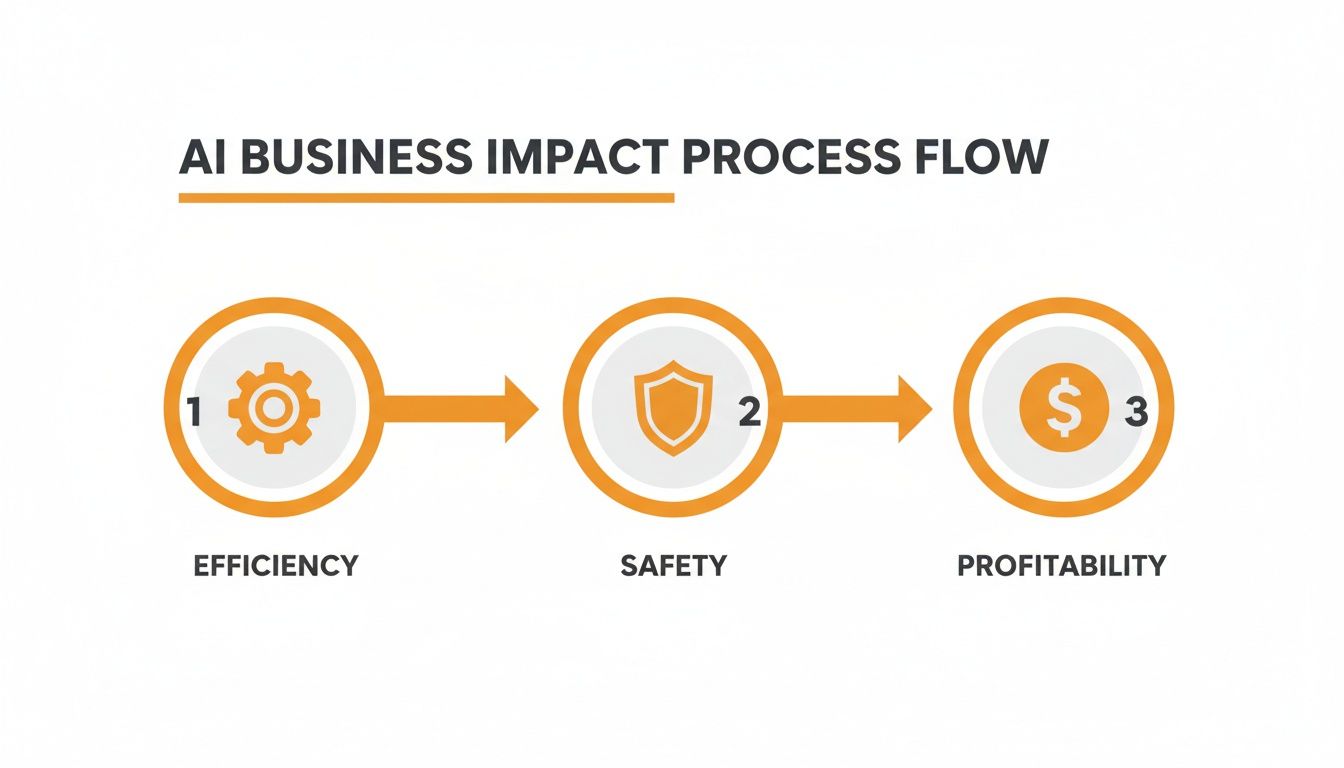
As this flow shows, AI initiatives logically progress from boosting operational efficiency to enhancing safety, which ultimately drives profitability. The gains in efficiency and safety are not separate goals; they are foundational steps that lead directly to a stronger financial bottom line.
Prove the Value With a Pilot Project
Instead of attempting a massive, site-wide AI rollout from day one, it is far wiser to start small. A pilot project is a focused, small-scale test designed to solve one specific problem and prove the value of the technology. This approach minimises risk, keeps initial costs down, and helps your team learn valuable lessons in a controlled setting.
A successful pilot project is your most powerful tool for getting buy-in from leadership and the wider team. When people see a tangible result, like an AI model successfully predicting failures in a specific fleet of haul trucks, they become advocates for expanding the technology.
Choosing the right pilot is critical. Look for a problem that is both significant and solvable. Here are a few ideas for a strong first step:
- Focus on a single asset type. Instead of trying to predict maintenance for all your equipment, start with one critical fleet, like your primary excavators or haul trucks.
- Target a clear pain point. Choose an issue that everyone agrees is a problem, such as unplanned downtime on a key conveyor belt or bottlenecks at the crusher.
- Define clear success metrics. Know exactly what you want to achieve. For example, your goal might be to reduce unplanned downtime for the pilot fleet by 15% within six months.
Once your pilot project delivers a clear win, you have a powerful case study to justify a broader rollout. You have demonstrated the value, worked out the kinks in your process, and built momentum for the next phase. This one-room-at-a-time approach ensures that as you scale up, you are building on a foundation of proven success. It is the most reliable path to successfully implementing AI in mining for long-term results.
How the Technology Behind Mining AI Actually Works
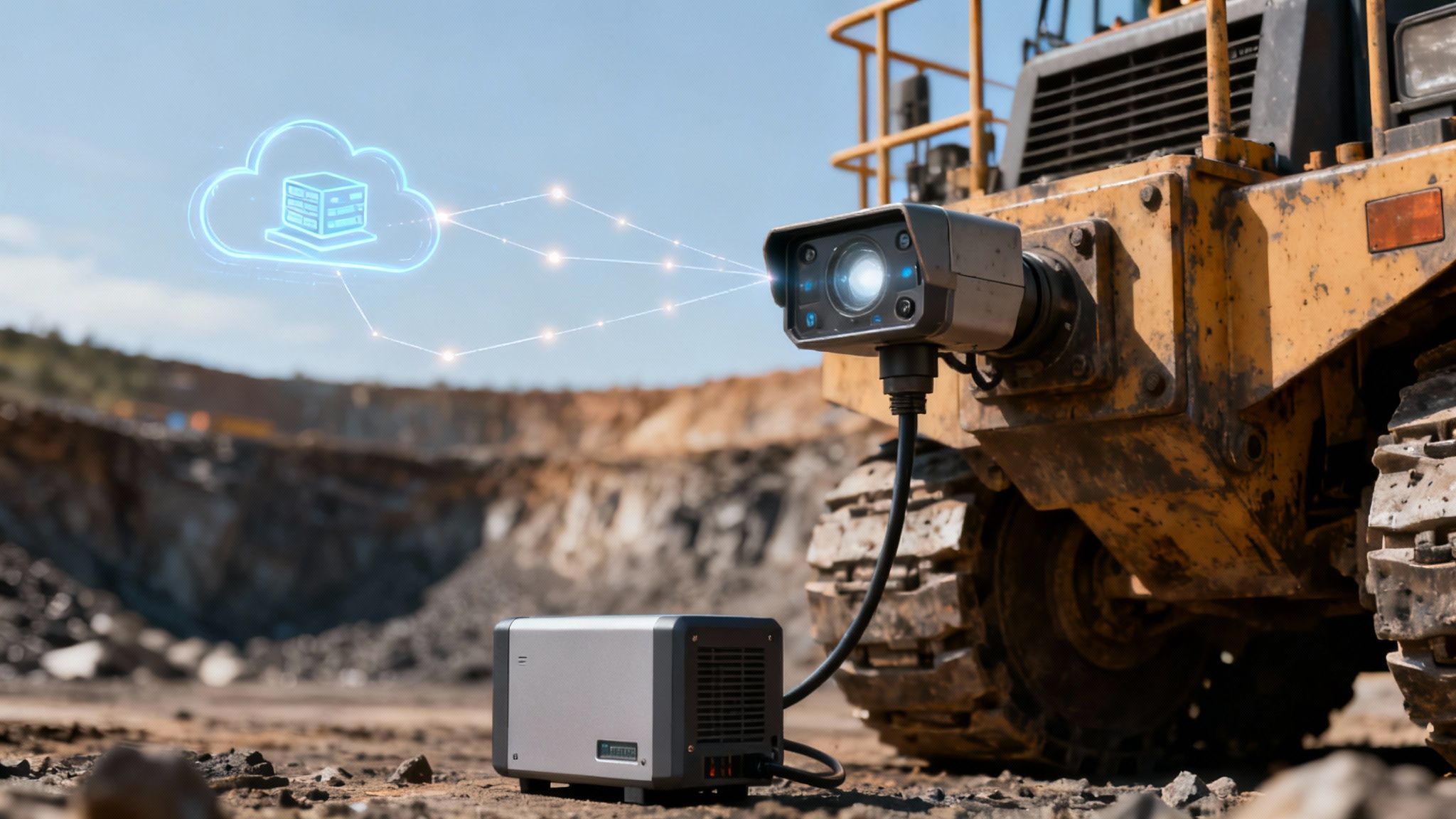
To get a real handle on AI in mining , you do not need to be a data scientist. It is more helpful to lift the bonnet and look at the engine’s key parts without getting lost in overly technical jargon.
Let’s think of the whole system like a human body, where different parts have to work together to produce intelligent actions. It is all built on a simple premise: collect information from the real world, figure out what it means, and then act on it. This creates a feedback loop that allows the operation to learn and adapt on the fly.
The Brains and Nerves of the Operation
At the core of any AI system are the AI agents. You can think of these as highly specialised digital members of your team. One agent might be an expert at listening to the vibrations of a haul truck engine to flag a potential failure days in advance. Another could be dedicated to analysing geological data, spotting patterns humans might miss to suggest the most promising place to drill next. They are the ‘brains’ of the outfit.
Of course, a brain is useless without information. That is where sensors come in, they are the ‘eyes and ears’ of the entire mine site. They are constantly gathering raw data, from GPS trackers on vehicles and cameras on conveyor belts to temperature gauges on critical machinery.
The whole network of these devices is what we call Industrial IoT solutions, and they form the nervous system of the operation. This constant stream of information is fed directly to the AI agents, giving them the real-world data they need to make smart decisions.
Where the Thinking Happens: Edge vs Cloud
Once a sensor collects data, it has to be processed. This is where you will hear the terms ‘edge’ and ‘cloud’ computing thrown around, but the concept is actually quite simple.
Think of it this way: your reflexes are a form of ‘edge computing’. If you touch a hot surface, you pull your hand away instantly without conscious thought. The decision happens right at the source, your hand. Your deeper thoughts, like planning a project or recalling a memory, are more like ‘cloud computing’. They require the full processing power of your brain.
In a mining context, this distinction is critical.
- Edge Computing is for split-second, local decisions. An autonomous haul truck uses edge computing to slam on the brakes if a person unexpectedly walks into its path. The decision is made right there on the truck for maximum speed and safety.
- Cloud Computing is for the heavy lifting. This is where massive datasets are sent for deep analysis. For example, you would use the cloud to train an AI model on years of maintenance data from your entire fleet to predict component failures across the board.
This balance between immediate, on-site reflexes and deep, centralised analysis is what makes the whole system so powerful.
This technological shift is not just theory; it is being backed by serious investment. The Australian AI market, which is crucial for the resources sector’s digital progress, reached USD 6,191.8 million in revenue in 2025. It is projected to explode to USD 80,150.5 million by 2033. Tech giants are pouring billions into local infrastructure, with Microsoft and AWS expanding their data centres, including new facilities in Perth, specifically to handle the high-speed data demands of the mining industry.
By understanding these core components, it becomes clear that AI in mining is not magic. It is a practical, logical system where digital workers, sensors, and smart computing collaborate to build a safer and more productive operation.
Navigating Challenges and Ensuring Long-Term Success
Introducing any new technology into the high-stakes world of mining is never a simple plug-and-play exercise. A realistic strategy for AI in mining has to account for the very real hurdles on the ground, from locking down sensitive operational data to making sure the workforce is on board with the changes. True success is not just about the technology; it is about the people and processes that make it work.
Think of it like dropping a high-performance engine into a classic ute. It has got incredible power, but you still need a skilled mechanic to fit it, a driver who understands its quirks, and the right safety checks to keep it on the road. It is the same principle here, success is born from a smart partnership between the AI, your team, and your established operational procedures.
Keeping Humans in the Driving Seat
One of the biggest challenges is making sure AI serves as a trusted co-pilot, not an unquestioned commander. The most effective systems are always built around a “human-in-the-loop” model.
This means the AI does the heavy lifting, analysing terabytes of data to suggest an optimal haul route or flag an imminent equipment failure, but a seasoned human expert always has the final say.
This approach is non-negotiable for safety and accountability. It ensures the hard-won experience and gut instinct of your veteran engineers and operators are enhanced, not replaced, by the machine’s analytical power. Building that trust between your team and the technology is absolutely fundamental to seeing any long-term benefit.
Meeting Australia’s Strict Safety Rules
Australian mining operates under some of the most stringent safety and environmental regulations on the planet. Any new system you bring on-site can’t just meet these standards; it has to actively enhance your ability to exceed them. This is where AI can become a powerful ally, helping to spot hazards and prevent incidents before they even have a chance to develop.
For a wider view on how different industries are adapting to new compliance demands, it is worth exploring the current advancements and trends in the OHS landscape. When AI is integrated thoughtfully, it helps foster a proactive safety culture that moves well beyond a simple tick-box compliance mentality.
The goal is to create a system where technology and people work together, each playing to their strengths. The AI crunches the immense data, and your team provides the critical thinking and final judgement.
Choosing the right implementation partner is just as critical. You need a team that gets the unique pressures of a mine site, not just the intricacies of the code. They need to understand the commercial importance of uptime, the necessity of robust data security, and the absolute, unshakeable priority of safety.
A successful AI strategy is ultimately built on careful planning, proactive training for your workforce, and a deep, ingrained respect for safety protocols. To develop a plan that genuinely fits your operational needs, it is often wise to speak with expert AI consultants who can help you navigate these complexities and build a tailored roadmap for success.
Frequently Asked Questions About AI in Mining
Here are some straightforward answers to the questions we hear most often when talking with mining leaders about putting artificial intelligence to work on site.
Will AI Replace Mining Jobs?
It is not about replacing people; it is about changing the work they do. A geologist, for instance, might spend less time manually logging core samples and more time interpreting AI-generated 3D models that pinpoint high-potential drilling targets with incredible accuracy.
The focus shifts from repetitive, often dangerous tasks to roles that demand sharper analytical and technical skills. Think of AI as a powerful co-pilot. It gives your teams the data-driven insights they need to make better decisions, faster, freeing them up to tackle the kind of complex, strategic problems that technology can’t solve on its own. A solid implementation plan always builds in reskilling programs, ensuring your current workforce can step confidently into these new, higher-value roles.
How Much Data Do We Need to Get Started?
You probably have more than enough data to begin right now. The key is not the volume of data you have, but its quality and relevance to a specific problem. You do not need a perfectly pristine, site-wide database to get going.
A smarter way to start is to pick one high-impact issue and focus your efforts there. For example, you could target predictive maintenance for a single fleet of haul trucks. The historical sensor data and maintenance logs you already possess are the perfect starting point. The first step is to work with specialists to clean and structure that specific dataset for a small-scale pilot. This approach lets you prove the value quickly and builds a compelling business case for investing in broader data strategies down the track.
What’s the Typical Return on Investment for an AI Project?
The ROI often arrives much faster and is more significant than many expect. With predictive maintenance, the returns can be seen within months. Preventing a single catastrophic failure of a primary crusher or a haul truck can save millions in unplanned downtime and repair costs, which more than pays for the initial investment.
In other applications, like AI-guided ore sorting, the returns come from increased yield and lower processing costs. By separating waste rock from valuable ore more effectively before it ever hits the mill, you boost recovery rates and slash energy consumption. Any good pilot project will have clearly defined metrics from the outset, so you can precisely calculate the financial upside before committing to a full-scale rollout.
At Osher Digital , we know the journey to AI adoption can seem daunting. We specialise in building practical, results-focused strategies that align with the realities of your mining operation. If you’re ready to see how AI can create tangible value for your site, our expert AI consultants can help you map out a clear path to success.
Last updated on July 1, 2026
Free tool · 3 minutes
AI Readiness Assessment
Score how ready your business is for AI in a few minutes, with tailored next steps.
Continue Reading
View all
AI Agency Software
We have productized our own internal AI agency software – administrate.dev
Jan 31, 2026
A Plain English Guide to AI in Logistics
Artificial intelligence in logistics is about giving your supply chain a brain. It is not about self-aware robots taking over the warehouse floor, but rather about using smart systems to make your entire operation more efficient, predictive, and resilient. Think of it as the ultimate co-pilot for your logistics team. It is an assistant that […]
Jan 22, 2026

A Business Guide to AI Regulation in Australia
Diving into AI is a bit like getting the keys to a high-performance car. You can feel the power and potential, but you also know you need to learn the rules of the road before you hit the accelerator. That’s pretty much what AI regulation is: the collection of guidelines and laws being drawn up […]
Jan 22, 2026
Sick of reading about automation?
Book a free 15-minute intro call. We’ll talk through what you’re trying to automate and whether we’re a good fit.