Smarter Hiring With AI in Recruitment
When you hear “AI in recruitment,” it’s easy to picture robots making hiring decisions. The reality is far less science fiction and much more practical. Think of these smart systems not as replacements for your team, but as powerful co-pilots. They are designed to handle the heavy lifting, the tedious, repetitive tasks that clog up […]
By Matthew Clarkson · January 22, 2026

When you hear “AI in recruitment,” it’s easy to picture robots making hiring decisions. The reality is far less science fiction and much more practical. Think of these smart systems not as replacements for your team, but as powerful co-pilots. They are designed to handle the heavy lifting, the tedious, repetitive tasks that clog up a recruiter’s day, freeing up your people to focus on what they do best: building genuine connections with great candidates.
What Exactly Is AI in Recruitment?

Let’s cut through the buzzwords. At its heart, AI in the hiring world is a set of specialised tools built to help human experts, not take over their jobs.
Imagine your talent team is sitting in a massive library, trying to find the one perfect book for a very specific reader. The old way would be to manually check the back cover of every single book, a painfully slow and inefficient process. Now, what if they had an expert librarian who had already read every book and could instantly hand them the top five matches?
That’s what AI does for recruitment. It’s the expert librarian for your candidate pool, instantly sifting through thousands of resumes to pinpoint the best-fit people for a role. It supports, rather than replaces, the critical human element of hiring.
By automating the most time consuming parts of the process, this technology gives your team the breathing room to focus on what truly matters: engaging with talented people and making thoughtful, strategic decisions.
How Does It Actually Work?
At its core, AI in recruitment uses clever programs to analyse information and spot patterns a person might miss. This could be as simple as scanning a CV to match keywords and skills against a job description. Or it might involve something more complex, like searching your existing talent database to find past applicants who are a perfect fit for a new opening.
The goal is to make the entire hiring cycle faster, fairer, and more effective. By handling the initial legwork, these tools ensure your team does not overlook great talent buried in a mountain of applications. It simply organises information in a smarter way, allowing your recruiters to act on insights, not just raw data.
Why This Matters Now
The hiring world is moving at a breakneck pace, and candidates are adopting new technologies just as quickly as businesses. In Australia’s fiercely competitive graduate market, for example, a striking 42% of graduates are now using AI to polish their job applications. That’s a huge jump from just 27% the previous year, highlighting just how fast these tools are becoming standard practice on both sides of the hiring desk. You can find out more from this research on graduate recruitment and development trends from Australia.
This rapid shift puts organisations still relying on manual methods at a distinct disadvantage. Adopting AI gives your team the support they need to keep up, find the best people, and ultimately create a better experience for every single applicant. If you’re looking for help finding the right solution, our team of AI consultants can guide you through the options.
How AI Is Reshaping the Recruiter’s Role
If you’re a recruiter, you know the daily reality is a constant juggling act. You’re posting job ads, wading through an ocean of applications, and trying to keep every candidate in the loop. It often feels like the administrative overload leaves precious little time for the part of the job that actually matters: connecting with great people.
This is exactly where AI in recruitment comes in. It’s best to think of it not as a replacement for human recruiters, but as an incredibly efficient assistant. Its core purpose is to take over the repetitive, high volume tasks, freeing up your team to focus on strategic work that genuinely requires a human touch.
Imagine having to manually review hundreds of CVs for just one open position. Instead of burning days on that initial sift, an AI tool can analyse the entire pile in minutes, serving up a curated shortlist of the most promising candidates. This simple change hands a massive amount of time back to your team, time they can reinvest in actually engaging with that top tier talent.
From Administrator to Strategic Advisor
By shouldering the administrative burden, AI fundamentally elevates the recruiter’s role. It allows them to move from being bogged down in process to becoming genuine strategic advisors. This shift means they can focus on what they do best: building strong, lasting relationships with candidates and hiring managers.
Instead of just filling jobs, they can start thinking about the bigger picture:
- Deeper Candidate Engagement: Spending more quality time talking to top prospects, understanding their long term career goals, and building a rapport that makes your company their first choice.
- Strategic Partnership with Hiring Managers: Using data driven insights from AI tools to guide hiring managers on market trends, salary benchmarks, and the real world talent pool available.
- Proactive Talent Sourcing: Focusing their energy on finding exceptional passive candidates, those who are not actively looking but are a perfect fit for the team. This is a nuanced task that automation cannot replicate.
This evolution could not come at a more critical time. Demand for AI skills in Australian job ads has climbed sharply, and it’s expected that most roles will soon be augmented by AI in some way. As both job seekers and employers adopt these tools, application volumes are exploding, placing immense pressure on talent teams. You can find a deeper analysis of these trends in this workforce outlook from Talent International.
Solving Common Hiring Headaches
AI directly tackles some of the most persistent frustrations in the recruitment cycle. This is not just about making things faster; it’s about building a more effective and fair process for everyone.
Take sourcing, for example. AI powered tools can search far beyond the usual job boards, uncovering hidden talent pools on platforms like GitHub, professional networks, and niche industry forums. They can pinpoint skilled people who might never have seen your job ad but are ideal for the role, significantly broadening your reach.
Automated screening also brings a new level of consistency. By assessing every single application against the same objective criteria, it helps reduce the unconscious bias that can easily creep into manual reviews. The result is often a more diverse and demonstrably qualified shortlist.
An intelligent chatbot can be a complete game changer for the candidate experience. It offers instant, 24/7 updates on application status, answers common questions, and can even help schedule interviews. This simple tool dramatically improves how candidates perceive your company and frees recruiters from an endless cycle of back and forth emails.
By taking on these common pain points, AI in recruitment does not just speed up the process. It makes it smarter, fairer, and more people centric, leading to better hires and a more strategic HR function. If you’re trying to figure out which tools are the right fit for your organisation, our AI consultants can provide expert guidance.
A Snapshot of Your Recruitment Process Before and After AI
To really understand the impact, it helps to see a direct comparison. The table below shows how everyday recruitment tasks are transformed when you introduce AI powered tools.
| Recruitment Task | The Traditional Method | The AI-Powered Method |
|---|---|---|
| Sourcing Candidates | Manually posting on job boards and searching LinkedIn. | AI actively scours the web, professional networks, and internal databases to find both active and passive talent. |
| CV Screening | A recruiter spends hours, or even days, reading through every single application. | AI analyses thousands of CVs in minutes, ranking them based on qualifications, skills, and experience. |
| Candidate Communication | Replying to candidate queries one by one, often with significant delays. | An AI chatbot provides instant, 24/7 answers to common questions and gives application status updates. |
| Interview Scheduling | Endless email chains trying to align calendars between the candidate and multiple interviewers. | AI syncs with everyone’s calendars and automatically finds and proposes suitable interview times. |
| Data Analysis | Relying on gut feelings or basic spreadsheet tracking to understand hiring metrics. | AI provides predictive analytics on time-to-hire, cost-per-hire, and identifies bottlenecks in the process. |
As you can see, the shift is from reactive, manual work to a proactive, data informed strategy. This frees up the recruitment team to focus on the high value human interactions that ultimately secure the best talent.
A Practical Roadmap for Implementing AI
Seeing the potential of AI in recruitment is one thing; actually putting it into practice is another. Many organisations are caught between excitement and anxiety, worried about a complex rollout. The good news is, you do not need a dense technical manual, just a solid, logical business plan.
Think of it like renovating a kitchen. You would not just start tearing down walls. First, you would pinpoint what is not working, maybe the lack of bench space or that one awkward cupboard. Then, you would map out a clear plan, pick the right appliances, and probably tackle one small part of the job before committing to a full overhaul.
Bringing AI into your hiring process follows the same logic. It’s a strategic project, not a technical free for all. The aim is to create a smooth, manageable transition that adds real value without causing chaos for your team or candidates.
This visual shows how AI tools can plug into the core stages of your recruitment workflow, from sourcing candidates right through to screening and engagement.
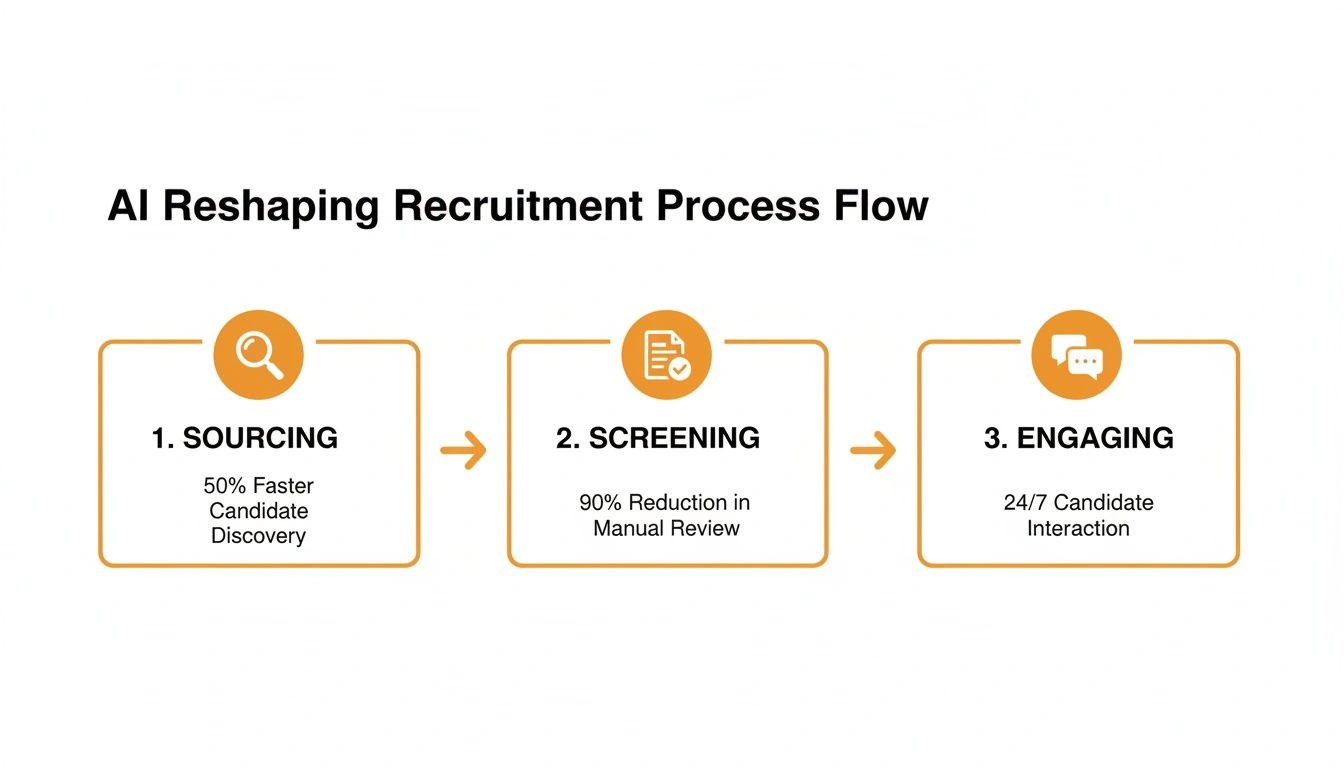
As you can see, AI supports recruiters at each critical touchpoint, automating the repetitive work so they can get back to what they do best: building relationships.
Stage 1: Start With Your Pain Points
Before you even look at a single piece of software, stop and take a hard look at your current recruitment process. The most successful AI implementations do not begin with technology; they begin with a problem.
Get your team in a room and ask some direct questions:
- Where are our biggest bottlenecks? Is it the sheer volume of initial applications bogging us down?
- Which tasks eat up the most manual hours? Think about scheduling interviews or sending out update emails.
- Are we constantly struggling to find candidates for specific, hard to fill roles?
- Is our candidate experience letting us down with slow communication and a clunky process?
Your answers will naturally form a priority list. This is not about trying to fix everything at once. It’s about zeroing in on the one or two areas where AI could make the most immediate and significant impact. For instance, if your recruiters are sinking 80% of their time into screening CVs for high volume roles, you’ve found your starting point.
Stage 2: Get Your Data in Order
AI tools are a bit like a talented chef, they need high quality ingredients to produce a great result. In the world of AI, that ingredient is data. If your candidate information is messy, disorganised, or incomplete, even the most sophisticated AI will fail to deliver.
This means taking the time to clean up your Applicant Tracking System (ATS) and other candidate databases.
Think of it as organising your pantry before you start cooking. You need to know what you have, where it is, and make sure it’s all fresh. A clean, well structured dataset is the foundation for any successful AI initiative.
This step could involve standardising job titles, purging duplicate entries, and filling in the gaps in candidate profiles. It might feel like thankless work, but it’s absolutely non negotiable. Getting this right from the start will save you countless headaches down the track and ensure your new tools are effective from day one. If your data challenges need a more tailored solution, exploring custom AI development can provide a system perfectly matched to your business needs.
Stage 3: Run a Pilot Project
One of the biggest mistakes organisations make is attempting a company wide, “big bang” rollout of new technology. A far smarter approach is to start small with a pilot project. This allows you to test everything in a controlled environment, learn what works, and build confidence before scaling up.
Pick a single, well defined area to focus on. A great candidate for a pilot is often a high volume role that consistently generates a large pool of applications, like a customer service or entry level sales position.
The goal of the pilot is to gather real world data and honest feedback. Here’s what you need to find out:
- Does the tool solve the problem? Did it genuinely slash the time spent on manual screening?
- How does the team find it? Is it user friendly? What training and support do they need?
- What is the impact on key metrics? Keep a close eye on your time to hire and the quality of shortlisted candidates.
By starting small, you create a low risk environment to prove the concept and demonstrate value. Once you have a successful pilot under your belt, you’ll have a powerful business case, and a team of internal champions, to support a wider implementation across the organisation. This methodical approach turns a daunting project into a series of manageable, strategic steps.
Choosing the Right AI Recruitment Partner
https://www.youtube.com/embed/PmpcGJb7Z1U?feature=oembed
Picking an AI vendor is a bit like hiring a builder for a major renovation. The quality of their work, their reliability, and how well they understand your vision ultimately dictates the final result. You’re looking for a genuine partner, not just a salesperson with a slick demo.
The aim is to find a technology provider whose solution fits your organisation like a glove. You should not have to twist your unique processes to fit into their rigid, one size fits all software. This means looking past the flashy features and asking the tough questions about what really matters for your business.
A great AI recruitment partner should feel like an extension of your own team. They need to get to grips with your specific hiring challenges and be genuinely committed to helping you solve them, offering support long after the ink on the contract has dried.
Look Beyond the Sales Pitch
When you start exploring options, it’s easy to get dazzled by promises of futuristic features. But the most important considerations are often the most practical ones. Before you sign anything, you need to dig into the fundamentals of how the tool will actually operate within your existing setup.
Focus your evaluation on these critical areas:
- Seamless Integration: Can the new tool connect smoothly with your current Applicant Tracking System (ATS) and other HR software? A system that does not play well with others will create more problems than it solves.
- Real Support and Training: Does the vendor provide proper training to get your team up and running? What does their ongoing support look like when you inevitably have questions or hit a snag?
- Data Security and Compliance: How do they handle your sensitive candidate data? Make sure they are fully compliant with Australian privacy laws and have robust security measures in place.
- A Clear and Fair Pricing Model: Is the pricing structure transparent and easy to understand? You need to be sure there are no hidden costs that will pop up down the track.
Finding the right partner is less about buying a product and more about forming a strategic relationship. You need a provider who is as invested in your success as you are, ready to help you adapt and grow.
This careful evaluation ensures you’re not just buying software, but investing in a solution that will deliver genuine, long term value to your recruitment function.
The Value of a Vendor-Agnostic Approach
It’s also worth considering a partner who is not tied to a single technology. A vendor agnostic consultant can look at your business needs objectively and recommend the best possible tool for the job, regardless of who makes it. This approach ensures the solution is genuinely tailored to your goals.
For instance, when looking at ways to improve your hiring process, a specialised AI resume builder might be a valuable tool to look for from a potential partner. A neutral advisor can help you assess whether this kind of feature is truly necessary for your specific workflow.
Making the Right Choice for Your Team
Ultimately, the right partner is one who understands that technology should serve people, not the other way around. They should be able to clearly explain how their AI in recruitment tools will make your team’s lives easier and your hiring process more effective. This is especially important as the demand for tech skills continues to climb.
Australia’s job market currently shows AI engineering as the fastest growing role, a clear signal of AI’s shift from a niche skill to a business essential. As more roles require AI literacy, finding a partner who can help you identify this talent is critical.
Asking the right questions and focusing on practical needs will empower you to find a partner who delivers a solution that truly fits. For expert, unbiased advice on navigating this process, our team of AI consultants can help you assess your needs and identify the best technology to achieve your goals.
Navigating the Ethics of AI in Hiring

Introducing AI into your recruitment process is a bit like handing the keys to a high performance vehicle to your team. It can get you to your destination much faster, but you still need to understand the rules of the road to drive it safely. With AI in recruitment , there’s a serious responsibility to uphold fairness, protect privacy, and maintain trust.
The single biggest concern is bias. If an AI tool is trained on historical hiring data where, for instance, technical roles were mostly filled by men, the algorithm will learn to favour male candidates. It’s not malicious; it simply replicates the patterns it’s shown, accidentally cementing past prejudices into future decisions.
This is why establishing clear ethical guardrails is not just a “nice to have,” it’s fundamental. It’s about consciously designing your process so this new technology becomes a force for fairness, not just an amplifier for old biases.
Building Fairness into the System
To stop AI from learning the wrong lessons, you have to be deliberate about fairness right from the start. Think of it as actively teaching the system what an equitable, unbiased decision looks like, rather than just letting it infer from messy historical data.
A critical step is conducting regular audits of your AI tools. This is like a routine health check to spot whether any unintended bias is creeping into its recommendations. You need to partner with vendors who are transparent about how their algorithms work and can show you exactly how they test for and reduce bias.
The goal is to create a system where every candidate is judged on their skills and potential, not on factors like their gender, background, or postcode. True fairness in AI hiring is achieved through active, ongoing vigilance.
It also means being upfront with your candidates. If someone is interacting with a chatbot or having their application assessed by an AI, they have a right to know. This simple act of honesty builds trust and shows respect for the people applying to your company.
Keeping a Human in the Loop
Even the most sophisticated AI is no replacement for human judgment. Technology is brilliant at analysing data and spotting patterns, but it cannot grasp context, nuance, or a candidate’s potential in the way a person can. That’s why human oversight is completely non negotiable.
Your recruitment team must always have the final say. The AI’s job is to deliver a well researched shortlist, not to make the final hiring decision. This “human in the loop” approach ensures that crucial decisions are still guided by empathy, instinct, and real world experience.
This partnership is so important for a few key reasons:
- Contextual Understanding: A recruiter can see beyond a resume, recognising that a career gap might have been for family leave or that experience in an adjacent industry brings valuable, transferable skills.
- Assessing Soft Skills: Qualities like leadership, creativity, and teamwork are incredibly difficult for an AI to measure but are easily identified by a skilled interviewer.
- Accountability: Ultimately, your organisation is responsible for its hiring practices. Keeping people at the centre of the process ensures there is always clear accountability.
Legal and Privacy Considerations in Australia
It’s also vital to remember your legal obligations. In Australia, hiring practices are governed by strict employment and privacy laws, and using AI does not give you a pass. You must ensure your processes are compliant with the Privacy Act, which dictates how personal information is collected, stored, and used.
For a comprehensive breakdown of the ethical and compliance challenges in AI driven HR, this guide on navigating AI ethics, EPPA compliance, and risk management in human resources is an excellent resource.
By proactively managing these ethical, legal, and human elements, you can use AI in recruitment to build a fairer, more effective hiring process that people trust. If you need help developing a responsible AI strategy, our AI consultants can provide the expert guidance you need.
Measuring the Success of Your AI Investment
Investing in new recruitment technology can feel like a leap of faith. You commit the budget and resources, but how do you know if it’s actually working? With AI in recruitment , you cannot just hope for the best; you need a clear, no nonsense way to measure its impact and prove it was worth it.
So, how do you show the investment is genuinely paying off? It’s not about drowning stakeholders in complex spreadsheets or technical jargon. It’s about tracking a few powerful numbers that tell a simple, compelling story of progress.
The aim here is to move past vanity metrics. We need to focus on the real business outcomes that matter, less about the number of applications and more about tangible savings in cost, time, and the calibre of people you bring on board.
Key Numbers to Watch
To build a solid business case, you need to zero in on a handful of key performance indicators (KPIs) that tie directly to the bottom line. These metrics offer the concrete proof needed to show that AI is making your hiring process smarter, not just faster.
Here are the most important ones to get a handle on:
- Time-to-Hire: This is the big one. Track the average number of days it takes from a job going live to an offer being accepted. A significant drop here is an undeniable win. It means you’re filling critical roles faster and minimising the productivity drain from vacant positions.
- Cost-per-Hire: Tally up every recruiting expense, from job board ads to agency fees and salaries, and divide it by the number of hires. AI should drive this number down by automating manual tasks and reducing your reliance on expensive third party recruiters.
- Quality of Hire: This gets to the heart of it: are you actually hiring better people? You can measure this by looking at the first year performance review scores of new hires or their retention rates after 12 months. An uptick in high performing, long term employees is a powerful signal of success.
Think of these KPIs as the vital signs of your recruitment function’s health. A positive trend in these areas shows your AI investment is not just another expense, it’s a strategic advantage that strengthens the entire business.
Building Your Business Case
Tracking these numbers gives you the hard evidence needed to demonstrate the real world value of your AI tools. When you can walk into a leadership meeting and say, “Our new system has cut our time to hire by 25% ,” you’re speaking a language everyone understands: results.
A simple “before and after” comparison can be incredibly persuasive. Start by benchmarking your metrics for a specific department or role before you introduce AI, then measure again after a few months. This gives you a clear, digestible snapshot of the return on investment (ROI). For organisations managing large volumes of data, understanding automated data processing can unlock even more efficiency gains.
By focusing on measurable improvements in speed, cost, and quality, you build an undeniable case for the power of AI in recruitment. This approach not only justifies the initial investment but also builds the momentum needed for future innovation. If you need a hand setting up a measurement framework that delivers clear results, our AI consultants can help you build the right strategy.
Frequently Asked Questions About AI in Recruitment
When a technology like this comes along, it’s natural to have questions. Leaders want to cut through the hype and understand how AI actually works on the ground. Let’s tackle some of the most common queries about using AI in recruitment.
Think of this as the practical, no nonsense chat you’d have with an expert over a coffee.
Will AI Replace Our Human Recruiters?
Not a chance. This is probably the biggest misconception out there. The point of AI is not to make your talented recruitment team redundant; it’s to give them superpowers. It’s built to handle the soul crushing, high volume tasks that eat up their day.
Here’s a good way to think about it: your AI tool is the tireless assistant who sifts through a mountain of 1,000 applications to hand you the 20 most promising ones. This frees up your human recruiters to do what they do best, build genuine relationships, conduct deep dive interviews, and make those critical, nuanced judgements that a machine cannot.
Simply put, AI takes care of the repetitive, mechanical work so your people can focus on the human connections that actually drive great hiring decisions. It’s about making your team better, not replacing it.
This shift allows your team to move from being administrators bogged down in paperwork to becoming true strategic advisors to the business.
How Can We Ensure AI Hiring Is Fair and Unbiased?
This is a crucial question, and it’s smart to approach it with a healthy dose of caution. An AI trained on historical hiring data can easily learn and even amplify old biases. But the good news is that modern, well built AI in recruitment platforms are designed from the ground up to prevent this.
These systems are configured to focus strictly on objective, role relevant criteria, things like specific skills, qualifications, and measurable experience. They consciously ignore the demographic details that can trigger unconscious bias in human reviewers.
But the technology is only one piece of the puzzle. A robust fairness strategy really needs three key elements:
- Choose transparent partners. Work with vendors who are open about how their algorithms work and can clearly explain their bias reduction techniques.
- Audit the outputs. Regularly review the AI’s performance and recommendations to ensure they remain equitable and are not skewed over time.
- Keep a human in the loop. The AI should recommend and shortlist, but the final hiring decision must always rest with a person.
Is It Expensive to Implement AI Recruitment Tools?
The cost can certainly vary, depending on the tool’s complexity and the scale of your organisation. It’s much more useful, however, to frame it as an investment rather than an expense. When implemented correctly, the right AI tool generates a clear return.
Think about the value it delivers. By automating countless hours of manual work, AI dramatically shrinks your time to fill, boosts the quality of candidates you engage with, and makes your entire recruitment function more productive. When you calculate the savings from these gains, the initial outlay often becomes a very straightforward business case.
At Osher Digital , we help organisations find and implement the right AI solutions to solve their biggest challenges. If you’re ready to explore how AI can make your hiring process faster and more effective, talk to our AI consulting team today.
Last updated on July 1, 2026
Continue Reading
View all
AI Agency Software
We have productized our own internal AI agency software – administrate.dev
Jan 31, 2026
AI in Mining Uncovered: How Smart Tech Boosts Safety and Profit
Imagine having a partner for your operations team who never sleeps. A partner who can sift through endless streams of data from your drills, trucks, and sensors, spotting tiny clues that signal a million-dollar problem is just around the corner. That’s the real value of AI in mining. It is not about sci-fi robots; it […]
Jan 30, 2026

A Plain English Guide to AI in Logistics
Artificial intelligence in logistics is about giving your supply chain a brain. It is not about self-aware robots taking over the warehouse floor, but rather about using smart systems to make your entire operation more efficient, predictive, and resilient. Think of it as the ultimate co-pilot for your logistics team. It is an assistant that […]
Jan 22, 2026
Sick of reading about automation?
Book a free 15-minute intro call. We’ll talk through what you’re trying to automate and whether we’re a good fit.