
Best Enterprise Resource Planning Software: Finding Your Perfect Fit in 2025
Choosing the right system to run your entire business is a challenge. You’re probably drowning in spreadsheets. Different departments are using their own favourite tools, none of which talk to each other, and you just have this nagging feeling that everything could be… smoother. So much smoother. I’ve been there. I know that feeling of […]

Choosing the right system to run your entire business is a challenge. You’re probably drowning in spreadsheets. Different departments are using their own favourite tools, none of which talk to each other, and you just have this nagging feeling that everything could be… smoother. So much smoother.
I’ve been there. I know that feeling of constantly chasing data instead of actually using it to make smart decisions. It’s frustrating. You need something that ties everything together, from finance and inventory to HR and the supply chain, without costing the earth or needing a PhD to use.
Honestly, one of the best reasons to even think about a new ERP is how much time it can save. When you see some real-world business process automation examples, it clicks. You start to see how much time your team could get back.
And that’s what this list is all about. We’re going to walk through some of the absolute best enterprise resource planning software for Australian businesses right now. Not just a boring list of features copied from a brochure. Nope. We’ll take a real look at what they’re like, who they’re really for, and the honest drawbacks you need to know about. We’ve even grabbed screenshots and direct links for each one.
Okay, let’s find the right fit for you.
1. SAP S/4HANA Cloud, public edition (SAP)
Alright, let’s start with the big one. SAP S/4HANA Cloud is a serious powerhouse in the ERP world. It’s SAP’s main offering for medium to large businesses that are finally ready to ditch their old, clunky on-premise systems and jump into the cloud. What makes it special is that it’s built on industry best practices. So instead of starting from scratch, you’re getting pre-configured business processes with all the smart analytics already baked in. It’s like buying a house where the plumbing and electrical are already perfectly laid out.
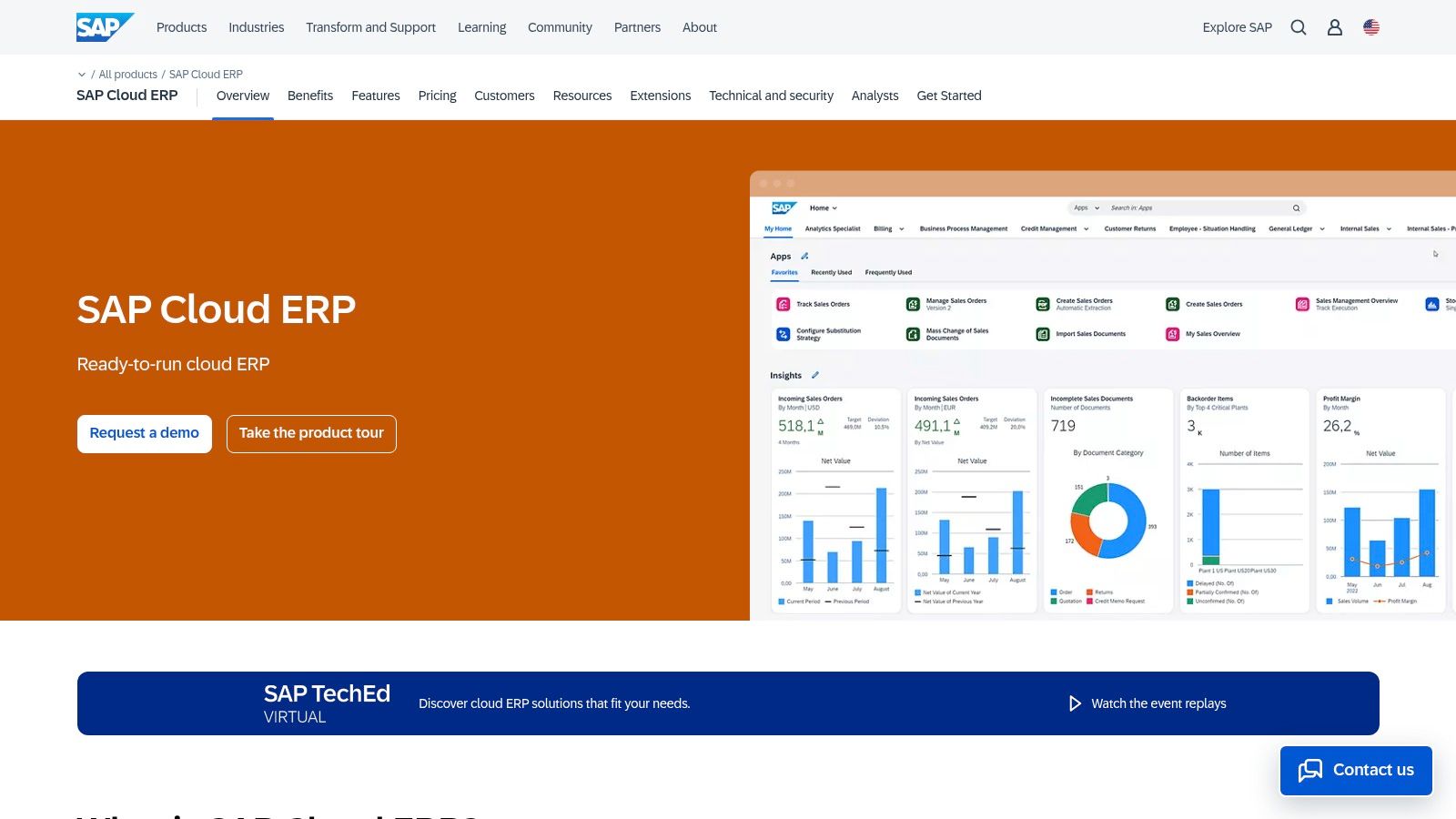
Think of it as the standardised, ready-to-go version of SAP’s massive capabilities. This structure means you can get up and running faster, and you get cool new features every quarter without those huge, painful upgrade projects of the past. One of the handiest features is their guided trial system. You can actually test-drive specific processes before you buy, which is amazing for getting your team on board. It is a complex beast, though, so understanding system integration best practices from the get-go is absolutely critical.
Key Details & Considerations
- Best For: Midmarket to large enterprises that want a standardised, cloud-first ERP with smarts built in.
- Pricing: Quote-based subscription. You’ll need to chat with SAP or one of their partners.
- Pros: It’s got enterprise-grade everything, constantly gets better, and you can try before you buy.
- Cons: The price isn’t listed anywhere, and you’ll definitely need a specialist partner to set it up. It’s also not as customisable as the old-school SAP systems.
Website: https://www.sap.com/products/erp/s4hana.html
2. Oracle NetSuite Australia
Oracle NetSuite has been a huge name in cloud ERP for ages, and for a very good reason. It was one of the first systems “born in the cloud,” offering a single platform for financials, inventory, CRM, and e-commerce. A single source of truth… sounds nice, doesn’t it? For Aussie businesses, this means you’re getting a mature, well-supported solution with plenty of local experts who can help. It’s built to grow with you, from a bustling mid-market company to a much larger, more complex one.
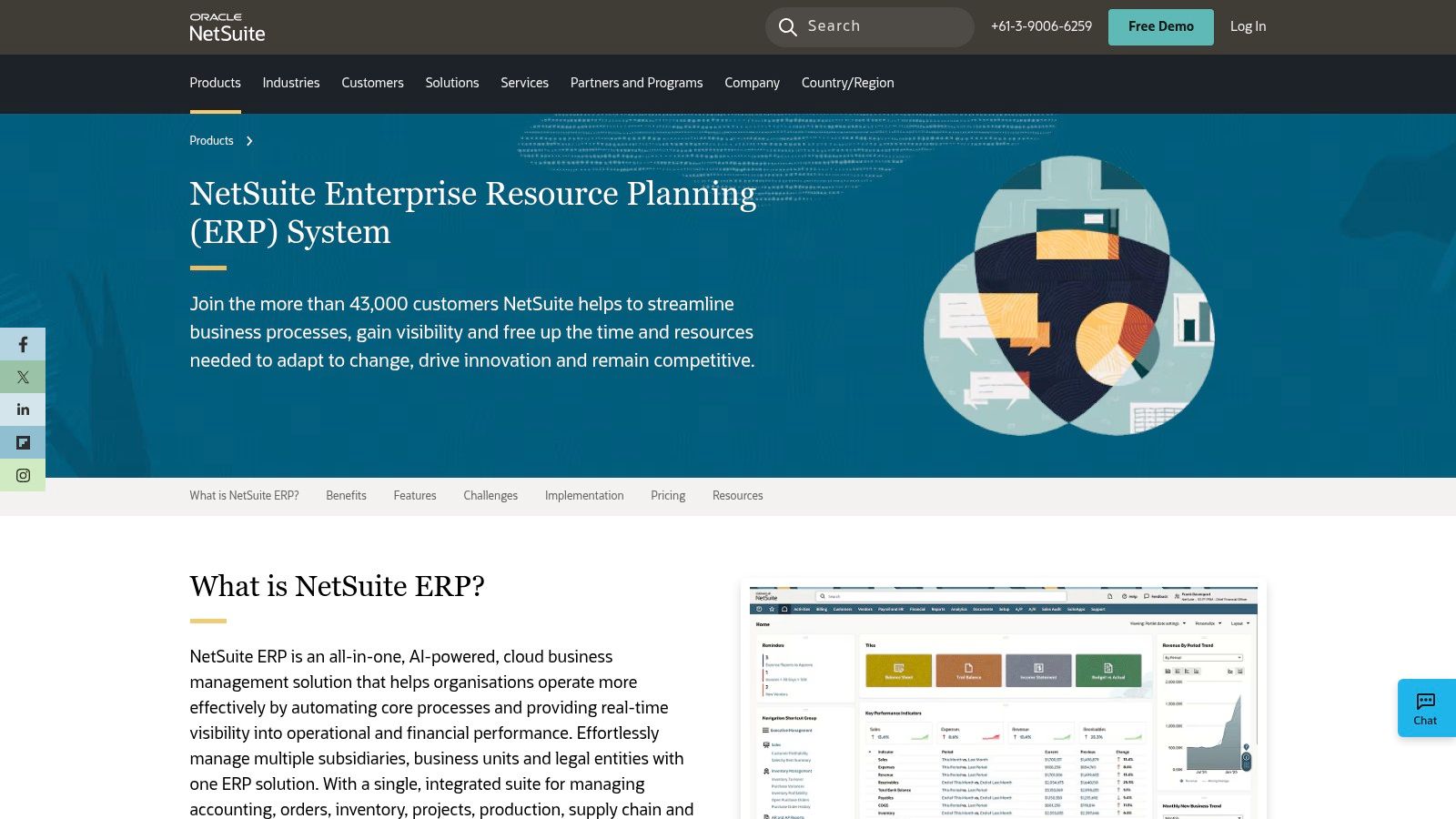
The real magic of NetSuite is that it does pretty much everything. You’re not just buying an accounting package; you’re getting a platform that can run your whole show. Its ability to handle multiple companies and currencies is built right in, which is perfect if you have your sights set on expanding overseas. Getting the initial setup right is so important, though. You’ll need a solid data migration strategy from day one to make the switch from your old systems as painless as possible.
Key Details & Considerations
- Best For: Mid-market to larger businesses in Australia and New Zealand looking for a proven, all-in-one cloud ERP that can grow with them.
- Pricing: Quote-based subscription. They tailor the price based on what modules you need, how many users you have, and your company size.
- Pros: A very mature and complete cloud platform with a heap of Australian customers. It scales really, really well.
- Cons: No public pricing. The total cost can also climb quite a bit as you add more modules or users.
Website: https://www.netsuite.com.au/portal/au/products/erp.shtml
3. Microsoft Dynamics 365 Business Central (AU)
Microsoft Dynamics 365 Business Central is the tech giant’s solution for small to mid-sized businesses looking for a complete cloud-based ERP. And it absolutely shines if your company already lives and breathes Microsoft. Its killer feature? The seamless way it connects with Microsoft 365 and the Power Platform. This means you can manage things directly from Outlook or build custom apps and workflows with tools your team probably already uses. It’s just… very practical.
I love that the Australian site is so upfront. They publish their pricing in AUD and offer a 30-day free trial, which just removes so much of the initial guesswork. You can see what you’re getting into before you commit. The AppSource marketplace is another massive plus, letting you bolt on specialised add-ons to tweak the system to your needs. While it’s powerful, successful ERP systems integration often means working with a Microsoft partner who can handle the setup and make sure it fits your business like a glove.
Key Details & Considerations
- Best For: Small to mid-market businesses, especially those that are all-in on the Microsoft 365 ecosystem.
- Pricing: Clear subscription tiers. Essentials starts at $109.20 AUD, and Premium at $156.00 AUD per user/month. A Team Members licence is just $12.50 AUD.
- Pros: Works beautifully with other Microsoft products, has transparent Aussie pricing, and a free trial makes it easy to check out.
- Cons: The really advanced manufacturing and service features are only in the more expensive Premium tier. You’ll likely need a partner to implement it.
Website: https://www.microsoft.com/en-au/dynamics-365/products/business-central
4. Sage X3 (Sage Australia)
Sage X3 is a fantastic choice for mid-market businesses, especially if you’re in manufacturing or distribution here in Australia. It’s not trying to be a one-size-fits-all giant. Instead, it carves out a great niche by offering a really capable system that you can tailor to your specific operational needs. What really makes it stand out is its flexibility. You’re not forced into the cloud if you’re not ready. You can host it yourself, in a private cloud, or use Sage’s own managed service.
That choice is a really big deal, especially for companies with unique security needs or those that just want more control over their own gear. Sage X3 is also great at the fundamentals, easily handling complex financials for multiple companies and currencies, which is a must for any business operating across borders. Their local Aussie presence means you have access to a network of partners who get the local market, and the Sage Marketplace has a solid range of integrated apps to extend what the platform can do. It’s a practical, powerful choice when you need one of the best enterprise resource planning software solutions without the rigidity of some of the bigger players.
Key Details & Considerations
- Best For: Mid-size Australian manufacturers and distributors who need a flexible ERP that can be run on-premise or in the cloud.
- Pricing: Quote-based. You’ll need to get in touch with Sage or a local partner for a detailed quote.
- Pros: Flexible deployment that matches your IT strategy, strong focus on manufacturing and distribution, and great local partner support.
- Cons: Pricing isn’t public, and the total cost will vary. For larger projects, you really want an experienced implementation partner to get it right.
Website: https://www.sage.com/en-au/erp-software/
5. Infor CloudSuite Industrial (SyteLine) (AU)
Infor CloudSuite Industrial, which many people still know by its old name SyteLine, is made for manufacturers. Simple as that. This isn’t a generic ERP trying to be something it’s not. It’s a specialist platform designed for the nitty-gritty of the factory floor, working well for both discrete and process manufacturing. What makes it so good is its deep, industry-specific functionality. You get tools that actually understand the real-world headaches of production scheduling, quality control, and managing operations across multiple sites.
Think of it as the central nervous system for your production line that also connects everything back to your finance and customer teams. This focus means you’re not trying to jam a square peg into a round hole. It’s especially powerful for businesses that need precise control over their supply chain and factory floor, and it offers both cloud and on-premise deployment. That flexibility is a huge plus, letting you choose the model that fits your IT strategy and budget, making it a great piece of enterprise resource planning software.
Key Details & Considerations
- Best For: Small to large manufacturing businesses, especially in discrete and process sectors, that need detailed production control.
- Pricing: Quote-based. You’ll need to chat with Infor or an Australian partner for a detailed quote.
- Pros: Deep, manufacturing-specific features from the factory floor to the top floor, and flexible deployment options (cloud or on-premise).
- Cons: The price isn’t public. Its specialised nature also means it’s not the best fit for businesses outside of manufacturing or services.
Website: https://www.infor.com/en-au/solutions/erp/syteline
6. Epicor Kinetic (Epicor ANZ)
Epicor Kinetic is a name that always pops up when you talk to mid-market manufacturers, especially here in Australia and New Zealand. It’s a cloud-first ERP built specifically for the complex world of discrete and make-to-order manufacturing. This isn’t a general system trying to pretend it knows manufacturing; it was practically born on the factory floor. Its strength is its deep understanding of production workflows, from the initial quote and engineering right through to scheduling and shipping.
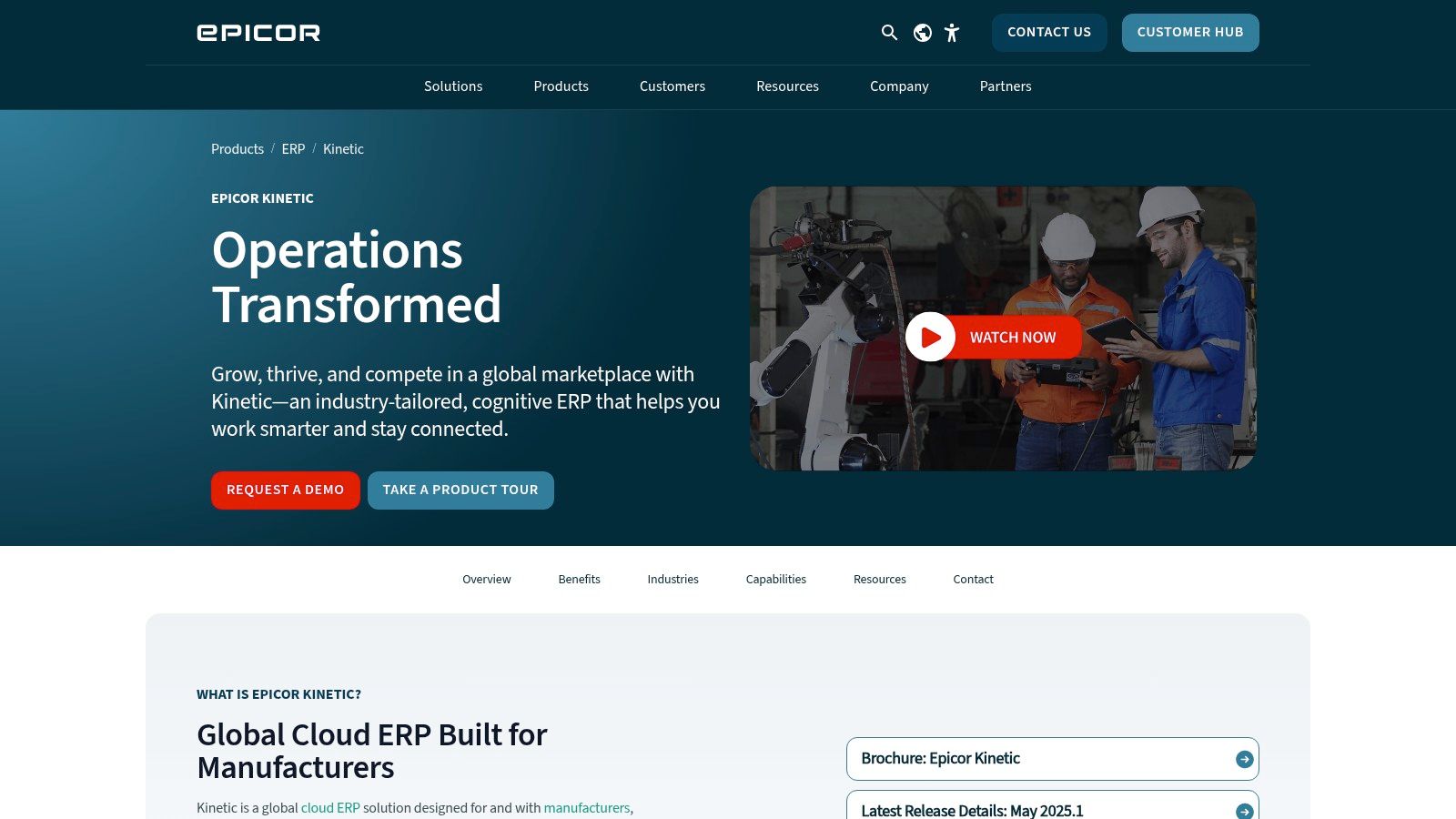
What’s really handy is its local ANZ presence. You get access to local support teams and resources who understand our market, which can make a world of difference during setup and beyond. The platform itself feels modern and is designed to be configured rather than heavily customised, which is a good balance between flexibility and keeping things standard. Its built-in analytics also mean you can get real-time insights into your operations without having to buy yet another system. It’s a rock-solid choice if you’re hunting for one of the best enterprise resource planning software solutions made for manufacturing.
Key Details & Considerations
- Best For: Mid-market discrete and make-to-order manufacturers in the AU/NZ region.
- Pricing: Quote-based. You’ll need to connect with Epicor or a local implementation partner.
- Pros: Deep manufacturing-specific features, strong local presence and support, and a modern cloud design.
- Cons: Pricing isn’t public, implementations are partner-led, and it’s less suited for non-manufacturing or service-based companies.
Website: https://www.epicor.com/en-au/products/enterprise-resource-planning-erp/kinetic/
7. Odoo (Open‑source ERP with Cloud plans)
Odoo completely flips the traditional ERP model on its head. It uses a modular, open-source approach that’s incredibly flexible. Instead of one giant, monolithic system, you pick and choose from a massive suite of integrated apps that cover everything from CRM and accounting to manufacturing and eCommerce. This makes it an amazing choice for businesses that want to start small, maybe with just one or two apps, and then scale up as they grow.
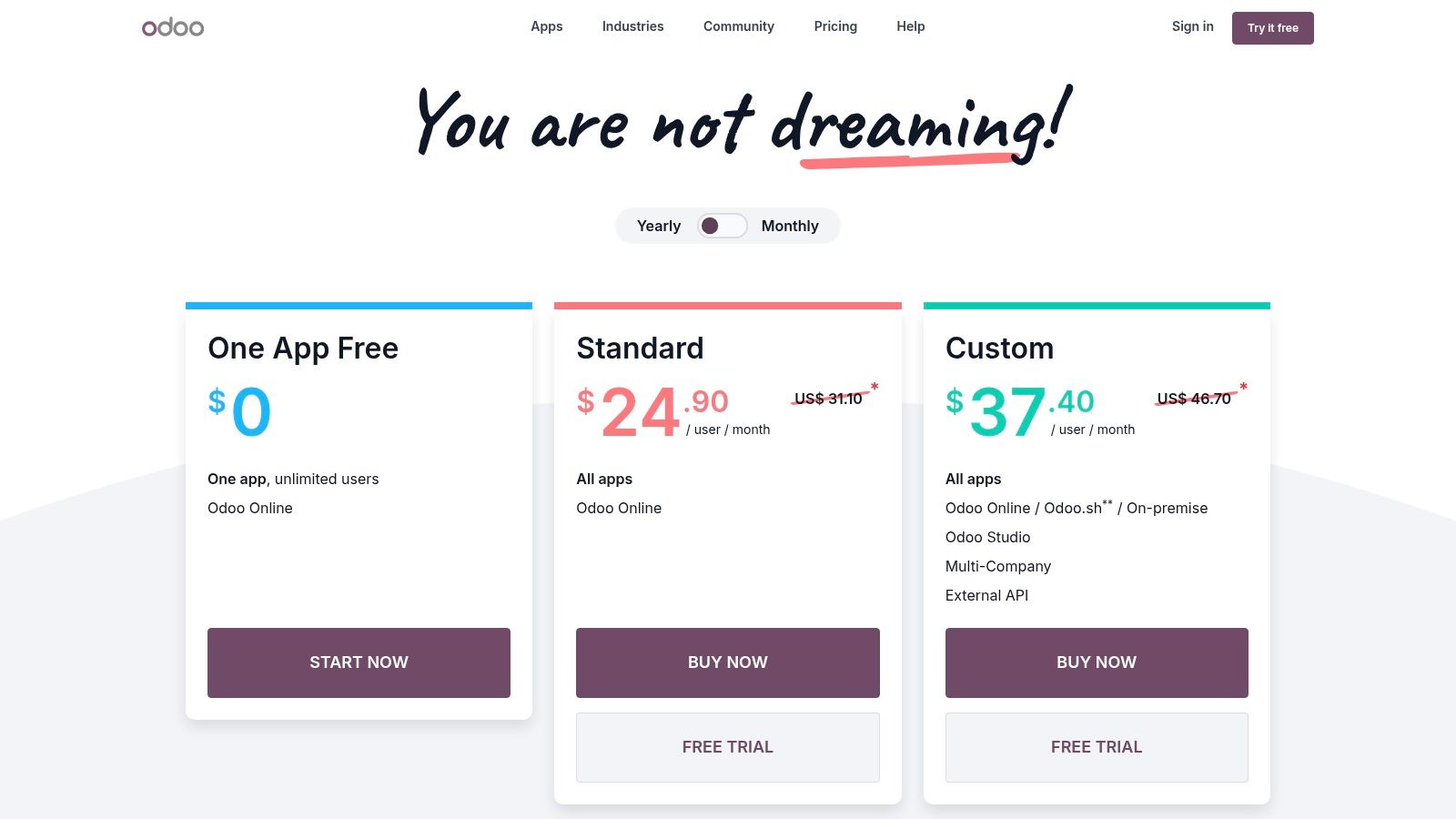
The real game-changer is how accessible it is. You can start with a single app for free. That’s almost unheard of in the enterprise software world. It lets you genuinely try it out without a big financial risk. From there, the pricing is transparent and per-user, so it’s predictable. Because it’s open-source, you have ultimate control to customise it if you have the tech skills, or you can lean on a network of local AU partners to handle the setup and any local tweaks. It’s one of the best enterprise resource planning software options for growing companies that value both affordability and control.
Key Details & Considerations
- Best For: Small to large businesses that want a highly customisable, modular ERP they can grow into over time.
- Pricing: Has a free one-app tier. Paid plans are priced clearly online, starting at a low per-user, per-month fee plus the cost of the apps you choose.
- Pros: Super affordable entry point and transparent pricing, incredibly flexible, and a huge app ecosystem for extensions.
- Cons: More complex setups will likely need help from a specialised partner, and some Aussie-specific features might need third-party add-ons.
Website: https://www.odoo.com/pricing
8. MYOB Acumatica (formerly MYOB Advanced) – Australia
For businesses in Australia and New Zealand, MYOB Acumatica is a very serious contender. It’s the powerful, globally-recognised Acumatica platform, but it’s localised and hosted right here in Australian data centres. That’s not a small detail; it’s a massive plus for any organisation worried about data sovereignty and local compliance. MYOB has tailored it for the ANZ market, building in deep Australian payroll and workforce compliance features from the start.
So what you’re getting is a modern, flexible system that covers everything from finance and inventory to projects and field service, all available through a clean interface and great mobile apps. The real strength here is the combination of a world-class platform with local expertise and support. It feels like it was purpose-built for our region, which is a huge comfort when you’re dealing with complex local regulations. This makes it a standout option for any mid-sized Aussie business looking for a powerful enterprise resource planning software solution that truly gets their specific needs.
Key Details & Considerations
- Best For: Mid-sized Australian and New Zealand businesses that need a cloud ERP with strong local compliance, hosting, and support.
- Pricing: Quote-based. Pricing varies by edition and user count and is usually provided through MYOB partners.
- Pros: Local Australian data hosting and support, covers a huge range of modules, and has a modern mobile-friendly interface.
- Cons: The price isn’t public, and the Australian release schedule can sometimes be a little behind the global Acumatica updates.
Website: https://www.myob.com/au/erp-software/products/myob-acumatica
9. TechnologyOne (Australia) – SaaS+ ERP
TechnologyOne is a massive Australian player, especially if you’re in government, education, or another industry with a lot of physical assets. Their big point of difference is what they call the “SaaS+” model. It’s not just about giving you the software; they bundle the entire delivery, ongoing management, and support into a single contract. This is designed to get rid of that classic finger-pointing between the software vendor, the implementation partner, and the support team. It’s one throat to choke, which can be a huge relief.
They lean heavily into pre-configured solutions for specific industries, like OneCouncil for local government and OneEducation for the education sector. This means you’re not starting from scratch; you’re getting a system that already understands your industry’s unique processes and compliance rules. For Australian organisations, having local data residency is a big tick for data sovereignty. With their new AI platform, PLUS, they’re also focused on embedding intelligence and speeding up implementation times, making it a really compelling local option if you want a streamlined, all-in-one experience.
Key Details & Considerations
- Best For: Australian/NZ government, education, and asset-heavy sectors wanting a single vendor for both software and implementation.
- Pricing: Quote-based. You’ll need to chat with their team for a detailed proposal.
- Pros: The vendor-led delivery reduces risk, they have a strong local presence and support, and it comes pre-configured for key public sectors.
- Cons: It’s highly focused on specific industries, so it’s less of a general-purpose ERP. Pricing isn’t transparent.
Website: https://www.technology1.com
10. Pronto Xi (Pronto Software, Australia)
Pronto Xi is a name that really means something to Australian businesses, and for good reason. It’s a locally developed ERP and analytics platform that’s been refined over 45 years to meet the specific needs of the Australian market. What makes it stand out is its deep, modular functionality combined with genuine local support. You’re not just buying software from an overseas company; you’re working with a team that gets the local landscape, from compliance rules to supply chain challenges.
The platform is modular, so you can tailor it to your industry, whether that’s manufacturing, distribution, retail, or service. It covers everything from finance to advanced inventory without feeling bloated. One of the most practical things they offer is industry-specific case studies and interactive demos. This gives you a real feel for how it would actually work in your business before you have to make a decision. For businesses where data sovereignty is a priority, the option for Australian data residency is a massive plus.
Key Details & Considerations
- Best For: Australian midmarket to large businesses in manufacturing, distribution, or retail looking for a proven, locally supported ERP.
- Pricing: Quote-based. You’ll need to contact Pronto Software directly for a tailored quote.
- Pros: Strong local references and direct vendor support in Australia, plus practical demos tailored to Aussie industries.
- Cons: Pricing isn’t transparent, and its ecosystem of third-party extensions is smaller than the global giants.
Website: https://www.pronto.net/
11. G2 – ERP Systems Category (comparison site)
Okay, so G2 is less of a single software solution and more of an essential tool for your research phase. Think of it as a compass for navigating the crowded ERP market. It’s a review and comparison platform that collects feedback from real, verified users. Instead of just listening to the marketing spiel, you can see what people in your shoes actually think. This is incredibly powerful when you’re trying to build a business case or just narrow down your shortlist.
Its real strength is the data. You can filter the best enterprise resource planning software by company size, industry, or region, and then use G2’s famous grid system to visually compare the leaders, contenders, and niche players. This helps you look beyond the usual big names and maybe find a solution that’s a much better fit for your specific needs. It’s a fantastic resource for checking if vendor claims hold up and getting a feel for things like ease of implementation and support quality.
Key Details & Considerations
- Best For: Teams that are in the discovery and validation stage of their ERP selection process.
- Pricing: Free to access reviews and comparison data.
- Pros: Access to thousands of verified user reviews, powerful filtering and comparison tools, and it helps you validate vendor claims with real feedback.
- Cons: The quality and number of reviews can vary a lot between products, and it’s a research tool, not a place to buy directly.
Website: https://www.g2.com/categories/erp-systems
12. AWS Marketplace – GROW with SAP on AWS (Marketplace access)
Now this is a bit different. For companies already heavily invested in the Amazon Web Services world, this isn’t a new ERP but a different, more streamlined way to buy one. The AWS Marketplace listing for GROW with SAP basically makes getting SAP’s powerful S/4HANA Cloud feel like just another part of your existing cloud setup. Instead of a totally separate buying process, you can handle it through a familiar marketplace, which can seriously simplify things.
The real advantage here is about aligning your money and your operations. For some customers, you can even use your existing AWS spending commitments towards your ERP purchase, which is a massive win for the finance team. You’re also getting a solution that’s ready to integrate with other AWS services, from AI models to data lakes. It’s a smart move for organisations looking to consolidate their cloud spending and tech stack, making this a unique way to get one of the best enterprise resource planning software solutions.
Key Details & Considerations
- Best For: Companies deep in the AWS ecosystem who want to streamline ERP purchasing and align it with their cloud strategy.
- Pricing: Quote-based. You buy it through the AWS Marketplace, but the commercial terms are still set by SAP.
- Pros: Streamlined purchasing through AWS, potential to use existing AWS spend commitments, and tighter integration with the AWS service portfolio.
- Cons: This is just a way to buy it, not implement it. You’ll still need a specialised partner for the complex ERP rollout, and marketplace listings can change.
Website: https://aws.amazon.com/marketplace
Top 12 ERP Systems: Side-by-Side Comparison
| Product | Core features | Target audience | Unique selling points | Implementation & UX | Price / Procurement |
|---|---|---|---|---|---|
| SAP S/4HANA Cloud, public edition (SAP) | End‑to‑end processes, embedded analytics, multi‑tenant public cloud, guided trials | Mid‑market & enterprise | Enterprise breadth, quarterly innovation, hyperscaler options (GROW) | Rapid standardized deployments, but partner‑led and complex | Subscription, quote‑based; available via SAP, partners, AWS Marketplace |
| Oracle NetSuite Australia | Modular ERP: financials, inventory, order mgmt, CRM, commerce; multi‑currency | Mid‑market to larger AU/NZ organisations | Mature cloud suite, strong local references, industry editions | Partner‑led implementations; demos/tours available | Annual subscription, quote‑based via sales/partners |
| Microsoft Dynamics 365 Business Central (AU) | Native M365 & Power Platform, AppSource add‑ons, 30‑day free trial | SMBs & mid‑market, Microsoft‑centric customers | Transparent AU pricing, free trial, fast time‑to‑value, Copilot integration | Often implemented via partners; tiered editions | Published AUD pricing online; purchased via channel partners |
| Sage X3 (Sage Australia) | Multi‑entity financials, manufacturing & distribution, cloud or on‑prem | Mid‑size manufacturers & distributors in AU | Flexible deployment options, local partner network | Implementation varies by scope; partner expertise recommended | Quote‑based pricing |
| Infor CloudSuite Industrial (SyteLine) (AU) | Advanced planning/scheduling, quality, multisite manufacturing, cloud/on‑prem | Discrete & process manufacturers | Strong shop‑floor to finance coverage; industry focus | Partner‑led; suited to manufacturers, less general ERP fit | Quote‑based pricing |
| Epicor Kinetic (Epicor ANZ) | Depth for discrete/make‑to‑order manufacturing, cloud‑first, embedded analytics | Mid‑market manufacturers in AU/NZ | Manufacturing pedigree, frequent releases, local resources | Partner‑led implementations; localized ANZ support | Quote‑based pricing |
| Odoo (Open‑source ERP with Cloud plans) | Modular apps (CRM, Accounting, MRP, eCommerce), open‑source, multi‑hosting | SMBs, startups, organisations needing high customization | Transparent online pricing, free one‑app tier, highly extensible | Easy to trial/roll out; complex setups benefit from partners | Online transparent pricing; free tier available |
| MYOB Acumatica (formerly MYOB Advanced) – Australia | Acumatica platform, AU hosting, payroll/compliance, mobile apps | ANZ businesses needing local payroll/compliance | Local data centres, AU payroll & compliance focus | Channel partner implementations; AU release cadence may lag | Partner‑provided quotes; hosted in AU |
| TechnologyOne (Australia) – SaaS+ ERP | SaaS+ (software + delivery), industry pre‑configs, local data residency, AI features | Government, education, asset‑intensive & corporate sectors | Vendor‑led delivery, reduced multi‑party risk, sector fit | Vendor‑led implementation/support; pre‑configured templates | Quote‑based proposals |
| Pronto Xi (Pronto Software, Australia) | Modular ERP (finance, distribution, manufacturing, retail), AU data residency | Australian mid‑market across industries | Longstanding local presence, direct vendor support, tailored demos | Local implementation and support; smaller ecosystem | Quote‑based pricing |
| G2 – ERP Systems Category (comparison site) | Crowdsourced reviews, product grids, filters, buyer guides | ERP buyers researching options, shortlisting teams | Peer validation, side‑by‑side comparisons, free access | Varies by product/region; review depth inconsistent | Free access; links to vendor trials/demos |
| AWS Marketplace – GROW with SAP on AWS (Marketplace access) | Marketplace procurement for GROW with SAP, AWS integration paths | Organisations buying SAP S/4HANA via AWS commitments | Streamlined procurement, align ERP spend with AWS credits | Easier onboarding via AWS, but implementation still partner‑managed | Marketplace procurement; terms vary, eligibility applies |
Making a Choice… and Making It Work
Right, so we’ve journeyed through the giants like SAP and Oracle, explored Australian powerhouses like TechnologyOne and Pronto Xi, and even looked at the flexible, open-source world of Odoo. That was a lot to take in. I get it. Your head is probably spinning with feature lists, pricing models, and implementation timelines.
The biggest takeaway shouldn’t be which software has the most features. Instead, it’s about realising there’s no single “best enterprise resource planning software” for everyone. It’s a myth. The real mission is finding the system that’s the best fit for your organisation, right here, right now. It’s like trying on a suit. A custom-tailored one will always feel and perform better than the most expensive one off the rack that doesn’t fit your shoulders.
So, how do you move from this long list to a short, actionable one? It comes down to asking the right questions.
Your Next Steps: From Reading to Doing
Forget the marketing slogans for a moment. It’s time for some honest self-reflection about your business. This is where the real decision-making begins.
- Map Your Real-World Workflows: Before you even book a demo, grab a whiteboard and physically map out your core processes. Where does an order start? How does it move through finance, into the warehouse, and out for delivery? Where are the bottlenecks? Seeing it visually will instantly highlight what your new ERP must be able to do.
- Prioritise Ruthlessly: You can’t have everything. What are the three to five absolute non-negotiables? Is it industry-specific compliance for your manufacturing business? Is it seamless multi-currency consolidation for your global operations? Be specific. This isn’t just about ‘better reporting’; it’s about ‘real-time inventory tracking across three warehouses to reduce stockouts by 15%’.
- Think About Your People: Who will be using this system every single day? Your tech-savvy finance team might love the complexity of SAP, but will your warehouse crew find its mobile interface clunky and slow? Adoption is everything. A powerful system that no one uses is just expensive, digital shelfware.
- Consider the Future… But Not Science Fiction: Where will your business be in five years? Ten? You need a platform that can scale with you. A system like NetSuite or Dynamics 365 might offer the flexibility to add new modules as you grow, which is a huge plus. But don’t over-invest in features you won’t need for a decade. Find the balance.
Choosing the software is genuinely just the first, and maybe even the easiest, part of the puzzle. The real challenge, and where the incredible value is unlocked, is in the implementation. It’s about making this powerful new system talk to all your other tools, automating the tedious manual tasks, and ultimately, freeing up your team to do the work that actually matters. This integration piece is where so many projects stumble, but it’s also where the biggest wins are hiding. It’s a significant journey, no doubt, but one that will fundamentally change the way your business operates for the better.
Feeling a bit overwhelmed by the integration and automation side of things? That’s completely normal, and it’s exactly where we can help. Osher Digital is an AI agency that specialises in connecting these complex systems and building the automated workflows that make your new ERP truly powerful. If you want to make sure your investment works for you from day one, let’s have a chat.
Jump to a section
Ready to streamline your operations?
Get in touch for a free consultation to see how we can streamline your operations and increase your productivity.