How to Make Cross Functional Team Collaboration Actually Work
Getting different teams to work together seems simple enough on paper, right? But the reality of cross-functional team collaboration is often just… messy. It’s the place where great ideas get bogged down by competing departmental priorities and unspoken frustrations. Why Getting Different Teams to Cooperate Is So Hard You’ve probably seen it firsthand. That sinking […]
By Matthew Clarkson · November 15, 2025

Getting different teams to work together seems simple enough on paper, right? But the reality of cross-functional team collaboration is often just… messy. It’s the place where great ideas get bogged down by competing departmental priorities and unspoken frustrations.
Why Getting Different Teams to Cooperate Is So Hard
You’ve probably seen it firsthand. That sinking feeling when you realise everyone is speaking a completely different language, even though you’re all supposed to be on the same project. It’s maddening.
Marketing might ask the engineering team for a ‘quick’ change to the website, not understanding it means unravelling a week’s worth of code. From their perspective, it’s a tiny tweak. But to the developers, it’s a massive distraction from a critical backend project. Suddenly, there’s tension.
Or maybe sales promises a major client a new feature to get the deal over the line. Great for them. But the product team only hears about it after the contract is signed. Now they’re left scrambling, trying to figure out how to build something that wasn’t even on the roadmap.
It’s not that people are actively trying to be difficult. I really don’t think they are. The real issue is that each team lives in its own world.
The Problem of Different Worlds
Every department operates with its own unique set of goals, pressures, and success metrics. It’s like they’re playing different sports on the same field.
- Sales is laser-focused on hitting quarterly revenue targets.
- Engineering is obsessed with building a stable, scalable product.
- Marketing is measured on generating leads and building brand awareness.
None of these goals are wrong, but they often pull in completely different directions. When each person is judged by their own department’s success, the collective project goal can easily get lost in the shuffle. It’s like three people trying to get to three different destinations in the same car… someone is bound to be unhappy with the route.
This disconnect is the single biggest reason collaboration efforts fail. It’s not a lack of talent or a lack of trying; it’s a fundamental misalignment of what ‘done’ and ‘successful’ actually mean to each group.
The Invisible Walls We Build
These separate goals create invisible walls. Silos. Inside each silo, teams develop their own jargon, processes, and ways of seeing problems. They become incredibly efficient at their specific function, which is great for the department but can be disastrous for the wider organisation.
This is where you see processes become rigid and resistant to change. Things like Lean Six Sigma are designed to break down these very inefficiencies. You can learn more about how to spot and remove these blockers by understanding the principles of Lean Six Sigma.
When you bring these teams together for a project, you aren’t just combining skill sets; you’re clashing entire cultures. This friction leads to misunderstandings, delays, and a whole lot of frustration. Before we can even start talking about solutions, we have to acknowledge this reality. We have to understand why we’re stuck before we can build a genuine path forward.
Laying the Groundwork for Real Collaboration
So, you’ve felt the pain of siloed teams and clashing priorities. You know something has to change, but where do you even begin?
Trying to force collaboration without a solid foundation is like building a house on sand. It’s a recipe for frustration and will likely collapse the moment you hit the first real disagreement. So let’s get the foundational pieces in place that make working together feel natural, not forced.
Start with One Shared Goal
The very first thing you need is a genuinely shared goal. And I’m not talking about some vague mission statement painted on the wall in the breakroom. I mean a crystal-clear, measurable objective that every single person, regardless of their department, can rally behind.
It has to be something that feels bigger than any individual’s KPIs. A goal so clear that when an engineer and a marketer are debating a feature, they can both point to it and ask, “Which path gets us there faster?” This becomes your North Star.
Creating this isn’t just a leadership task; it should be a collaborative effort. Get representatives from each function in a room and don’t leave until you have a single sentence that everyone agrees on. This simple act of co-creation is the first step in breaking down those walls. A leader’s playbook to breaking silos and aligning teams) can be a massive help here.
The following visual shows how unresolved departmental silos can escalate into conflict and, ultimately, lead to project failure.
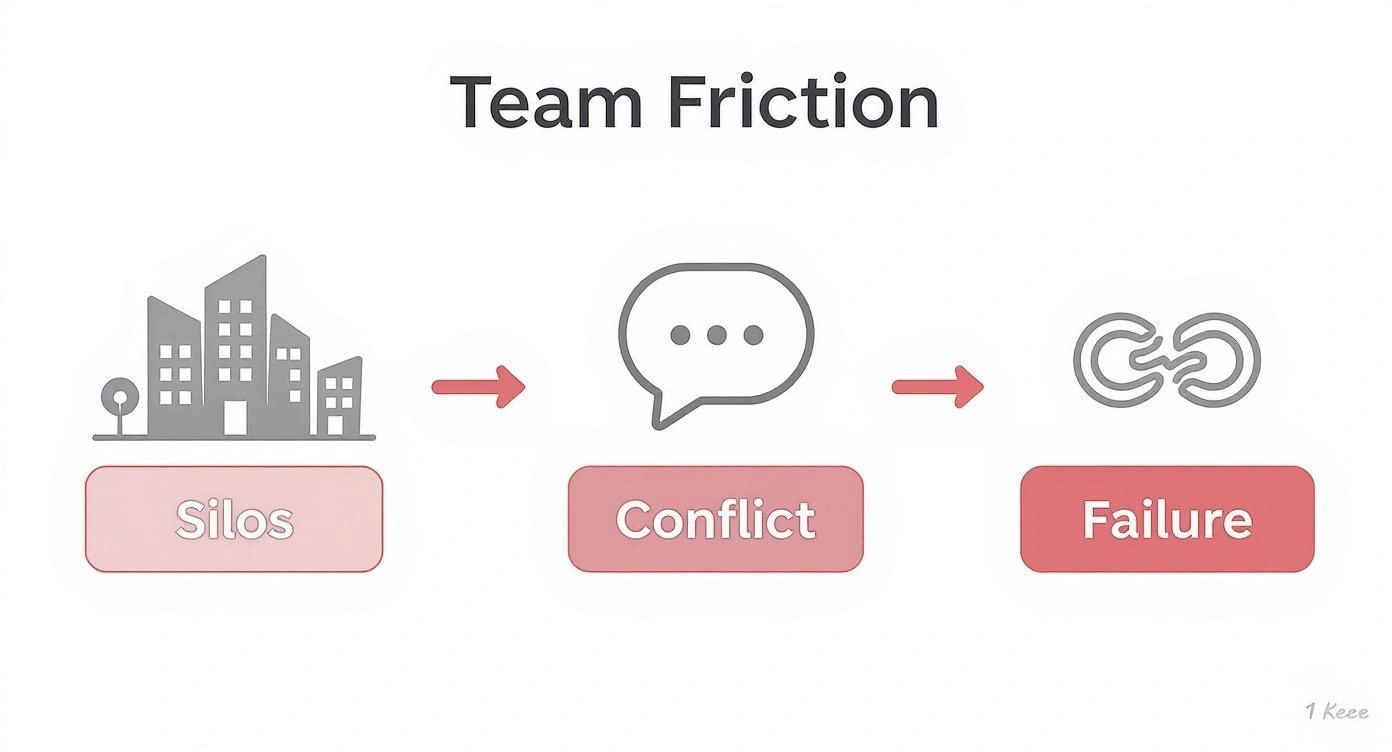
This simple flow demonstrates that silos aren’t a passive problem. They are the starting point for active dysfunction that can derail entire initiatives.
Get Brutally Clear on Roles
It’s amazing how much friction stems from simple confusion. One person thinks it’s their job to make the final call on copy, while someone else thinks it’s theirs. The result? Either two people do the same work, or worse, nobody does it because they assume the other has it covered.
You need to clarify who is responsible for what. This doesn’t have to be a massive, bureaucratic exercise. A simple chart or document will do the trick.
- Who is the Decider? For any key decision, who has the final say?
- Who is Responsible? Who is the person actually doing the work?
- Who needs to be Consulted? Whose valuable input should be heard before a decision is made?
- Who needs to be Informed? Who needs to know what’s happening after a decision has been made?
Defining these roles removes ambiguity and empowers people to act with confidence. It puts a stop to those endless meetings where no one is quite sure who is meant to be doing what.
This isn’t about creating rigid job descriptions. It’s about drawing a clear map so everyone knows how to navigate the project without bumping into each other.
Define Your Rules of Engagement
Finally, you need to agree on how you’re all going to work together. Think of it as a social contract for the team. A basic operating system for your collaboration.
Once again, co-create this. Get the team to answer a few key questions:
- How will we communicate? Is Slack the place for urgent questions? Are emails reserved for formal updates? Do we have a ‘no meetings on Fridays’ rule?
- How do we make decisions? Is it by consensus? Does one person have the final say after hearing everyone out? What’s the process for escalating a decision that’s stuck?
- How will we handle disagreements? Because they will happen. Agreeing upfront that it’s okay to disagree respectfully, and that all debates should tie back to the shared goal, is massive.
Documenting these simple rules provides a framework that makes everything smoother. You can check out our guide on process documentation best practices for tips on how to capture these agreements effectively. This isn’t about creating rigid corporate policy; it’s about having a simple playbook that everyone helped write.
Creating a Culture Where Collaboration Actually Thrives
This is the tricky part. The human bit. You can have the most brilliant strategy, the clearest goals, and the slickest project management software, but if the underlying culture isn’t right… well, collaboration will always feel like you’re trying to push a giant boulder uphill. It’s absolutely exhausting.

So how do you create an environment where people actually want to work together, instead of just tolerating it because they have to?
The Foundation of Trust: Psychological Safety
The biggest piece of this puzzle is what experts call psychological safety. It’s a term that gets thrown around a lot, but what does it really mean in practice?
Simply put, it’s the shared belief that you won’t be punished or humiliated for speaking up with ideas, questions, concerns, or mistakes. It’s the freedom to be human at work.
Think about it. How many times have you sat in a meeting with a half-formed idea but kept it to yourself, worried it might sound stupid? Or you spotted a potential flaw in a plan but stayed quiet because you didn’t want to be labelled as negative? That silence is the sound of psychological safety evaporating. And it kills innovation stone dead.
Creating this safety isn’t about being ‘nice’ or avoiding tough conversations. It’s about building enough trust that your team can have those tough conversations, challenge ideas, and take calculated risks without fear of personal fallout.
Leaders play a massive role here. You can build trust by admitting when you don’t have all the answers, by actively asking for dissenting opinions, and by framing mistakes not as failures, but as learning opportunities. When someone points out a flaw in your plan and your immediate response is, “That’s a great point, thank you for catching that,” you’re actively building a safer culture.
Walking in Someone Else’s Shoes
Another huge component of a collaborative culture is genuine empathy. It’s incredibly easy to get frustrated with another department when you don’t truly understand the pressures they’re under. The sales team might seem pushy, but maybe they’re facing immense pressure to hit a number that keeps the whole company afloat.
I once worked on a project where the engineering and marketing teams were constantly at odds. The engineers felt marketing was making impossible demands with no appreciation for the technical complexity. In return, marketing felt the engineers were slow and uncooperative. Classic.
We ran a simple exercise. We got them in a room and had each team map out their core process and list their top three pressures for the quarter. It was a revelation. For the first time, the engineers saw the lead generation targets marketing had to hit, and marketing saw the mountain of technical debt the engineers were wrestling with.
The tone in the room shifted immediately. From accusation to understanding. You can foster this kind of empathy too:
- Shadowing: Have a designer spend half a day with a customer support representative to hear firsthand what users are struggling with.
- “Day in the Life” Presentations: Ask each department to give a short, informal presentation on their biggest challenges and recent wins.
- Shared Metrics: Tie a small part of each team’s success metrics to the overarching project goal, making everyone genuinely invested in the collective outcome.
The goal isn’t for everyone to become an expert in everyone else’s job. It’s about building a real appreciation for the different challenges each person faces. That’s how you start to build bridges between those stubborn silos.
Celebrating and Learning Together
Finally, a culture of cross-functional team collaboration is strengthened by how you handle both wins and losses. When a project succeeds, it can’t just be a win for the product team. It has to be a win for everyone involved—from the salesperson who landed the initial client to the support team who handled the rollout.
Celebrate those shared wins publicly. Make a point to acknowledge every department’s contribution. This reinforces the core idea that you succeed together.
And when things go wrong? That’s even more important. Don’t let it devolve into a blame game. Conduct a blameless retrospective where the focus is squarely on the process, not the people. What can we learn? How can we adapt our approach so this doesn’t happen next time?
This approach transforms setbacks from sources of conflict into powerful opportunities to strengthen the team’s bonds and improve your collaborative muscle for the next big project.
This isn’t just theory; the data from Australian businesses backs it up. Teams that are intentional about planning and tracking their work across functions see tangible benefits.
Impact of Cross-Functional Planning on Team Performance
The following table highlights the significant performance improvements seen in Australian teams that effectively plan and track their work across different functions.
| Performance Metric | Likelihood of Improvement |
|---|---|
| Meeting project goals on time | 4.7x more likely |
| Feeling confident in team’s ability to hit goals | 3.8x more likely |
| Staying on budget | 2.5x more likely |
| Meeting customer expectations | 2.3x more likely |
As you can see, the rewards for getting this right are substantial. A structured approach to collaboration directly translates into better project outcomes, higher team morale, and happier customers.
Choosing Your Tools Without Adding to the Noise
Tools. They’re often sold as the silver bullet for every business problem, aren’t they? If communication is clunky, there’s an app for that. Project tracking a mess? Just subscribe to a new platform. Easy.
But you and I both know it’s rarely that simple. More often than not, throwing another piece of software into the mix just creates more digital noise. It becomes another login to remember, another notification to ignore, and another place where crucial information gets buried. The promise of clarity quickly turns into a digital mess.

This isn’t about creating a massive list of the trendiest apps. It’s about being intentional. Let’s focus on building a simple, connected toolkit that actually makes life easier, not more complicated.
The Three Pillars of a Solid Tool Stack
When it comes to cross-functional team collaboration , your needs generally boil down to three core functions. I like to think of them as the three legs of a stool… if one is missing or wobbly, the whole thing becomes unstable.
- A Central Hub for Work: This is your project’s single source of truth. It’s where tasks live, deadlines are set, and everyone can see progress at a glance. Think of platforms like Jira or Asana. Without this, you’re stuck in that endless loop of “Hey, what’s the status of that thing?” emails.
- A Space for Real-Time Conversation: This is for the quick, informal, and urgent stuff. It’s the digital equivalent of spinning your chair around to ask a colleague a quick question. Slack and Microsoft Teams own this space for a reason; they drastically cut down on email clutter for those fast-moving discussions.
- A Home for Shared Knowledge: This is your team’s collective brain. It’s where you document processes, store meeting notes, and house the ‘why’ behind your decisions. Tools like Notion or Confluence are perfect for this, creating a permanent, searchable library of information. Our guide on using Confluence for documentation has some practical tips for setting one up effectively.
The real magic isn’t in picking the ‘best’ tool in each category. It’s making sure they all talk to each other.
Integration Is Everything
A disconnected tool stack is just a fancier version of the departmental silos we’re trying to break down. The absolute key to a great toolkit is integration.
Picture this: a designer completes a mock-up and marks the task ‘Done’ in Asana. Instantly, a notification pops into the relevant Slack channel, letting the developer know the designs are ready. That same Asana task also links directly to the detailed project brief stored in Confluence. See? No duplicate work, no lost messages. Just a smooth, logical flow of information.
The goal is to create a seamless ecosystem where work flows from one place to the next without someone having to manually copy and paste updates. It’s about reducing friction, not just managing tasks.
When you’re evaluating your options, take some time to research the top remote team collaboration tools available that are built with these kinds of seamless workflows in mind.
This is more critical now than ever. The Australian collaboration software market is projected to hit AUD $257.61 million by 2025 , with a massive focus on tools that integrate smoothly with existing systems. Businesses are no longer just buying apps; they’re investing in connected ecosystems.
Don’t Forget Asynchronous Communication
Finally, a quick word on something that’s absolutely crucial for modern teams, especially those spread across different locations or schedules: asynchronous communication.
This simply means communication that doesn’t demand an immediate response. It’s about building a culture where it’s okay not to reply to a message within five minutes. Tools like Loom for recording quick video walkthroughs or detailed, well-structured documents in Notion are perfect for this.
It allows your team members to engage with information on their own terms, leading to more thoughtful responses and far fewer interruptions. It’s a sign of a mature, respectful collaborative culture. Your toolkit should support this, not fight against it.
Navigating Remote and Global Team Challenges
https://www.youtube.com/embed/Qgf8wr6E06Y?feature=oembed
Getting a cross-functional team collaborating in the same room is one challenge. But what happens when that ‘room’ is virtual, and your teammates are spread across Melbourne, Perth, and maybe even London? It’s the reality for so many of us in Australia now. And it adds a whole new layer of complexity to building effective teams.
Suddenly, you can’t just bump into a developer at the coffee machine to clarify a quick question. You can’t read the body language in a meeting to see if an idea is really landing. It forces a much more deliberate and thoughtful approach to connection.
And let’s be honest, the challenges run a lot deeper than just a dodgy Wi-Fi connection.
More Than Just Time Zones
Time zones are the obvious monster under the bed. It’s far too easy to schedule meetings that suit the head office, leaving colleagues in other regions to either wake up at dawn or log on when their family is sitting down for dinner. That’s a fast track to burnout and resentment.
But smart scheduling is just the start. The trickier challenges are the cultural ones that sneak up on you. A direct, straight-to-the-point comment that’s seen as efficient in one culture can come across as blunt or even rude in another. The friendly slang we use without a second thought in Australia might be completely confusing to a teammate overseas.
These aren’t small things. They’re the little grains of sand that can grind the gears of cross-functional team collaboration to a halt if you’re not paying attention.
It’s no surprise this has become a significant hurdle. A recent study found that 59% of Australian employees now work with international colleagues. The main friction points are exactly what you’d expect, but the numbers paint a clear picture.
Common Barriers in Global Collaboration for Australian Teams
For Australian teams working across borders, certain obstacles appear time and time again. The data below highlights the most significant challenges employees face when trying to connect and deliver work with their international counterparts.
| Challenge | Percentage of Employees Affected |
|---|---|
| Time Zone Differences | 44% |
| Language Barriers | 42% |
| Cultural Misunderstandings | 33% |
These statistics show that nearly half of all employees are grappling with fundamental logistical and communication issues. For a deeper dive, you can explore more insights on global team collaboration.
What’s really telling is that only 38% of teams consistently provide visual aids for non-native speakers, and just 36% of meeting speakers make an effort to slow down or avoid slang. We’re often creating these barriers without even realising it.
Building a Toolkit for Inclusive Collaboration
So, how do we fix this? It comes down to building a toolkit of inclusive practices that make everyone feel seen, heard, and valued, no matter where their desk is located.
It’s about being deliberate. Extremely deliberate.
- Over-communicate with clarity. When you lose the nuance of in-person conversation, you have to compensate with crystal-clear communication. Summarise key decisions in writing after a call. Use visual aids like flowcharts or mock-ups whenever you can to create a shared understanding that transcends language.
- Embrace asynchronous work. Not everything needs a real-time meeting. Encourage the team to use recorded video updates with tools like Loom, or create detailed documents that people can review on their own schedule. This respects different time zones and gives people the space for deep, focused work.
- Establish communication norms. Be explicit about your team’s communication expectations. For instance, create a “core hours” window where everyone is expected to be available for quick chats, but fiercely protect the time outside of that. This offers the flexibility people need while ensuring work keeps moving forward.
- Get curious about culture. Don’t just ignore cultural differences; learn about them. Take five minutes at the start of a call to ask about a public holiday in a colleague’s country. You have to actively create spaces for the informal, human connection that remote work can so easily strip away.
This isn’t about creating complicated new rules. It’s about cultivating awareness and empathy. It’s about recognising that when you’re working across distances, you have to consciously build the bridges that physical proximity once provided for free.
Maintaining Momentum for the Long Haul
So, you’ve done it. You’ve put in the hard work, navigated the tricky conversations, and your cross-functional team is finally humming along. It’s a great feeling, isn’t it?
But here’s the thing that trips up so many teams. How do you stop it all from slowly unravelling over the next three months? How do you keep this collaborative spirit alive when the next big project lands and everyone feels that familiar pull back towards their departmental silos?
Great collaboration isn’t a one-off project you can tick off a list. It’s more like a garden. It needs constant care and attention to thrive.
The Power of the Blame-Free Look Back
This is where the retrospective becomes your most valuable tool. And I’m not talking about another boring, soul-crushing meeting that could have been an email. A real retrospective is a dedicated, blame-free space for the team to pause and reflect on three simple but powerful questions:
- What’s working well for us?
- What’s getting in our way?
- What could we try differently next time?
This process is absolutely not about pointing fingers. It’s about putting the process under the microscope, not the people. Maybe your daily stand-ups are dragging on too long. Or maybe the way you’re flagging urgent tasks in your project management tool is creating more confusion than clarity. A good retrospective uncovers these little bits of friction before they turn into major roadblocks.
The goal is to create a continuous loop of feedback and improvement. It’s about embedding this habit into your team’s rhythm, so it becomes ‘just how we do things around here.’
Measuring What Really Matters
It’s also crucial to look beyond the obvious metrics like simply hitting deadlines. Of course, that’s important, but it doesn’t tell the whole story about your team’s collaborative health.
You need to ask deeper questions. Are people actively helping each other out, or is every task a rigid transaction? Is communication flowing freely, or are decisions constantly getting stuck in bottlenecks? These are the real indicators of true cross-functional team collaboration.
The impact of getting this right is huge. Research shows that when Australian teams align their work to shared goals, they are 6.4 times more likely to produce high-quality work and 4.9 times more likely to meet their deadlines. But here’s the kicker: only 16% of Australian workers feel fully engaged on the job. You can dive deeper by reading the full State of Teams report.
This data reveals a massive gap between potential and reality. Maintaining momentum is all about closing that gap, ensuring your team doesn’t just succeed once but gets stronger and more connected with every project they tackle. If you’re looking to embed these kinds of sustainable systems, a specialised AI agency can help automate and refine these complex workflows.
Of course, theory is one thing, but putting it all into practice is another. You’re bound to run into a few tricky situations when you start building cross-functional teams. It’s all part of the process.
Let’s walk through a couple of the questions that come up time and time again.
How Do You Handle Conflict Between Departments?
It’s inevitable. When you bring people together from different disciplines with different perspectives, disagreements are going to happen. The goal isn’t to stamp out conflict entirely—some of the best innovations are born from a bit of healthy debate. The trick is to manage it constructively.
First, always push for team members to try and resolve things directly, one-on-one. The golden rule here is to keep the focus on the task or the process, not the person. Frame it as “I see this problem differently” rather than “You’re wrong.”
If that direct approach doesn’t clear the air, it’s time for a neutral facilitator to step in. This is often the project lead, but it can be anyone who isn’t emotionally invested in a particular outcome. Their role is to steer the conversation back to the north star: the shared project goal. The ultimate tie-breaker should always be the question, “Which path gets us closer to our shared objective?” This simple question can defuse a personal battle and turn it back into a collaborative problem-solving session.
What Is the Ideal Size for a Cross-Functional Team?
While there’s no single perfect number, the ‘two-pizza rule’ popularised by Amazon’s Jeff Bezos is a brilliant starting point. If you can’t feed the entire team with two large pizzas, it’s probably too big.
In practice, this lands you in the sweet spot of 5 to 9 people.
Smaller teams are just more nimble. Communication is clearer, decisions happen faster, and everyone feels a stronger sense of personal ownership. Once you get into double digits, the communication lines get tangled, and it’s too easy for individual accountability to get lost in the crowd.
If you’re tackling a huge project that genuinely requires more people, resist the urge to create one massive team. A much better approach is to break the work down and form smaller, dedicated sub-teams that are responsible for specific streams and coordinate their efforts.
At Osher Digital , we specialise in creating the systems and automations that make complex collaboration feel simple. If you’re looking to embed these practices and remove operational friction, see how our AI agency can help build a more connected and efficient workflow for your teams.
Last updated on July 1, 2026
Continue Reading
View all
n8n Outlook Automation: Where the Node Stops and Graph Begins
n8n Outlook automation breaks in predictable places: subfolders, attachments, shifting email IDs, plus the Graph API workarounds we run in production.
Mar 16, 2026

What Is a Workflow? Definition, Parts, and What Breaks
A workflow is the repeatable set of steps that takes a task from start to finish. Here is what a workflow is made of, and the parts that quietly break.
Mar 1, 2026

Aussie Guide to Marketing Automation for Small Business
Imagine having an extra team member who works around the clock, remembers every customer's name and history, and never once asks for a day off. That is the real power of marketing automation, and it is a complete game changer for small businesses. At its core, marketing automation is just software designed to handle routine […]
Dec 11, 2025
Sick of reading about automation?
Book a free 15-minute intro call. We’ll talk through what you’re trying to automate and whether we’re a good fit.