A Simple Guide to Data Integration
Imagine your business data is a collection of puzzle pieces, but they’re all stored in different boxes. Your sales figures are in one box, customer feedback is in another, and your stock levels are tucked away in a third. Data integration is the art of bringing all those scattered pieces together to reveal the complete […]
By Matthew Clarkson · December 18, 2025

Imagine your business data is a collection of puzzle pieces, but they’re all stored in different boxes. Your sales figures are in one box, customer feedback is in another, and your stock levels are tucked away in a third. Data integration is the art of bringing all those scattered pieces together to reveal the complete picture of your business.
What Data Integration Really Means
Let’s use a simple analogy: your favourite local coffee shop. The till records every sale, a separate supplier system tracks coffee bean orders, and a loyalty app keeps tabs on your regular flat white. At the moment, this information lives in three separate places. Data integration is the technical bridge that connects them.
But it’s not just about dumping all the information into one massive spreadsheet. It’s about creating a conversation between these different systems so the data they share actually makes sense. When you get this right, you start to see powerful connections between parts of your business that were previously invisible.
For example, by linking sales and stock data, the coffee shop owner might discover that every time they run a special on croissants, their flat white sales jump by 15%. That’s a simple, actionable insight that would be completely lost if the data remained locked away in separate systems.
Why It Matters for Your Business
Connecting your data allows you to move from guesswork to informed strategy. Instead of making assumptions about what your customers want, you have cold, hard facts to guide your decisions. This capability is quickly becoming essential for Australian businesses aiming to stay competitive.
The momentum behind this shift is undeniable. The Australian data integration market was valued at USD 166.8 million in 2023 and is on track to hit USD 442.5 million by 2030. That dramatic growth isn’t just a number; it signals a fundamental change in how businesses operate. You can dive deeper into these figures in the full market analysis.
So, what does this look like in practice? Here are a few tangible benefits:
- A Complete Customer View: Linking sales data with your CRM or loyalty app gives you a 360-degree view of your customers. You can finally understand their buying habits, pinpoint your most valuable clients, and design offers they’ll genuinely respond to.
- Smarter Operations: When your stock system talks to your sales till, you can automate reordering. You’ll know to order more almond milk the moment stock gets low, preventing lost sales and keeping customers happy.
- Better Decision-Making: With all your data in one place, spotting trends becomes much easier. You might realise your busiest period isn’t the morning rush, but the mid-afternoon slump when everyone needs a caffeine hit to get through the day.
The ultimate goal of data integration is to establish a single source of truth. It ensures everyone in your organisation, from marketing to operations, is working from the same reliable and up-to-date information.
Ultimately, data integration transforms raw, fragmented information into a strategic asset. It provides the clarity you need to run your business more efficiently, understand your customers on a deeper level, and uncover new pathways for growth.
Common Ways to Bring Your Data Together
When you’re trying to bring all your data together, you have a few basic choices to make. Think of it like a chef deciding how to prepare a complex meal with ingredients from dozens of different suppliers. Do you prep everything carefully on the cutting board before it ever hits the pan? Or do you toss it all in and let the heat and a powerful blender do the heavy lifting?
This is the core difference between the two most common data integration methods: Extract, Transform, Load (ETL) and its modern cousin, Extract, Load, Transform (ELT). We’ll also look at the tempo of your data flow, whether you need a steady, scheduled delivery (batch processing) or a live, up-to-the-second feed (streaming).
This conceptual map gives you a high-level view of the journey your data takes, moving from raw sources, through the integration machinery, and finally emerging as valuable business insights.
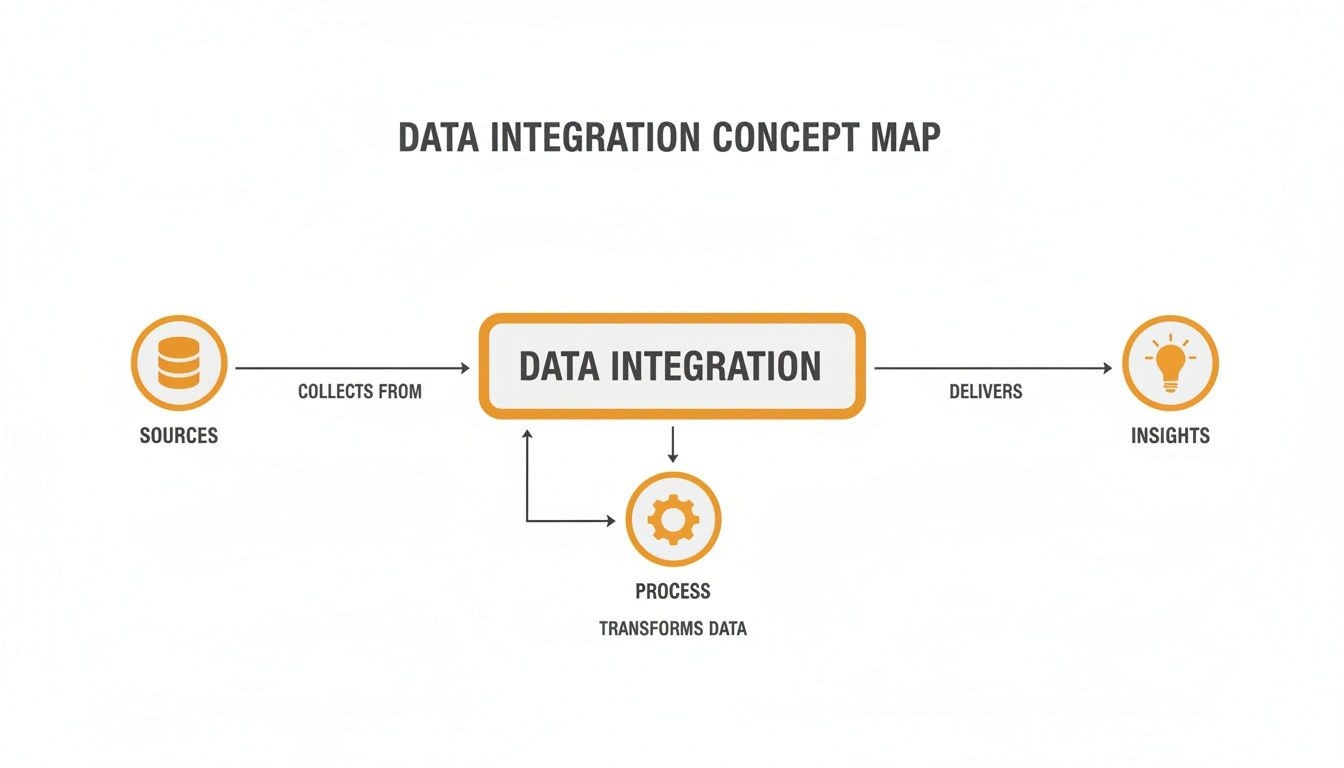
As the diagram shows, the goal is to create a seamless, well-oiled pipeline. The choices you make about how and when to process that data will define how efficient and effective that pipeline is.
ETL vs. ELT: The Two Main Recipes
The most foundational decision in data integration is choosing between ETL and ELT. They might sound similar, but the order of the steps makes a world of difference to your setup, costs, and capabilities.
With the traditional ETL approach, data is pulled from its source, cleaned and reshaped on a separate processing server (the “staging area”), and only then loaded into the destination data warehouse. It’s a very structured, deliberate process. You’re essentially doing all the prep work upfront to ensure only clean, standardised data lands in your pristine warehouse.
ELT , on the other hand, flips this on its head. It extracts the raw data and immediately loads it into a powerful, modern data warehouse. All the transformation, like the cleaning, joining, and structuring, happens inside the warehouse itself, using its massive processing power. This approach takes full advantage of the scalability of cloud data platforms like Snowflake or BigQuery.
To make it clearer, let’s break down the key differences.
ETL vs. ELT: A Simple Comparison
This table compares the two methods side-by-side, using our cooking analogy to keep things simple.
| Aspect | ETL (Prepare First, Then Cook) | ELT (Cook First, Prepare Later) |
|---|---|---|
| Transformation Location | Occurs in a separate staging server before loading. | Happens directly within the target data warehouse after loading. |
| Data Loaded | Only clean, transformed, and structured data enters the warehouse. | Raw, unstructured data is loaded first, offering more flexibility. |
| Warehouse’s Job | Primarily for storage and running queries on prepared data. | Acts as both the storage and the high-powered processing engine. |
| Best Suited For | Older systems, and compliance-heavy tasks where data needs pre-cleansing. | Big data, cloud environments, and when you need fast data ingestion. |
Ultimately, ETL is the classic, reliable method for structured data, while ELT is the agile, scalable choice for the modern cloud era.
Batch vs. Streaming: What’s Your Tempo?
Once you’ve settled on an ETL or ELT pattern, the next question is about timing. How often does your data need to move?
Batch processing is the traditional workhorse. It gathers data over a period, say, every hour or once a day, and moves it in large, scheduled chunks. Think of it as a daily delivery truck. It’s efficient, predictable, and great for non-urgent tasks like end-of-week sales reporting.
- Pros: Cost-effective, easier to manage, and simplifies error recovery.
- Cons: The built-in delay means insights are never real-time, which can be a dealbreaker for some situations.
Streaming , in contrast, processes data continuously, often within milliseconds of it being created. This is your live feed, essential for situations where immediacy is everything, like detecting fraudulent transactions or monitoring website activity.
- Pros: Provides real-time insights for immediate action.
- Cons: Can be more complex and expensive to build and maintain.
For a lot of businesses, the answer isn’t one or the other. It’s often a hybrid model: streaming for critical operational data and batch processing for historical analysis and reporting.
How to Choose the Right Approach
So, which path is right for you? Your decision should hinge on a few practical things: your data volume, your budget, your team’s skills, and, most importantly, how quickly your business needs answers.
- Go with ETL when you have heavy, complex transformations and need to ensure strict data quality and compliance before it enters your main analytics system.
- Opt for ELT if you’re working with a modern cloud data warehouse and want to get large volumes of raw data loaded quickly for flexible, on-the-fly analysis.
- Use batch processing for standard business intelligence, financial reporting, and any process where a few hours’ delay doesn’t hurt.
- Choose streaming when you need to power real-time dashboards, trigger instant alerts, or feed machine learning models with live data.
Building a robust data flow from scratch can be challenging. This practical guide on how to build a data pipeline provides a solid foundation, covering the essential steps for creating automated and scalable workflows for both batch and streaming scenarios.
And if you’re exploring specific tools for the job, you might be interested in our guide on data integration solutions to see which platforms align with your chosen strategy.
Next up, we’ll dive into another critical decision: should you build your own integration solution from the ground up or buy an off-the-shelf platform?
Choosing Your Path: In-House Build vs. Using a Platform
So, you’re ready to start connecting your data. You’ve hit a classic fork in the road: do you get your team to build a data integration solution from the ground up, or do you buy a ready-made platform? This is the timeless “build versus buy” dilemma, and there’s no single right answer. It all boils down to your company’s specific situation.
Think of it like getting a new house. Building it yourself means you get total control. Every room, every fixture, every detail is exactly where you want it. This custom approach gives you ultimate flexibility, which is perfect if you have very specific or unusual business needs.
On the flip side, buying a pre-built home is a whole lot faster. You can move in almost right away, and you don’t need to be an expert in architecture or construction. It’s a much more straightforward path to getting what you need, even if you have to live with a layout that isn’t a one-hundred-percent perfect fit.
The Case for Building Your Own Solution
Going the in-house route is the path of maximum control. If your business deals with truly unique data sources, has complex security protocols, or relies on proprietary processes that off-the-shelf tools just can’t handle, a custom solution might be your only real option. It lets you create a system that fits your operations like a glove.
But this path demands a serious upfront investment in both time and talent. You’ll need a skilled team of developers and data engineers to design, build, test, and deploy the entire thing. The initial costs can be steep, and timelines have a nasty habit of stretching out longer than anyone expects.
And the work doesn’t stop once you go live. Ongoing maintenance, security updates, and bug fixes all land squarely on your team’s shoulders. As your business changes or new data sources pop up, your team will have to constantly adapt the system, adding to the long-term cost of ownership.
The Advantages of Using a Data Integration Platform
For most businesses, especially small to medium-sized ones, picking a data integration platform is the more practical choice. These platforms, often called Integration Platform as a Service (iPaaS), are built to do all the heavy lifting for you. It’s an approach that’s rapidly gaining traction. The global iPaaS market is tipped to grow from $12.87 billion in 2024 to a staggering $78.28 billion by 2032.
Here’s why so many companies go this way:
- Speed to Value: You can be up and running in days or weeks, not months or years. Most platforms offer pre-built connectors for hundreds of common applications, which cuts down setup time dramatically.
- Lower Initial Cost: A subscription model avoids the huge capital outlay needed for a custom build. It makes powerful data integration accessible without needing a massive upfront budget.
- Reduced Maintenance Burden: The platform provider handles all the updates, security patches, and backend maintenance. This frees up your team to focus on using the data, not managing the plumbing.
- Effortless Scalability: As your data volumes grow, a good cloud-based platform will scale right along with you. You won’t have to worry about outgrowing your infrastructure.
The real value of a platform is that it makes data integration accessible to everyone. It gives organisations without massive IT teams or specialised engineers the ability to achieve the same sophisticated outcomes as large enterprises.
Of course, there’s a trade-off. You’re working within the platform’s framework. While the best ones are highly configurable, you might hit a wall if you have extremely niche requirements. If you’re exploring what’s possible with a data platform, check out a success story involving time series data with Snowflake for a little inspiration.
Ultimately, the decision comes down to balancing control with convenience. If you need a fast, reliable, and cost-effective way to integrate standard business applications, a platform is almost always the better choice. But if your needs are so unique that no existing tool can meet them, and you have the resources to back it up, a custom build might be the only way to go.
How Data Integration Delivers Real-World Results
So far, we’ve talked a lot about the technical side of things. But what does data integration actually do for a business? In simple terms, it’s the engine that turns raw, disconnected data into genuine strategic insights. It helps Australian organisations solve complex problems, find efficiencies, and create real value for their communities.
Think of it as connecting a series of dots that have always existed but were never joined. Once you link them, a clear picture finally emerges, revealing patterns and opportunities that were completely hidden before. This ability to see the whole story is the foundation of smarter, data-informed decision-making.
From Public Policy to Public Transport
The applications are everywhere, often working quietly behind the scenes to improve our daily lives. From shaping federal policy to managing local services, data integration gives Australian organisations the complete picture they need to make better choices.
The Australian Bureau of Statistics (ABS), for example, is a leader in this space. One of their standout projects involves building an agricultural microdata asset by combining information from levy payer registers with labour, demographic, and economic data. This unified view helps policymakers understand and support farm viability, especially in the face of challenges like climate change. You can see more of their work on the ABS data integration project register.
The impact is just as powerful on a local level. Let’s say a city council is trying to manage traffic during a major sporting event. By itself, live traffic data is helpful, but it doesn’t provide the full context.
Data integration allows the council to merge this live feed with other critical information, like public transport timetables, ride-sharing demand, and even the weather forecast. Suddenly, they can anticipate bottlenecks before they happen and proactively adjust traffic light timing or reroute buses to keep the city moving.
Improving Health and Retail Outcomes
The benefits of a connected data strategy cut across every sector, from critical healthcare services to the fast-paced world of retail. In every case, linking information from different systems opens up opportunities to boost efficiency, minimise risk, and deliver better experiences.
Here are a few practical examples:
- In a Hospital: A hospital can integrate its patient records system with the pharmacy’s dispensing data. This simple link can automatically flag potential drug interactions or incorrect dosages, creating a vital safety net that prevents harmful medication errors.
- For an Online Retailer: An e-commerce business can connect its website analytics with its inventory system and customer support chat logs. This helps them understand not just what people are buying, but why they might be abandoning their carts. They might discover a confusing checkout step or learn that a popular item is always out of stock.
- In Financial Services: A bank can integrate transaction data with its customer relationship management (CRM) system. This combination allows them to spot unusual spending patterns that could signal fraud, alerting customers in real time to prevent financial loss.
Each of these scenarios shows that data integration isn’t just a technical task. It’s a strategic capability that provides the clarity needed to operate more effectively. If you’re ready to start connecting the dots in your own organisation, our team of AI consultants can help you build a roadmap for success.
Keeping Your Connected Data Safe and Reliable
Bringing all your business data together is a powerful move. But it’s also a bit like putting all your most valuable assets into a single, high-tech vault. The potential is enormous, but so are the responsibilities. Once everything is in one place, you absolutely must ensure it’s secure, trustworthy, and handled correctly.

In the world of data integration, this boils down to three non-negotiable pillars: data quality , security , and compliance. Getting these right isn’t just a technical box-ticking exercise. It’s the foundation for building a data asset you can actually rely on to make critical business decisions.
Why Data Quality Is Your Most Important Ingredient
Think of your data as the ingredients for a meal. If you start with fresh, high-quality produce, you’re well on your way to creating something fantastic. But if your ingredients are stale, incomplete, or just plain wrong, the final dish will be a letdown, no matter how skilled the chef.
The same principle applies directly to business data. If the data you’ve worked so hard to integrate is messy, riddled with errors, or out of date, any insight you try to extract will be flawed. It’s the classic computing dilemma: “garbage in, garbage out.”
Poor data quality is one of the biggest reasons data integration projects fail to deliver on their promise. It undermines trust and can lead to costly mistakes based on faulty conclusions.
Maintaining high standards is an ongoing commitment. You can explore the practical steps involved in our complete guide to data quality management.
Securing Your Centralised Data Hub
Once you bring all that valuable data together, you’ve essentially created a central treasure chest. This unified hub is incredibly powerful for analysis, but it also becomes a prime target for threats. This makes robust security an absolute necessity, not an afterthought.
Securing your integrated data requires a multi-layered approach:
- Access Control: This is about defining who gets to see what. Your sales team, for example, needs access to customer data but should have no business seeing sensitive payroll records. It’s about granting permissions on a need-to-know basis.
- Encryption: Think of this as scrambling your data into an unreadable code that can only be unlocked with a specific key. Data must be encrypted both when it’s being stored ( at rest ) and when it’s moving between systems ( in transit ).
- Regular Audits: You need to periodically check who is accessing what data. This helps you spot unusual activity and ensures your security policies are actually being followed.
Staying on the Right Side of the Rules
Compliance simply means playing by the rules set by governments and industry bodies. When you centralise data, especially personal customer information, you take on a serious obligation to adhere to strict regulations.
In Australia, the key framework is the Australian Privacy Principles (APPs), which dictate how businesses must handle personal information. Any data integration strategy has to be designed from the ground up to respect these principles, covering everything from collection and use to storage and disclosure.
On top of this, new compliance drivers are always emerging. For example, ESG compliance is now a major focus, with over 6,000 Australian entities facing new obligations to report on climate-related financial data. This is forcing companies to unify data from operations, supply chains, and finance just to meet these new standards.
Failing to meet these obligations can lead to heavy fines and, perhaps more damagingly, a severe loss of customer trust. Getting this right is complex, and it’s where real expertise makes a difference.
Your Roadmap to a Successful Data Integration Project
https://www.youtube.com/embed/sEEKfCmRwoc?feature=oembed
Taking on a data integration project can feel like planning a major expedition. Without a clear map, you’re bound to get lost, burn through resources, and never reach your destination. This practical roadmap breaks the entire journey down into manageable stages, guiding you from a simple idea all the way to a successful launch.
And it all starts not with the technology, but with a simple question: what are you actually trying to accomplish?
The first, and most critical, step is to clearly define your business goals. Are you trying to get a 360-degree view of your customers? Or maybe you want to automate your stock reordering process. Pinpointing the specific business problem you’re trying to solve gives you a “why” that will steer every decision you make down the line.
Charting Your Course
Once you know where you’re headed, you need to map the terrain. This means getting a complete inventory of your data sources. Where does all your information currently live? Is it tucked away in a modern cloud app, a legacy on-premise database, or scattered across dozens of spreadsheets?
This discovery phase is absolutely crucial for understanding the real scope of your project. It helps you identify precisely what data you need and where to find it. Without this clarity, you’re essentially flying blind, just hoping you stumble across the right information by accident.
A classic misstep is jumping straight into choosing a tool without first understanding the business objective and the data landscape. A successful data integration project is 80% strategy and 20% technology. Get the strategy right, and you’re well on your way to delivering real value.
Choosing Your Vehicle and Starting Small
With your goals and data sources mapped out, now you can select the right tools for the job. Whether it’s a pre-built platform or a custom solution, the technology has to fit your specific needs, your budget, and the skills your team already has. This is a big decision, and a well-defined data migration strategy can provide invaluable insight into how to move and connect your information effectively.
Finally, fight the temptation to connect everything all at once. The most successful projects start small with a pilot. Pick just two or three data sources and connect them to solve one specific, high-impact problem. This approach lets you prove value quickly, learn important lessons on a much smaller scale, and build momentum for the bigger journey ahead.
If navigating this process seems daunting, expert guidance can make all the difference. Our specialist AI consultants can help you build the right strategy and steer your project to a successful outcome.
Frequently Asked Questions About Data Integration
Here are answers to some of the most common questions we hear about data integration, explained in a simple and direct way. We’ll skip the technical jargon and get straight to what you need to know.
What’s the Main Difference Between Data Integration and Data Migration?
This is a great question, and it’s easy to get the two mixed up.
Think of data migration like moving house. It’s a one-off project where you pack up everything from your old location and move it to a new one. Once you’re done, the old house is empty.
Data integration , on the other hand, is more like setting up a permanent mail-forwarding service from several different addresses to one central mailbox. It’s an ongoing, continuous process that syncs data from multiple sources into a single hub, giving you a live, unified view. The data also stays in its original location.
How Long Does a Data Integration Project Usually Take?
That’s a bit like asking, “How long does it take to build a house?” The honest answer is: it depends entirely on the scope and complexity. A straightforward project, like connecting two modern cloud-based tools, might only take a few weeks.
A common mistake is underestimating the complexity of older, legacy systems. Integrating these can significantly extend project timelines due to outdated technology and poor documentation.
But a large-scale enterprise project involving many disparate, older systems could easily take several months, or even over a year. The best approach is always to start small with a clear, achievable goal. This lets you score a quick win and demonstrate value before you tackle the bigger, hairier challenges.
Can Small Businesses Benefit from Data Integration?
Absolutely. Data integration isn’t just a game for large corporations with huge IT budgets anymore. The rise of affordable, user-friendly cloud tools has made it more accessible than ever for Australian businesses of all sizes.
For example, think about a small e-commerce store integrating its website data with its accounting software and email marketing tool.
- Financial Clarity: They can automatically see which products are most profitable without having to manually wrangle spreadsheets.
- Customer Insight: They can link purchase history to marketing engagement to really understand what makes their customers tick.
- Smarter Marketing: This insight allows them to send targeted, effective campaigns that actually get results.
Even a simple integration setup can provide a serious competitive edge, helping smaller businesses make smarter decisions and operate more efficiently.
At Osher Digital , we specialise in making complex data work for you. If you’re ready to connect your systems and unlock clearer insights, our team of expert AI consultants can help you build the perfect strategy for your business.
Last updated on July 1, 2026
Free tool · 2 minutes
Automation ROI Calculator
See what a manual process is really costing you, and the payback on automating it.
Continue Reading
View all
Customer Data Integration: Build a Unified View with Real-World Examples
Customer data integration is all about creating a single, trustworthy source of truth for every customer. It’s the process of pulling together information from all your scattered business systems, like your sales software, marketing platform, e-commerce site, and support desk, to build one complete picture. This makes sure everyone, from sales to support, is working […]
Dec 13, 2025

What is System Integration? A Quick Guide to Boosting Your Efficiency
System integration is all about connecting your different software and applications so they can share information and work together as one big, happy team. It’s about breaking down the digital walls between your departments so data can flow freely, automating tasks and making your whole business run a lot smoother. What is System Integration? I […]
Nov 15, 2025

What Is Data Integration
On the surface, “data integration” might sound like another bit of corporate jargon. A bit dry, right? But let’s cut through the noise and get to what it really means for you and your business. So What Is Data Integration? Think of it like trying to solve a puzzle where you’ve got pieces scattered everywhere. […]
Nov 11, 2025
Sick of reading about automation?
Book a free 15-minute intro call. We’ll talk through what you’re trying to automate and whether we’re a good fit.