Robotic Process Automation Solutions for a More Efficient Business
Imagine you have a new team member who loves doing all the boring, repetitive tasks you hate. They can copy-paste data, fill out forms, and run reports all day long. The best part? They work 24/7, never need a coffee break, and never make a single typo. That’s pretty much what robotic process automation is… […]
By Matthew Clarkson · December 13, 2025

Imagine you have a new team member who loves doing all the boring, repetitive tasks you hate. They can copy-paste data, fill out forms, and run reports all day long. The best part? They work 24/7, never need a coffee break, and never make a single typo. That’s pretty much what robotic process automation is… a digital assistant for your business.
What Are Robotic Process Automation Solutions?
Let’s get one thing straight. When we talk about robotic process automation, we aren’t talking about physical, clanking robots on a factory floor. We’re talking about smart software ‘bots’ that work right on your computer.

Think about how you’d train a new employee. You’d show them the ropes: log into this system, open that program, find this bit of information, copy it, and then paste it over here. An RPA bot learns the same way. You show it the exact, click-by-click process, and it will follow those steps perfectly, 24/7.
The real magic is that it uses your screen just like a person does. It clicks buttons, types into fields, and navigates menus. This is a huge advantage because it means these bots can work with almost any program you already have, including older software that doesn’t easily connect with anything else.
Breaking Down The Basics
At its heart, RPA is designed for tasks that are:
- Rule-Based: The process follows clear ‘if this, then that’ logic. There’s no need for guesswork or complicated decisions.
- Repetitive: These are the jobs you do over and over again, like generating daily reports or processing weekly invoices.
- High-Volume: The task happens often enough that getting a bot to do it frees up a serious amount of your team’s time.
The goal is simple: take the robot out of the human. By giving the boring, predictable work to a software bot, you let your team focus on what they do best: solving tricky problems, coming up with new ideas, and talking to customers.
The Growing Demand in Australia
This practical, no-fuss way of boosting efficiency is exactly why businesses across Australia are getting on board with RPA. The local market is growing fast. In fact, the Asia-Pacific region, including Australia, is expected to see its RPA market grow from USD 5 billion in 2025 to almost USD 31 billion by 2030. It’s all driven by the constant need to work smarter and cut costs.
The technology is also getting easier to use, especially with cloud-based solutions that lower the setup cost for businesses of all sizes. For a deeper dive into the mechanics, have a look at our guide on what is robotic process automation. To get a broader perspective on the field from an industry leader, check out these insights from Richtech Robotics’ President.
How RPA Delivers Real Business Value
It’s easy to get lost in the tech talk about robotic process automation solutions, but what really matters is the real value they bring to a business. We’re not talking about fancy tech for its own sake. We’re talking about what it actually does for your bottom line, your team’s happiness, and your customers’ experience. At its core, RPA is a simple trade: swapping repetitive human effort for smart, automated accuracy.

Think about a routine task your team does hundreds of times a week, like processing supplier invoices. A person has to open an email, download a PDF, hunt for the key details, and then carefully type everything into your accounting system. It’s slow, boring work where a single typo can cause big problems later on. An RPA bot does the exact same thing, but it does it in seconds and without ever making a data entry mistake.
To see just how different the results are, let’s compare the two approaches side-by-side.
RPA Benefits Compared to Manual Processes
This table shows the clear difference in key business areas when tasks are managed by RPA solutions versus being handled by people.
| Business Metric | Manual Process | RPA Solution |
|---|---|---|
| Speed & Volume | Limited to human work hours and capacity. | 24/7 operation, handling huge volumes without getting tired. |
| Accuracy | Prone to human error (typos, missed details). | Near-perfect accuracy, with error rates often dropping to almost zero. |
| Cost Per Task | High; includes salary, benefits, and overheads. | Dramatically lower; bots cost a fraction of a full-time employee. |
| Audit & Compliance | Can be inconsistent; relies on manual record-keeping. | Creates a perfect, detailed log of every action for easy auditing. |
| Employee Focus | Staff are stuck on repetitive, low-value work. | Frees up staff to focus on strategic, creative, and customer-facing tasks. |
The table makes it clear. Shifting to an automated approach isn’t a minor tweak. It’s a major upgrade to how your business runs.
A Major Boost in Productivity and Savings
The first thing businesses notice is a big jump in productivity. When you pass the predictable, rules-based tasks to software bots, you instantly free up your people. They can stop being data entry clerks and start dedicating their time to what you actually hired them for: solving complex customer issues, building relationships, or thinking strategically about business growth.
This new efficiency leads directly to serious cost savings. You’re not just saving money on the hours previously spent on manual work. You’re also avoiding the expensive knock-on effects of human error, which can range from sending incorrect orders to facing compliance penalties.
RPA lets you achieve more with the team you already have. It’s not about replacing people. It’s about boosting their abilities and letting them focus on high-value work that drives the business forward.
For instance, a bot can process customer data updates around the clock, making sure your CRM is always current. This means your sales team has accurate information right when they need it, leading to better conversations and a smoother sales cycle. The value isn’t just in the time saved but in the improved quality of the work that follows.
Stronger Compliance and Data Accuracy
In many industries, following a process to the letter isn’t just good practice, it’s a legal requirement. RPA becomes a powerful friend for compliance because a bot will follow the rules you give it, every single time, without fail. This automatically creates a complete, auditable trail for every action it performs.
That same consistency also guarantees a much higher level of data accuracy across your entire business. When a bot copies and pastes information between systems, the risk of typos or missed fields drops to almost zero. Clean, reliable data is the foundation of good decision-making, and RPA helps you build that solid foundation.
Consider these improvements:
- Error Reduction: By automating data entry and transfers, businesses often see error rates fall by over 90% , preventing costly rework and customer frustration.
- Operational Speed: A software bot can perform tasks up to five times faster than a person, quickly clearing backlogs and speeding up processes like customer onboarding.
- Scalability: When business picks up, there’s no need to rush into hiring more staff for repetitive tasks. You can simply deploy more bots to handle the increased load instantly.
Ultimately, investing in RPA is a strategic move to build a more efficient, accurate, and scalable operation. If you’re wondering where the best opportunities lie in your business, our team of AI consultants can help you pinpoint them.
Practical RPA Examples in Australian Industries
Thinking about robotic process automation solutions can feel a bit abstract until you see it in action. So, let’s get practical and look at how Australian businesses, from small accounting firms to large companies, are already using this technology to solve everyday problems.
These aren’t futuristic ideas. They’re real-world applications happening right now. Seeing how others use RPA will help you spot exactly where a digital assistant could fit into your own business.
Taming the Financial Paper Trail
Finance and accounting departments are often buried under a mountain of repetitive, detail-heavy work. This makes them the perfect place to start with automation. Think of an RPA bot as the most organised bookkeeper you could hire, one who never gets tired of the same old tasks.
Take the daily flood of supplier invoices, for example. A bot can be trained to:
- Open the finance inbox and spot new invoice emails.
- Download the attached PDF or image file.
- Read the invoice to find key details like the vendor name, ABN, invoice number, due date, and total amount.
- Enter all this information perfectly into your accounting software, whether it’s Xero or MYOB.
- Flag any invoices that don’t match a purchase order, passing them to a human for review.
The same logic works for payroll, superannuation contributions, and even preparing the Business Activity Statement (BAS). A bot can pull the necessary data from different systems, run the calculations, and fill out the forms, leaving your team to handle the final check and lodgement.
In Australia, the financial sector has jumped on RPA. Over 60% of Australian financial institutions have adopted these solutions, driven by a $2.1 billion investment in automation technologies. It’s all about improving efficiency and meeting strict regulations from bodies like the ATO and APRA. You can explore more insights about RPA in Australian finance to see how deep this integration goes.
Supercharging Customer Service and Sales
Your customer service and sales teams are at their best when they’re building relationships, not getting bogged down in admin chores. RPA acts as their personal assistant, handling the background tasks so they can focus on what really matters: the customer.
A common headache is keeping the Customer Relationship Management (CRM) system updated. Instead of your sales team spending hours manually typing in notes and contact details, a bot can do it. For instance, a bot can read an enquiry email from your website, create a new lead in the CRM, and assign it to the right person. For more ideas on what’s possible, you can check out some other real-world robotic process automation examples.
Other powerful uses in this area include:
- Generating Sales Quotes: A salesperson enters a few key details into a form, and a bot instantly creates a professional quote document by pulling the latest pricing and product info.
- Handling Standard Enquiries: A bot can manage common questions like “What are your business hours?” or “Where is my order?” by accessing the right information and sending a prompt, accurate reply.
This doesn’t replace the human touch. It frees up more time for it. When your team isn’t drowning in admin, they have the space to provide thoughtful, high-quality service that builds real loyalty.
Unlocking Trapped Data in Older Systems
Many businesses rely on older, legacy software that still does its job but doesn’t connect easily with modern applications. This often creates frustrating data silos and forces staff into an endless cycle of copy-and-paste.
This is where RPA really shines. Because it interacts with a program’s screen just like a person does, it doesn’t need a modern API to get the job done. A bot can log into an old system, find the information it needs, copy it, and then paste it directly into a newer application, a spreadsheet, or a data warehouse. This ability to bridge the gap between old and new technology is a game-changer for data management, turning a common business weakness into a streamlined strength.
A Step-by-Step Roadmap to RPA Success
https://www.youtube.com/embed/9URSbTOE4YI?feature=oembed
Bringing robotic process automation solutions into your business isn’t a single task you can just tick off a list. It’s a journey. And like any worthwhile project, you need a solid plan to get it right from the beginning, avoiding common problems that can stop a project before it even gets going.
The whole journey starts with a simple but vital step: discovery. Think of this as looking for the low-hanging fruit. You’re hunting for those high-volume, mind-numbingly repetitive, and strictly rule-based processes. These are your perfect candidates for a first project because they deliver quick, measurable wins that build momentum and get everyone excited about what’s possible.
Once you’ve found your target, it’s time to move into design, development, and testing.
Charting Your Course From Idea to Launch
This is where the idea starts to take shape. The key here is not to try and do everything at once. A successful RPA rollout almost always begins with a small, manageable pilot project. This lets you prove the concept, iron out any kinks, and show real value to the wider business without needing a massive upfront investment.
The process usually unfolds in a few logical stages:
- Process Mapping: We need to document every single click, decision, and keystroke of the task. This detailed map is the blueprint the bot will follow, so being precise is everything.
- Bot Development: This is the hands-on part where the automation is actually built. A developer uses an RPA tool to essentially “teach” the bot the steps laid out in your process map.
- Rigorous Testing: Before a bot ever touches your live systems, it needs to be put through its paces in a safe, controlled environment. We have to be absolutely certain it can handle different situations and exceptions without causing problems.
Following this structured approach keeps the entire project manageable and predictable.
Think of your first RPA project like a test drive. You wouldn’t buy a car without taking it for a spin. A pilot project lets you see exactly how automation performs within your specific business processes and builds confidence before you commit to a larger rollout.
The following graphic shows a classic workflow where RPA connects key business functions like invoicing, CRM, and data management.
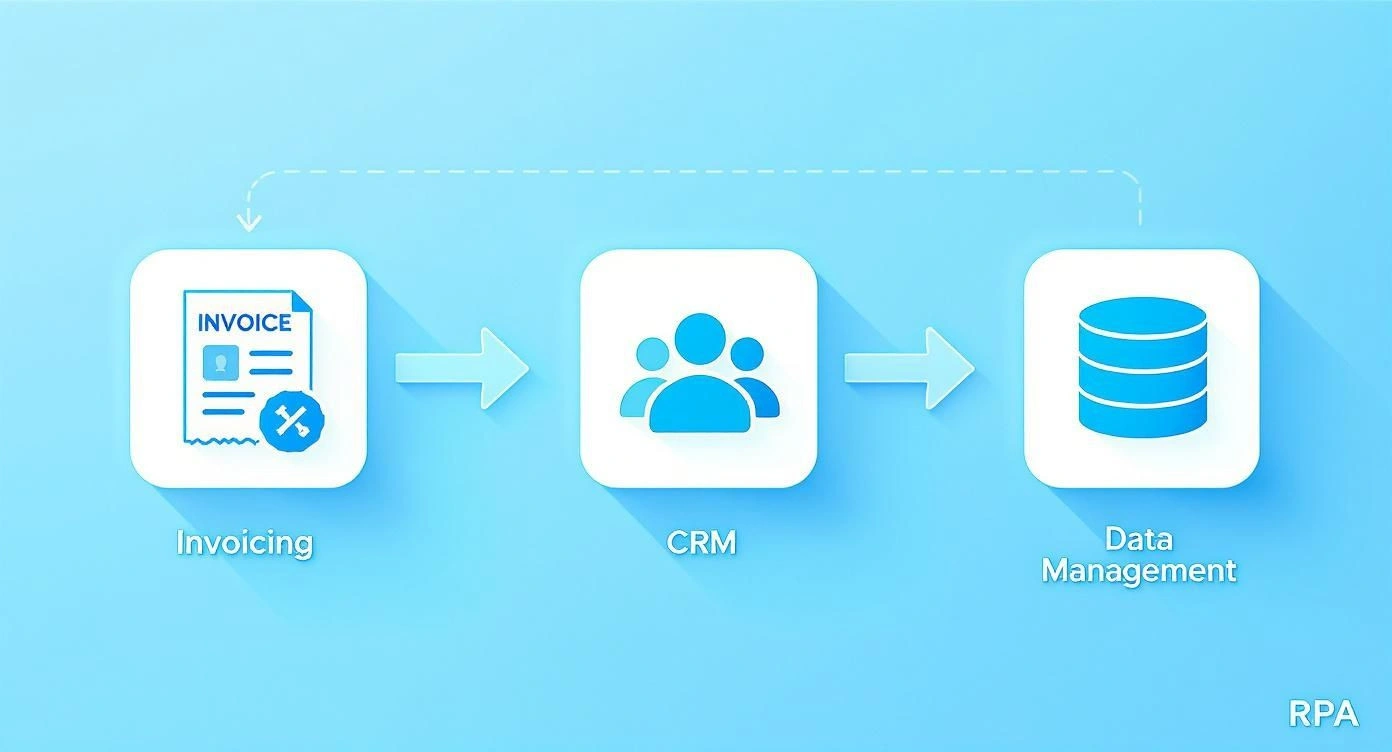
As you can see, the bot acts as a digital thread, smoothly passing information from one system to the next without a human ever having to step in.
Managing the Human Side of Automation
Of course, the technology is only half the battle. Just as important is getting your team on board. Words like “automation” can make people nervous, so clear and consistent communication is essential right from the start.
It’s all about how you frame it. You need to explain that the goal isn’t to replace people, but to free them from the most boring parts of their jobs. It’s about giving them a digital assistant so they can focus on the more interesting, strategic work that actually needs a human touch.
To make the transition a smooth one, focus on these areas:
- Open Communication: Keep everyone in the loop on what you’re doing, why you’re doing it, and how it will directly make their work better.
- Targeted Training: Provide training not just on how to work alongside the new bots, but also on the higher-value tasks they’ll now have the time to take on.
Getting this right is what turns a simple technology project into a real business success. When your team sees robotic process automation solutions as a tool that helps them win, you’ve built a powerful foundation for growth. If you need a hand defining this roadmap for your business, our team of AI consultants is here to guide you.
Pairing RPA with AI for Intelligent Automation
If robotic process automation solutions are the diligent ‘hands’ of your digital team, you can think of Artificial Intelligence (AI) as the ‘brain’. Standard RPA is brilliant at following a strict set of instructions, like a chef perfectly following a recipe. But what happens when the recipe calls for an ingredient you don’t have, or a customer asks for something unique? That’s where AI comes in.

When you combine RPA with AI skills like machine learning, you get what’s known as intelligent automation. This is where the real magic happens. Instead of just following rigid rules, your bots can start to handle messy, real-world information and make genuinely smart decisions.
This upgrade allows them to move far beyond simple, organised data. They can begin to understand the content and context of unstructured documents, think emails, contracts, or even customer feedback forms. That’s a massive leap forward.
From Doing to Thinking
The difference between standard RPA and intelligent automation is huge. A basic bot can copy data from a structured invoice into an accounting system. An AI-powered bot, on the other hand, can read that same invoice, understand that “Acme Co.” and “Acme Company Pty Ltd” are the same vendor, and even flag that a price seems unusually high based on previous invoices.
This combination of technologies allows businesses to automate entire, complex workflows rather than just single, separate tasks.
Intelligent automation is the next logical step in business efficiency. It’s about creating a digital workforce that can not only do tasks but also learn, adapt, and handle the kind of variety and judgement that used to be only for humans.
This evolution is a key driver of growth in the wider Australian robotics market. Valued at around USD 1.5 billion in 2024, the sector is projected to surge to USD 6.7 billion by 2033. This impressive expansion is happening across multiple industries, showing a clear trend towards more sophisticated automation. You can read the full research about Australia’s robotics market growth to see the scale of this shift.
Creating Custom Automation Solutions
This is where the true potential is unlocked. Off-the-shelf software is great, but every business has its own unique challenges and ways of working. With intelligent automation, you can build custom solutions specifically designed to solve your problems. Platforms like the Microsoft Power Platform provide a powerful foundation for building these tailored systems.
Just think about the possibilities:
- Predictive Maintenance: An AI model analyses data from machinery sensors and predicts when a part is likely to fail. It then triggers an RPA bot to automatically order a replacement and schedule a technician.
- Intelligent Document Processing: A bot can read through thousands of legal contracts to extract specific clauses, a task that would take a human team weeks to complete.
- Customer Sentiment Analysis: AI can analyse social media comments and customer support emails to gauge public feeling about your brand, with an RPA bot creating summary reports for the marketing team.
These aren’t just minor improvements. They represent a fundamental change in how work gets done. By combining the execution power of RPA with the thinking skills of AI, businesses can tackle problems that were previously too complex or too expensive to automate. For a deeper look at this synergy, explore our article on how AI and Robotic Process Automation work together.
Ultimately, this powerful pairing moves your business from simply automating repetitive tasks to creating intelligent, adaptive, and highly efficient operations. When you face a unique challenge that standard software can’t fix, our expert AI consultants can help design a custom automation solution that meets your exact needs.
Still Have Questions About Robotic Process Automation?
It’s completely normal to have a few questions when you’re thinking about bringing a technology like robotic process automation into your business. It’s a different way of thinking about work, so let’s tackle some of the most common queries we get from leaders just like you.
Think of this as a quick Q&A to help clear up any lingering doubts. We want you to feel confident about the path ahead.
Is RPA Going to Replace Our Employees?
This is probably the number one question we hear, and it’s a fair one. The short answer is no. In reality, RPA is here to get rid of the mind-numbing, repetitive parts of a job, the tasks that most people secretly (or not so secretly) hate doing.
By handing over the copy-paste and data entry work to bots, your team is freed up to focus on what humans do best: strategic thinking, creative problem-solving, and building real relationships with customers. It’s less about replacement and more about making your team better. You’re giving your staff a powerful digital assistant, which often leads to much higher job satisfaction and allows you to grow without just hiring more people for mundane tasks.
How Quickly Will We Actually See a Return on Our Investment?
The good news is that the payback period for RPA is often much faster than for other major tech projects. For straightforward automation, it’s not uncommon for businesses to see a positive return in just a few months.
This is because the wins are immediate and measurable: less time spent on a task, fewer human errors, and a big jump in productivity. The trick is to start smart. Pick a process with a clear, high-impact bottleneck to get that quick win.
For example, a great first project could be a bot that processes 500 invoices a week. The time your finance team gets back can justify the initial cost remarkably fast, often within the first quarter.
Seeing that rapid return builds serious momentum and makes it much easier to get support for expanding automation across the company.
We Have a Lot of Old, Clunky Software. Can RPA Still Work?
Absolutely. In fact, this is one of RPA’s superpowers. Traditional IT projects often get stuck trying to connect with older systems, which can be a nightmare. RPA, on the other hand, gets around that entire issue.
RPA bots work at the screen level, just like a person does. They click, type, and navigate through programs using the user interface. This means they can interact with almost anything, from old mainframe systems to clunky desktop software and modern web apps, all without needing expensive APIs or custom code. It’s a brilliant way to bridge the gap between your old and new systems.
What’s the Real Difference Between RPA and Other Kinds of Automation?
That’s an important distinction to make. While ‘automation’ is a general term, RPA is very specific. It’s all about copying human actions on a computer screen to carry out rule-based processes.
Other approaches, like workflow automation or direct API integrations, happen behind the scenes at a deeper software level. The beauty of RPA is its flexibility. It can work with any system, even those without an API. And when you blend it with AI, you get what we call ‘intelligent automation’, bots that can handle more complex tasks involving unstructured data and basic decision-making.
Here’s a simple breakdown:
- Robotic Process Automation (RPA): Think of it as a digital worker that follows a script, clicking and typing on the screen. It’s perfect for repetitive tasks and integrating with old software that has no other way to connect.
- API Integration: This is like a private, high-speed tunnel between two software systems. It’s incredibly fast and stable but requires both programs to have a modern API.
- Intelligent Automation (IA): This is RPA with a brain. It combines the ‘doing’ of RPA with the ‘thinking’ of AI, allowing it to read documents, understand context, and make simple judgments.
Knowing the difference helps you pick the right tool for the right job. The most effective robotic process automation solutions often use a smart mix of these approaches to get the best outcome for the business.
Ready to see what automation could look like in your organisation? The team at Osher Digital is here to help you pinpoint the best opportunities and map out a clear path to success. With our vendor-agnostic approach and 30-day satisfaction guarantee, you can be sure you’re getting the right solution for your business. Get in touch with our expert AI consultants today to start the conversation.
Last updated on July 1, 2026
Free tool · 2 minutes
Automation ROI Calculator
See what a manual process is really costing you, and the payback on automating it.
Continue Reading
View all
What Is Robotic Process Automation? A Simple Guide.
The term ‘Robotic Process Automation’ brings up images of actual robots wandering around the office, making coffee and delivering mail. The reality, thankfully, is a lot less dramatic and way more useful. So What Is Robotic Process Automation? Imagine you had a team of super-efficient digital assistants. Software ‘bots’ that live inside your computer systems. […]
Nov 22, 2025
RPA for Finance: Streamline Financial Operations in 2025
Discover how RPA for finance transforms operations. This guide explores use cases, ROI, and implementation steps for Australian financial teams.
Jul 24, 2025

Robotic Process Automation for Managed IT Services
Explore how Robotic Process Automation (RPA) is transforming managed IT services, improving efficiency, reducing errors, and enhancing customer satisfaction.
Sep 3, 2024
Sick of reading about automation?
Book a free 15-minute intro call. We’ll talk through what you’re trying to automate and whether we’re a good fit.