What Is AI Automation and How Does It Actually Work?
The term “automation” has been around for decades. But when we talk about AI automation, we’re talking about something fundamentally different. It’s not just about getting software to follow a script but about teaching it to think, learn, and adapt. Imagine it this way: traditional automation is like a basic calculator. It’s incredibly fast and […]
By Matthew Clarkson · January 5, 2026

The term “automation” has been around for decades. But when we talk about AI automation , we’re talking about something fundamentally different. It’s not just about getting software to follow a script but about teaching it to think, learn, and adapt.
Imagine it this way: traditional automation is like a basic calculator. It’s incredibly fast and accurate at performing the specific sums it was programmed for, but that’s where its usefulness ends. AI automation, on the other hand, is more like a seasoned financial advisor who can spot hidden trends in your data, forecast future outcomes, and even suggest new investment strategies you had not considered.
So What Is AI Automation, Really?
Imagine you run a busy café. Your trusty coffee machine is a perfect example of standard automation. You press a button, and it reliably brews the same espresso, every single time. It’s efficient, but it’s completely rigid.
Now, imagine you hire a master barista. This is not just someone who makes coffee. This barista notices when you’re running low on beans and automatically reorders from your supplier. They analyse daily sales data to suggest a new single-origin blend that customers are subtly asking for. They even adjust the brew time on a humid day to guarantee a perfect coffee.
That is the real difference. AI automation is not just about following rules. It uses intelligent technologies to learn from its environment, adapt to new information, and make independent decisions to handle complex jobs that always used to need a human in the loop.
AI automation combines the raw efficiency of traditional automation with the thinking and decision making power of artificial intelligence. It creates systems that can understand context, learn from new data, and get smarter over time, tackling complex challenges far beyond the scope of simple, rule-based tools.
Beyond Basic Instructions
Traditional automation is a workhorse for repetitive, predictable tasks. A simple script can copy data from one spreadsheet to another flawlessly, thousands of times a day. But the moment a column name changes or a new data format appears, the whole process grinds to a halt. It cannot think for itself.
AI automation thrives on that kind of variability. It’s designed to handle unstructured information and unexpected changes. For a great practical example, you can see how AI in Excel can automate tasks and provide smarter insights, moving way beyond simple formulas and macros.
This adaptability is fuelling its rapid growth. In fact, over 35% of Australian businesses had already adopted some form of AI or automation by 2024, with data entry and generative AI assistants leading the charge.
We have put together a simple table to make the distinction crystal clear.
Traditional Automation vs AI Automation at a Glance
This table compares the core differences between traditional rule-based automation and intelligent AI automation, helping you understand the leap in capability.
| Feature | Traditional Automation (like RPA) | AI Automation (with AI Agents) |
|---|---|---|
| Core Function | Follows pre-defined, static rules. “If this, then that.” | Learns from data, makes predictions, and adapts its actions. |
| Data Handling | Works with structured, predictable data (e.g., spreadsheets). | Can process unstructured data like emails, PDFs, and images. |
| Decision Making | No independent decision-making ability. | Makes context-aware decisions based on analysis and probability. |
| Adaptability | Brittle. Breaks when processes or inputs change. | Flexible and resilient. Can handle exceptions and new scenarios. |
| Example Task | Copying and pasting data between two known applications. | Reading a customer email, understanding its intent, and routing it to the correct department. |
As you can see, the shift is from simply doing a task to understanding and managing an entire process.
The Key Capabilities of AI Automation
So, what gives these systems their power? It really boils down to a few core abilities that mimic how humans think.
Here’s what that looks like in practice:
- Learning from Data: AI analyses past information to spot patterns and trends. This allows it to improve its performance over time without a developer needing to rewrite its code.
- Making Decisions: Instead of following a rigid script, AI can weigh up multiple factors to choose the best course of action, like prioritising an urgent customer support ticket over a routine one.
- Understanding Language: It can process and interpret human language using something called Natural Language Processing (NLP). This allows it to read emails, understand customer questions, and even generate human-like responses.
These are the building blocks that allow AI automation to move from just executing simple commands to orchestrating complex, end-to-end workflows.
How AI Automation Works Behind the Scenes
So, how does AI automation actually manage to think and act? To really get it, we need to look under the bonnet at the engine driving it all. The real magic happens with what are known as AI agents.
Forget thinking about software that just follows a rigid, pre-programmed script. An AI agent is more like a dedicated digital employee you can train for a specific role. Its whole purpose is to look at its environment, make sense of the information it gathers, and then take the right action to hit a specific goal.
A sales AI agent, for instance, will not just send a generic follow-up email on a schedule. It digs deeper. It analyses a customer’s past conversations, gauges the feeling in their replies, and then figures out the perfect time and message for the next touchpoint. It’s this ability to reason and act independently that really sets it apart.
The Core Ingredients of an AI Agent
These digital workers are built from a few key technologies that work together. Each one plays a vital part in giving the system its intelligence, allowing it to move beyond the simple, repetitive tasks of the past.
- Machine Learning (ML): This is the agent’s ability to learn from experience. Just as a new team member gets better at their job over time, ML algorithms allow the agent to sift through massive amounts of data, spot patterns, and fine-tune its performance without a developer needing to recode it for every new situation.
- Natural Language Processing (NLP): This is how the agent understands human language, the good, the bad, and the messy. NLP is what allows it to read a customer email, figure out if they’re thrilled or furious, and extract key details like an invoice number or a support request.
- Decision Logic: This is the brain of the operation. It’s the framework of rules and predictive models the agent uses to make choices. It takes what it has learned and understood, then decides on the best next move, like sending an urgent support ticket straight to a senior specialist.
The diagram below gives a great visual of how these components feed into each other in a continuous loop.
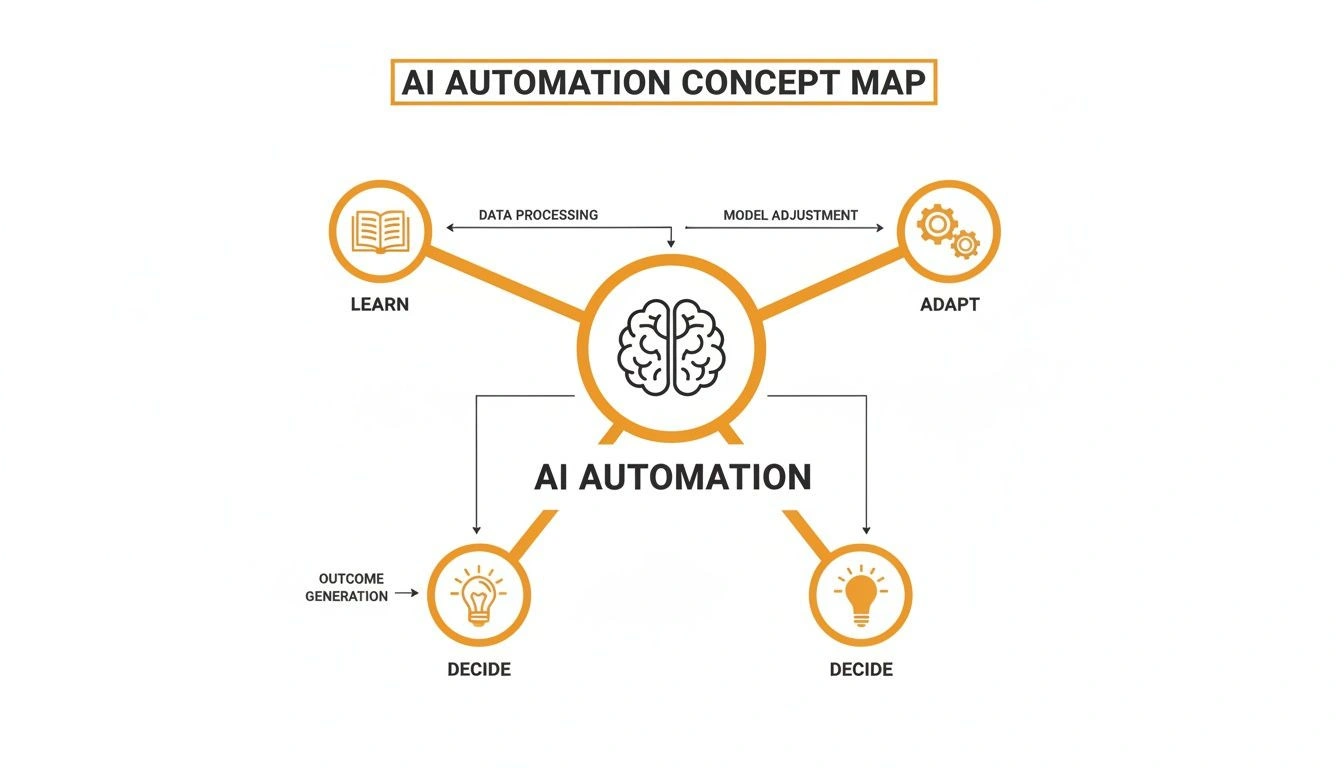
This cycle is fundamental to how AI automation operates. The system is always learning from new data, adapting its approach, and making smarter decisions to get the job done.
Putting It All Together in Practice
Let’s make this real. Imagine your finance team gets hundreds of supplier invoices a day, and each one looks slightly different. Traditional automation would likely fall over here, as it needs data to be in the exact same spot every single time. An AI agent, however, thrives on this kind of variety.
Here’s how the agent handles the problem on the fly:
- An Invoice Arrives: An email lands in the inbox with a PDF invoice attached.
- It Reads and Understands: Using NLP and computer vision, it reads the document, correctly identifying the supplier, invoice number, due date, and total amount, no matter where they are on the page.
- It Cross-Checks the Details: Next, it logs into your accounting system to check if the purchase order matches the invoice details.
- It Makes a Decision: If it all lines up, the agent approves the invoice for payment and archives the document. If there is a mismatch, it flags the invoice and sends an alert to a human team member, complete with a note explaining the problem.
This entire workflow is not just about ticking boxes. The AI agent is making small, intelligent judgements at every step, handling the kind of variability that would normally demand a person’s full attention.
While AI automation is a huge leap forward, it’s worth knowing how it relates to older technologies. You can see how it stacks up in our detailed comparison of AI and Robotic Process Automation.
This ability to deal with messy, unstructured, real-world information is the whole point. AI automation combines learning, language, and logic to create a flexible and powerful digital worker that can truly own complex business processes from beginning to end.
Real-World Examples of AI Automation in Action
Theory is one thing, but seeing what AI automation can do in the real world is where it all clicks. This is not some far-off concept anymore; businesses across Australia are already using these smart systems to solve everyday problems and get ahead.
This is not just a fleeting trend. Recent data shows that in the first half of 2025, Australian organisations saw a 119% surge in the creation of AI agents. These agents are taking on real work in sales, service, and customer interactions, proving their value day in and day out.
Even better, consumers interacting with them report 64% higher satisfaction , which shows just how effective they are. You can get more details on these agentic enterprise insights and see how they’re reshaping workflows.
Supercharging the Sales Team
Think about how much time your sales team spends just sorting through new leads. It’s crucial work, but it’s repetitive and pulls them away from what they do best: building relationships and closing deals.
This is a perfect job for an AI agent.
An AI-driven system can connect directly to your CRM and get to work the moment a new lead arrives. It does not just blindly assign it to the next person on the list. Instead, it reads the lead’s details, looks up their company to gauge its size, and even analyses their initial enquiry to understand their needs.
From there, the AI agent can:
- Qualify the lead by scoring its potential against your ideal customer profile.
- Draft a personalised outreach email that references the lead’s specific interests.
- Schedule a discovery call by checking the right salesperson’s calendar and offering available times.
This frees up your team to pour their energy into high-potential conversations, knowing the initial groundwork is being handled with speed and intelligence.
Making Marketing Budgets Smarter
Marketing is a game of constant adjustment. You launch campaigns across multiple platforms, but figuring out which ads are actually working and where to put your money is a massive challenge. AI automation turns this guesswork into a science.
Picture an AI system that monitors your campaign data in real time. It’s not just tracking clicks and conversions; it’s analysing deeper patterns, like which ad creative resonates most with a certain demographic or what time of day your ads perform best.
Instead of waiting for a weekly report to make decisions, the AI can automatically shift your ad spend throughout the day. If it notices one platform is delivering a better return, it will allocate more budget there, maximising your investment on the fly.
This means your marketing money is always working as hard as it possibly can, adapting to market signals in minutes rather than days.
Bringing Order to Finance
The finance department is often buried under a mountain of paperwork. Invoices, expense reports, and financial statements all require careful manual processing, which is slow and prone to human error. AI automation brings incredible accuracy and speed to these critical tasks.
Take invoice processing. An AI agent can read an invoice from a PDF, no matter the layout. It intelligently identifies the supplier, due date, and line items, then cross-references this with your purchase order system to check for discrepancies.
If everything matches up, it can approve the invoice for payment without anyone needing to lift a finger. This same intelligence can be applied to detect fraudulent transactions by spotting unusual patterns that a human might miss, protecting your business from costly threats.
Cleaning Up Data Warehousing
Good business decisions rely on good data. But in many organisations, that data is messy, inconsistent, and spread across different systems. This is where AI automation becomes the ultimate data steward.
An AI agent can be tasked with the never-ending job of cleaning and organising your information. It can:
- Merge duplicate customer records from your sales and support databases.
- Standardise addresses and company names to create a single, reliable source of truth.
- Identify and flag outdated or incomplete information for human review.
By automating this process, you ensure that your analytics and reports are always based on clean, accurate, and up-to-date information. This gives your leadership team the confidence to make strategic decisions based on what’s really happening, not just a messy approximation. To explore how this could work in your business, consider speaking with our team of AI consultants.
The True Business Benefits of Adopting AI Automation
Let’s cut through the hype. What real-world results can a business actually expect from AI automation? The answer is not just about saving a bit of time; it’s about building a more resilient, efficient, and intelligent operation from the ground up.
Think of it like this: your current processes are a fleet of delivery vans. They get the job done, sure. But AI automation is like upgrading to a fully integrated logistics network that predicts traffic, optimises routes in real time, and ensures every package arrives faster while using less fuel. It’s not just a small improvement, it’s a fundamental shift in what your business is capable of.

This shift is already creating tangible economic advantages. Here in Australia, the move towards AI is well underway, with AI-skilled workers commanding an average 56% wage premium in 2024. This is not just a random number; it shows how much value businesses are placing on these capabilities. Long-term modelling even predicts net job growth, driven by the productivity surge that AI brings. You can dive deeper into these economic benefits and technology investment trends to see the bigger picture.
Unlocking a Clear Return on Investment
At its core, AI automation delivers a powerful return on investment (ROI) by targeting the three biggest drains on any company’s resources: manual labour, costly errors, and inefficient processes. Every single repetitive task an AI agent takes over translates directly into cost savings.
This is not about replacing people; it’s about freeing them up to focus on the strategic work that genuinely grows the business. The financial upside is not just in the reduced wage bill for manual work, but in the increased value your expert staff can now create.
By automating high-volume, rule-based tasks, businesses can reallocate hundreds of employee hours each week from monotonous work to high-value activities like customer relationship building, strategic planning, and innovation.
Achieving Near-Perfect Accuracy
Humans are creative, strategic, and great at problem solving. What we are not built for is perfect, mind-numbing repetition. Fatigue and distraction inevitably lead to mistakes in tasks like data entry or invoice processing, and even small errors can have big financial consequences.
AI-driven systems, on the other hand, execute these tasks with almost flawless accuracy. An AI agent does not get tired or bored. It can process thousands of documents with a level of precision that a human team could never consistently match.
This translates into some serious benefits:
- Fewer Costly Mistakes: You’ll see a dramatic reduction in issues like incorrect billing, overpayments, or compliance slip-ups.
- More Reliable Data: Business intelligence and reporting become far more trustworthy when you know they’re based on clean, accurate data.
- Improved Customer Trust: Customers receive accurate invoices and consistent service every time, which builds real confidence in your brand.
Gaining Incredible Speed and Agility
One of the most immediate impacts of AI automation is the sheer speed it injects into your operations. Processes that once took your team days to wade through can now be completed in minutes.
Take closing the monthly financial books. Manually reconciling accounts and generating reports can easily turn into a week-long scramble. An AI system can pull data from all your sources, perform the reconciliations, and produce the final reports in a tiny fraction of that time.
This newfound speed translates directly into business agility. When you can execute faster, you can respond to market changes faster, onboard new clients more quickly, and scale your operations without the usual growing pains. In today’s market, this kind of agility is no longer just a nice to have; it’s a critical competitive advantage. If you want to explore how this might apply to your business, our team of AI consultants can help map out a plan.
Your Practical Roadmap to Implementing AI Automation
https://www.youtube.com/embed/KP0mMB77_bM?feature=oembed
Bringing AI automation into your organisation is not like flipping a switch. It’s more like building a custom piece of furniture. You need a clear plan, the right materials, and a step-by-step process to ensure the final product is sturdy, functional, and fits perfectly.
This is your practical roadmap for that journey. We will break down a complex project into manageable stages, helping you sidestep common risks and achieve the results you’re actually looking for.
Start with Discovery and Planning
Before you write a single line of code or sign up for any new software, you need to know exactly what you’re trying to fix. This is the discovery phase, and honestly, it’s the most important step of all.
Start by looking for the bottlenecks. Where do tasks get stuck? What repetitive work is burning out your best people? The prime candidates for AI automation are processes that are high-volume, rule-based, and frustratingly prone to human error.
Once you have a list of potential projects, prioritise them based on impact. Which one, if automated, would deliver the biggest bang for your buck? It could be freeing up your sales team from hours of data entry or dramatically speeding up your invoice processing. Pick one clear winner to start with; do not try to boil the ocean.
Focus on Clean Data and Solid Integration
Your AI system will only ever be as good as the data you feed it. Think of data as the fuel for your AI’s engine. If you put dirty, low-quality fuel in, you should not be surprised when you get poor performance.
This is why data preparation is so critical. You need to ensure the information your AI will learn from is clean, accurate, and accessible. This might involve a bit of a data clean-up project first, but it is time well spent.
Next, you have to think about integration. Your business already has systems it relies on, a CRM for sales, an ERP for finance. Your new AI solution needs to connect seamlessly with these existing tools. A successful AI and machine learning automation strategy always maps out how new tools will talk to old ones from the very beginning.
Test and Refine with a Pilot Plan
You would not launch a brand new product without testing it first, and the same logic applies to AI automation. A pilot project is your chance to test your solution in a controlled environment, learn what works, and make adjustments before rolling it out across the entire company.
A 30/60/90-day plan is a great way to structure this. It gives you a clear timeline with specific goals for each phase, helping you measure progress and prove the project’s value to key stakeholders.
The goal of a pilot is not just to see if the technology works. It’s to see how it works within your business, with your team, and with your unique processes. This is where you iron out the kinks and build the confidence needed for a wider launch.
Here’s a simple breakdown of what that might look like.
Sample 30/60/90-Day AI Automation Pilot Plan
A structured plan is the best way to guide your organisation through a successful pilot project, from the initial setup all the way through to measuring success and making the case for a full rollout.
| Phase | Key Actions | Success Metrics |
|---|---|---|
| First 30 Days | Finalise the project scope. Set up the technical environment. Begin training the AI model on a sample set of your data. | Project kick-off completed. AI model shows initial learning accuracy of 70% or higher. |
| Next 30 Days (60) | Run the AI automation in parallel with your current manual process. Have your team validate the AI’s outputs and provide feedback. | AI accuracy improves to 90% or higher. Team reports a 25% reduction in time spent on the manual task. |
| Final 30 Days (90) | Fully transition the pilot group to the AI-automated workflow. Document the process and gather final feedback and performance data. | The pilot process runs with 95%+ accuracy. A clear ROI is demonstrated through time savings and error reduction. |
This framework provides tangible milestones and keeps the project focused on delivering measurable outcomes, making it far easier to get buy-in for the next phase.
Choose Partners and Plan for Maintenance
Finally, remember that AI automation is not a “set and forget” project. It’s an ongoing commitment. The technology needs to be monitored, updated, and refined over time as your business evolves.
Choosing the right partner is a huge part of this. Look for experienced AI consultants who take the time to understand your business goals and can provide long-term support. They can help you navigate the complexities and ensure your investment continues to deliver real value for years to come.
Getting Started with Professional Guidance
Kicking off your AI automation journey can feel a bit like learning to sail. You know the destination is worth the effort, but navigating the complex winds, ropes, and charts is daunting at first. The good news is, you do not have to figure it all out alone.
The right partner acts as your seasoned captain, guiding you through the technical waters of choosing the right tech, integrating different systems, and managing organisational change. This kind of expert guidance is what ensures your automation strategy is actually aligned with your business goals, not just a tech project for tech’s sake.
Why a Partner Makes a Difference
Working with experienced professionals helps you sidestep the common pitfalls that trip up many businesses, leading to a much faster return on your investment. A good partner is not there to push a specific product; they’re focused on designing the best solution for your unique challenges, whether that means building custom AI agents or automating complex, multi-step workflows.
A dedicated AI partner bridges the gap between your business objectives and the technical execution. They translate your vision for efficiency into a practical, working solution that genuinely empowers your team.
For instance, an AI automation agency brings highly specialised skills to the table that are often missing in-house. They have the deep expertise to manage the entire lifecycle, from initial strategy and discovery right through to long-term maintenance and support, making sure your systems scale as your business grows.
If you are ready to explore how AI automation can unlock new levels of efficiency, consider speaking with our team of AI consultants.
Frequently Asked Questions About AI Automation
Even with a clear plan, it’s normal to have questions when you’re considering a big change to how your business runs. Let’s dig into some of the most common questions leaders have when they start exploring AI automation.
Think of this as the quick chat you have before kicking off a major project, just to make sure everyone’s on the same page.
Is AI Automation Only for Large Tech Companies?
Absolutely not. A few years ago, you could have made that argument, but today the tools are far more accessible and affordable. This is not just a game for the tech giants anymore.
We’re seeing businesses of all shapes and sizes, from manufacturing to professional services, use AI to solve real-world problems. The trick is to start small. Do not try to automate the entire company from day one.
The best approach is to pick one specific, high-impact process and prove the value there first. Maybe it’s automating how you handle supplier invoices or qualifying new sales leads. Once you see a clear return, you can expand from there.
This is about fixing a genuine business bottleneck, not just buying new tech for the sake of it.
Will AI Automation Replace Our Existing Staff?
This is probably the biggest question on everyone’s mind. The honest answer is that the most effective AI strategies are designed to boost your people, not replace them.
Think of it like this: AI is there to take on the tedious, repetitive tasks that burn out your team. This frees up your talented people to focus on the work that actually needs their creativity, strategic thinking, and human intuition.
For example, an AI agent can field the first wave of basic customer support queries. This allows your human team to dedicate their time to resolving the more complex and sensitive issues that truly define the customer experience. This shift often leads to higher job satisfaction and helps your team develop more valuable skills.
How Can We Start if Our Company Data Isn’t Perfect?
Welcome to the club. Almost no company has ‘perfect’ data, and that should not be a roadblock to getting started with AI automation.
Imagine you are about to start a project in a messy workshop. You do not need to make the entire space spotless; you just need to clear a small workbench and gather the specific tools you need for the first task.
The initial step in any good automation project is figuring out what data you actually need. An experienced partner can help you identify the right sources and create a plan to clean up just enough to get your first project humming. In many cases, the process of implementing AI ends up improving your data quality over time.
Ready to move past the questions and explore what a practical AI automation strategy could look like for your business? The team at Osher Digital can help. Our experienced AI consulting team can guide you through every step, from identifying the best opportunities to building and supporting a solution that delivers real results.
Last updated on July 1, 2026
Free tool · 3 minutes
AI Readiness Assessment
Score how ready your business is for AI in a few minutes, with tailored next steps.
Continue Reading
View all
AI Agency Software
We have productized our own internal AI agency software – administrate.dev
Jan 31, 2026

AI in Mining Uncovered: How Smart Tech Boosts Safety and Profit
Imagine having a partner for your operations team who never sleeps. A partner who can sift through endless streams of data from your drills, trucks, and sensors, spotting tiny clues that signal a million-dollar problem is just around the corner. That’s the real value of AI in mining. It is not about sci-fi robots; it […]
Jan 30, 2026
A Plain English Guide to AI in Logistics
Artificial intelligence in logistics is about giving your supply chain a brain. It is not about self-aware robots taking over the warehouse floor, but rather about using smart systems to make your entire operation more efficient, predictive, and resilient. Think of it as the ultimate co-pilot for your logistics team. It is an assistant that […]
Jan 22, 2026
Sick of reading about automation?
Book a free 15-minute intro call. We’ll talk through what you’re trying to automate and whether we’re a good fit.