What Is Business Process Automation? (A Simple Guide)
You’ve heard the term Business Process Automation (BPA) thrown around, right? It probably brings to mind crazy flowcharts and software that looks like it needs a PhD to operate. But if we just… strip all that jargon away, the idea is actually pretty simple. It’s about teaching technology to do the boring, repetitive parts of […]
By Matthew Clarkson · November 15, 2025

You’ve heard the term Business Process Automation (BPA) thrown around, right? It probably brings to mind crazy flowcharts and software that looks like it needs a PhD to operate. But if we just… strip all that jargon away, the idea is actually pretty simple.
It’s about teaching technology to do the boring, repetitive parts of your job. The stuff that makes your eyes glaze over. Think of it like a smart assistant for your entire business. One that doesn’t need coffee, never makes a typo, and follows the rules perfectly. Every. Single. Time.
What Is Business Process Automation?
Okay, let’s break it down over a virtual coffee. BPA is all about finding those predictable, rule-based jobs that clog up your team’s day and letting software take over. It uses tech to connect a bunch of steps in a process, moving work from one person to the next with almost no human nudging needed.
I remember working with this small logistics company. They were drowning in paperwork. No exaggeration. The operations manager spent half her day… maybe more… just manually matching invoices to delivery dockets. Then she had to punch that same data into three different spreadsheets. It was slow, it was painful, and one tiny typo could send a ripple of chaos through their whole week.
That’s the classic story, isn’t it? A good business, full of good people, being held back by a broken process. For them, automation wasn’t some flashy tech trend. It was a lifeline.
It’s More Than Just a Buzzword
So, what does business process automation actually look like day-to-day? It’s not about making one tiny task faster. Nope. It’s about stringing a whole bunch of tasks together into a smooth, flowing workflow. One that manages information and actions across different people and systems, all by itself.
Think about these common things you do:
- Onboarding a new employee: Sending the offer, getting their IT access sorted, scheduling orientation meetings.
- Processing a customer order: Taking the order, checking you’ve got the stock, creating an invoice, and getting it shipped.
- Managing expense claims: Someone submits a claim, it pings their manager for approval, then zips over to finance for payment.
These are all processes. And right now, you probably have people manually pushing each step along. BPA is about building a digital assembly line to handle that for you, making sure nothing gets lost or forgotten.
Business process automation is less about replacing people and more about replacing the soul-crushing parts of their jobs. It frees up human brains to do what they do best: think critically, solve complex problems, and build relationships.
This isn’t just a hunch. It’s a huge focus for Australian businesses. The local market for process automation pulled in over USD 1.7 billion recently and is on track to hit nearly USD 2.7 billion by 2030. This isn’t a fad. It’s a real shift in how we work. You can dig into the research about Australia’s automation market growth to see just how big this thing is.
A Quick Look at Manual vs Automated Tasks
To make this feel a bit more real, let’s compare the before and after. It’s usually in these small, daily grinds where automation brings the biggest sigh of relief.
| Business Task | The Manual Way Before BPA | The Automated Way With BPA |
|---|---|---|
| Invoice Processing | Manually typing data from a PDF invoice into your accounting software. Yawn. | Software automatically reads the PDF, grabs the data, and puts it in the system for you. |
| Customer Enquiries | A team member reads every single email, figures out who needs to see it, and forwards it on. | An automated system reads the email, spots keywords, and sends it to the right person. Instantly. |
| Generating Reports | Someone spends hours every week wrestling with different spreadsheets to build one report. | The system automatically pulls the data and emails the finished report every Monday at 9 am. Done. |
Seeing it laid out like that, it’s pretty clear, isn’t it? This isn’t about some distant sci-fi future. It’s about solving the very real, very frustrating things that slow you down today. It’s about giving your team—and your business—a bit of breathing room.
The Different Types of Automation Technology
Okay, so we’ve got the main idea of business process automation down: let tech handle the repetitive stuff. But how does it actually do that? It’s not just one magic tool.
It’s more like a builder’s toolbox. You wouldn’t use a sledgehammer to hang a photo, would you? Of course not. You need the right tool for the right job. Automation is exactly the same. Let’s open up that toolbox and see what’s inside.
Robotic Process Automation (RPA): The Meticulous Mimic
First up, we have Robotic Process Automation , or RPA. The name sounds a bit like something from a sci-fi movie, but it’s much more practical. The easiest way to think about RPA is as a digital team member that perfectly copies what a human does on a computer.
Imagine you’re showing a new starter how to do a very specific, click-by-click task. They open an app, copy some data from a spreadsheet, paste it into a form, click save. RPA ‘bots’ are programmed to do exactly that. The difference? They do it at lightning speed, 24/7, without a single typo… or a coffee break.
RPA is especially good for dealing with older systems that don’t have modern ways of connecting to other software. The bot just uses the screen and keyboard like a person would. It’s a bit like a highly trained parrot—it can repeat a sequence perfectly but doesn’t really understand why it’s doing it.
Workflow Engines: The Traffic Director
Next in the toolbox are workflow engines. If RPA bots are the diligent workers doing individual tasks, then workflow engines are the traffic directors, making sure everything flows smoothly from one step to the next.
These tools are all about managing the sequence of work. As soon as one task is finished, the workflow engine automatically sends it to the next person or system in the chain. An expense claim is a perfect example.
- An employee submits their expenses in a portal.
- The workflow engine instantly pings their manager for approval.
- Once the manager clicks ‘approve’, it’s automatically sent to the finance team for payment.
The engine handles all the passing back and forth, the reminders, and keeping track of where everything is. It’s the glue that stops complex processes from grinding to a halt because an important email got buried in someone’s inbox. There are some really powerful and customisable tools out there, including open-source workflow automation platforms like N8n, that are amazing at this sort of thing.
Workflow engines provide the big-picture structure, while other tools (like RPA) often do the individual tasks within that structure. They make sure the right work gets to the right place at the right time.
This coordination is so important. Without it, you just have little islands of automation that can’t talk to each other. Building bridges between them is a huge part of system integration. If you want to go a bit deeper on that, we’ve got a whole article explaining what system integration is and why it’s so critical for businesses today.
Artificial Intelligence (AI): The Creative Problem-Solver
And now for the big one: Artificial Intelligence (AI) and its cousin, machine learning. This is where automation stops just doing and starts thinking. If RPA is the parrot copying actions, AI is the creative problem-solver that can learn, adapt, and make judgments.
AI takes automation way beyond simple “if this happens, then do that” rules. It can handle jobs that need a bit of interpretation.
Instead of just following a strict script, AI-powered automation can:
- Understand messy data: It can read an email, a PDF invoice, or a customer support ticket and actually get the meaning.
- Make predictions: By looking at past data, AI can guess future sales trends or spot customers who might be thinking of leaving.
- Get smarter over time: The system learns from every interaction, constantly getting better at what it does.
So, where a basic bot might just forward every email with the word “invoice” to the accounts team, an AI system can do so much more. It can read the email, figure out if the customer is angry or just asking a question, pull out the key info, and decide if it’s an urgent problem or a standard notice. It’s a massive leap forward for automating those more complex, nuanced processes.
Why Australian Businesses Are Adopting Automation
So, let’s get down to it. It’s one thing to talk about clever tech, but it’s another thing entirely to see why it really matters for businesses right here in Australia. And this isn’t just a chat for the big companies in Sydney or Melbourne.
From Perth to Brisbane, businesses of all sizes are figuring out that automation isn’t just a “nice-to-have” anymore. It’s becoming a key part of staying competitive. It’s about solving the real, everyday frustrations you’re probably all too familiar with.
Of course, everyone’s first thought is saving money and being more productive. And they’re not wrong… those are huge wins. But the story goes a lot deeper than that, touching everything from how your team feels about their work to the headache of staying compliant.
More Than Just Efficiency Gains
We’re all human. We have off days, we get distracted, we make mistakes. Especially when we’re slogging through the same boring task for the hundredth time. Automation is the perfect solution for that.
Think about it this way: a software bot doesn’t get tired. It doesn’t get bored. It will process an invoice with the exact same focus at 4 PM on a Friday as it does at 9 AM on a Monday.
This consistency leads to some really powerful results:
- Drastically Reduced Human Error: Fewer typos, fewer wrong orders, and way fewer compliance issues. This isn’t about blaming people for mistakes; it’s about building a system that helps avoid them in the first place.
- Improved Compliance and Audit Trails: When a process is automated, every single step gets logged. This creates a perfect, unchangeable record, which makes things like audits a breeze. No more frantic searching to figure out who approved what and when.
- A Happier, More Engaged Team: This might just be the most important benefit of all. When you take the mind-numbing, repetitive work off your team’s plate, you free them up to do what they’re truly great at—tasks that need creativity, critical thinking, and a human touch.
Here’s a quick look at how different automation technologies come together to make this happen.
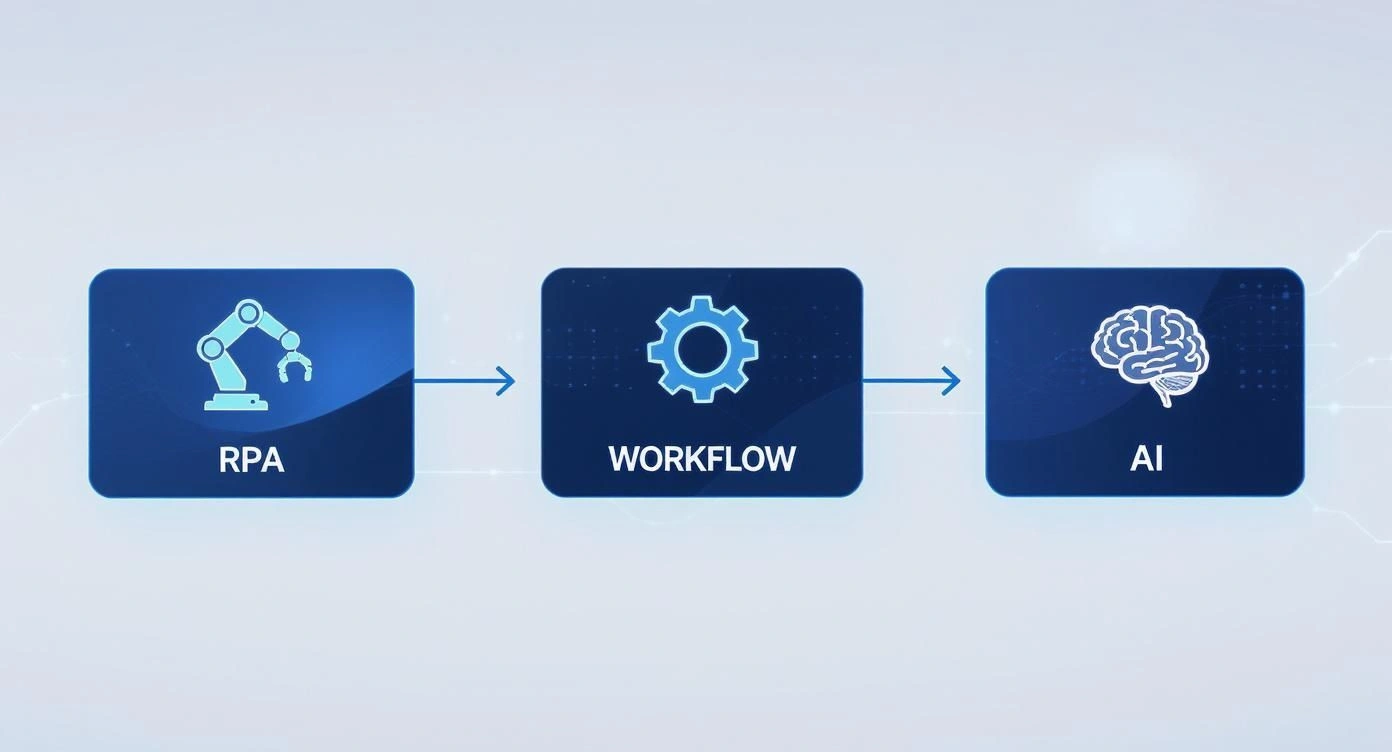
As you can see, foundational tools like RPA and workflow engines are often supercharged by AI, creating a powerful combination for solving complex business challenges.
The momentum across the country is hard to ignore. Over 35% of Australian businesses have already brought in some form of AI or automation, and that number is growing quickly. The spending shows it too, with investments hitting an estimated AUD 3.5 billion last year alone. More importantly, it’s working. A massive 48% of businesses reported seeing a positive return on their investment within the first year.
Top Benefits of BPA for Aussie Businesses
Recent data paints a clear picture of why Australian companies are so keen on automation. It’s not just theory; it’s about seeing real improvements right across the business.
| Benefit | Percentage of Businesses Reporting | Real World Example |
|---|---|---|
| Increased Productivity | 68% | An accounting firm automates invoice processing, freeing up staff to spend more time advising clients. |
| Cost Reduction | 59% | A logistics company uses RPA for data entry, cutting down on overtime costs and the need to hire more staff. |
| Enhanced Accuracy | 52% | A healthcare provider automates moving patient data between systems, which gets rid of critical data entry mistakes. |
| Improved Employee Morale | 45% | A marketing team automates weekly reports, so they can spend more time on creative strategy instead of spreadsheets. |
These numbers show a clear trend: businesses are using automation not just to be more efficient, but to create a better and more satisfying place to work.
Connecting Technology to Real Outcomes
When you get right down to it, the “why” behind automation is simple: it helps businesses become better versions of themselves. Faster. More accurate. More resilient.
It’s what lets a finance team close the books in days instead of weeks. It helps a customer service team answer questions instantly, creating happier, more loyal customers. It lets an HR team onboard new people smoothly, giving them a brilliant first impression of the company. To dig a bit deeper, you can explore the key business process automation benefits that are driving this big shift.
It’s about creating a business that runs more smoothly, where people are empowered to do their best work, and where growth isn’t held back by manual processes and how many hours there are in a day.
This isn’t some far-off dream. It’s happening right now, in businesses just like yours. By focusing on these real outcomes, it becomes clear that business process automation isn’t just a tech project; it’s a strategic move to build a stronger, more efficient, and fundamentally more human place to work.
Real Examples of Business Automation in Action
Okay, enough theory. It’s one thing to understand the tools, but what does it all look like when you’re actually using them? Let’s talk about what business process automation really means for real teams doing real work, day in and day out.
This isn’t some futuristic idea. These are practical, everyday things happening right now in businesses across Australia, helping them get faster, smarter, and a whole lot more efficient.
Putting Finance on Autopilot
The finance department is often ground zero for some of the most repetitive, rule-based work in any company. Take accounts payable… it’s a perfect candidate for automation because the process is so predictable.
Imagine thousands of invoices flooding in by email every month. Each one has to be opened, read, and its details manually typed into an accounting system. It’s a recipe for burnout and mistakes.
Here’s how automation completely changes that story:
- A bot keeps an eye on the accounts inbox for new invoices.
- When an invoice arrives, smart software scans the document, pulling out key details like the vendor name, invoice number, amount, and ABN.
- The system then automatically checks this info against a purchase order to make sure it all adds up.
- If everything matches, the invoice is scheduled for payment. If something’s off, it’s instantly flagged and sent to a human for a quick look.
No more manual data entry. No more chasing people for approvals. The result? Your finance team is freed up to focus on big-picture analysis instead of mind-numbing clerical work.
The real magic here isn’t just speed; it’s about creating a perfect, traceable record for every single transaction. It’s about building a process you can completely trust.
Reinventing Human Resources
Bringing a new person onto the team should be exciting. But way too often, it gets bogged down in paperwork and admin chaos. Contracts, IT access, payroll details… it’s a long list of manual tasks that can easily make for a messy and frustrating first day.
An automated onboarding workflow transforms this whole experience. As soon as a candidate says “yes” to an offer, a whole chain of events kicks off automatically.
The system can send the contract for a digital signature, create a ticket for the IT team to get a laptop ready, and schedule the new starter’s orientation meetings. It delivers a perfect, welcoming experience every single time, without an HR coordinator having to tick off a massive checklist.
Of course, to automate any process well, you first need to understand it inside and out. To see how your current workflows are really running, you might want to learn more about what process mining is and how it can find those hidden little bottlenecks.
Elevating the Customer Service Experience
We’ve all been there. Stuck in a support queue with a simple question. It’s frustrating for us, and it’s draining for support agents. The thing is, a lot of customer questions are the same ones, over and over. “What’s my order status?” or “How do I reset my password?”
This is where automation is brilliant. AI-powered chatbots can handle these common, simple questions instantly, 24/7. This immediate help keeps customers happy and massively cuts down the number of tickets that land with your human support team.
This doesn’t make your human agents obsolete. It makes them more valuable. It frees them up to deal with the really tricky, complex problems that need empathy, creative thinking, and a real human connection.
While automation adoption varies across Aussie industries, the benefits are clear wherever it’s used. Sectors like telecommunications and finance are leading the way, but manufacturing is also seeing huge improvements. Across the board, businesses are reporting big wins, with 36% pointing to increased efficiency, 33% seeing better productivity, and 29% achieving lower costs.
These examples are just a taste of what’s possible, but they prove that business process automation isn’t just a tech upgrade. It’s a strategic move that helps your best people do their best work. And that’s something any business can get excited about.
Your Roadmap to Getting Started With Automation
So, you’ve seen what automation can do. You’re probably feeling a mix of excitement and… let’s be honest, maybe a little bit of “where on earth do I start?”. That’s completely normal. The idea of changing processes that have been around forever can feel like you’re standing at the bottom of a huge mountain.
But here’s the secret. You don’t climb it in one giant leap. The best automation journeys don’t start with a massive, disruptive change. They start with a single, smart first step. This is your guide to making that first move feel less like a huge task and more like a confident stride forward.

Identify Your Starting Point
Before you can automate anything, you have to figure out where to aim. There’s always a temptation to go for the biggest, most complex process to get a huge win straight away, but that’s often a recipe for a headache. The smarter move is to go for the low-hanging fruit first.
How do you find it? It’s easy. Talk to your team. Ask them a really simple question: “What’s the most mind-numbing, repetitive, soul-destroying part of your day?” I promise their answers will give you a treasure map to your first automation project.
You’re looking for tasks that are:
- Highly repetitive: Things done the same way, over and over again. Like copying data from an invoice into a spreadsheet.
- Rule-based: The process follows clear “if this, then that” logic and doesn’t need complex human judgment.
- Prone to human error: Any task where a simple typo can cause a whole lot of problems is a perfect candidate.
- High in volume: Automating a task that you do 100 times a day is going to have a much bigger impact than one you do twice a year.
Starting with a small, clear win builds amazing momentum. It proves the idea works, shows the value, and gets everyone genuinely excited for what could come next.
Get Your Team on Board
This is a big one. And it’s where a lot of these projects can stumble. If your people see automation as a threat to their jobs, you’ll be fighting an uphill battle. It’s so important to frame this journey the right way from the very start.
This is not about replacing people. It’s about empowering them.
When you automate the boring parts of a job, you’re not taking work away. You’re giving them back time and mental energy to focus on what humans are great at: strategic thinking, creative problem-solving, and building real relationships with clients. Automation is the tool that frees up your best people to do their best work.
The goal is to make everyone’s job more interesting, not to make their job disappear. When people understand that automation is there to help them, they’ll become your biggest champions.
Choose the Right Tools (Without Breaking the Bank)
The world of automation tools is huge and can be pretty confusing. You’ve got everything from simple apps to complex, expensive platforms. The key is to start with a tool that matches the size of your first project.
You don’t need a sledgehammer to crack a nut. Very often, a simple and affordable tool can handle your first automation needs perfectly. Focus on finding something that solves your immediate problem well and has the ability to grow with you as you get more ambitious.
Measure What Matters
Finally, how will you know if it worked? You have to measure it. Before you even start, set a few simple benchmarks.
- How many hours a week does this manual task currently take?
- What’s the typical error rate?
- How long does the whole process take from start to finish?
Once your automation is running, track those same numbers. Seeing a 90% drop in time spent on a task or watching an error rate fall to zero is incredibly powerful. This data doesn’t just justify the first project; it builds a strong case for your next one. This step-by-step approach turns a massive ambition into a series of small, confident wins, paving the way for bigger changes later on.
Finding the Right Partner for Your Automation Journey
https://www.youtube.com/embed/9URSbTOE4YI?feature=oembed
Taking that first step into business process automation is exciting, but let’s be honest… you don’t have to go it alone. In fact, trying to manage everything yourself can often create more problems than it solves.
It’s one thing to automate a simple workflow. It’s a whole other challenge to get your shiny new software to talk to that ancient, but critical, system your finance team just can’t live without.
That’s where finding the right partner comes in. I’m not talking about just another vendor trying to sell you a one-size-fits-all product. You need an ally who will actually sit down, listen, and understand the unique quirks and pains of your business.
Why a Guide Is Better Than a Salesperson
A true partner is more like a guide on a tricky mountain trail. They know the path, they’ve seen where others have stumbled, and they can point out the safest, quickest way to the top. Their success is tied to yours, not just to making a sale.
This kind of hands-on expertise is so valuable for a few key reasons:
- Sidestepping common pitfalls: An experienced partner has seen what can go wrong. They’ll help you avoid expensive mistakes from day one.
- Achieving a faster ROI: They can help you find the high-impact, low-effort projects that deliver the biggest wins first, so you see a return on your investment much sooner.
- Future-proofing your strategy: A good partner helps you build something that doesn’t just fix today’s problems but can also grow and adapt as your business changes.
Think of it this way: you’re not just buying a tool. You’re investing in a relationship with an expert who can help you build a smarter, more efficient organisation from the inside out. They help you craft the strategy, not just install the software.
It’s all about finding that trusted advisor who can turn your business goals into a practical, achievable automation plan.
If you’re looking for that kind of guidance on what business process automation can do for you, working with a specialist AI agency can make all the difference, turning a complex journey into a confident and successful one.
Common Questions About Business Automation
Alright, we’ve covered a fair bit of ground. Whenever I chat with clients about what business process automation can do, the same few questions always seem to pop up. They’re great questions, too—the kind that get right to the heart of what people are worried or just plain curious about.
So, let’s just tackle them head-on.
Will Business Process Automation Replace Jobs?
This is usually the first thing people ask, and it’s a completely fair concern. Honestly, the goal isn’t to replace people, but to replace the bits of their jobs that are repetitive, tedious, and, frankly, a bit soul-crushing.
Think of it as giving your team a major upgrade. When you automate things like manual data entry or pulling together the same weekly report, you’re not making your people redundant. You’re freeing up their time and brainpower to focus on more strategic, creative, and customer-facing work… you know, the stuff that humans are actually brilliant at.
In my experience, this shift leads to more interesting and fulfilling roles. It allows a business to handle more work and grow without simply hiring more people to do the same manual tasks.
How Much Does It Cost To Implement BPA?
This is a classic ‘how long is a piece of string?’ question. The cost can swing wildly depending on what you’re trying to achieve. A simple workflow automation using a straightforward, off-the-shelf tool might be surprisingly affordable, even for a smaller business. You could be looking at a few hundred dollars a month.
On the flip side, a massive, custom AI-driven project for a large enterprise is obviously a significant investment. The key is not to try and boil the ocean.
The smartest way to start is with a small, focused project that has a clear and easily measurable return on investment. Many businesses find that the savings in time and the reduction in costly errors mean the automation pays for itself much faster than they expected.
How Do I Know Which Process To Automate First?
The best place to begin is with what we call the ‘low-hanging fruit’. Forget the super complex, ambitious stuff for now. Just look for the tasks that are causing the most friction and delivering the least value.
A great first step is to simply ask your team, “What’s the most annoying, boring part of your job?” Their answers will often point you straight to the perfect candidates for your first automation project.
You’re looking for tasks that are:
- Highly repetitive and rule-based (if X happens, then you always do Y).
- Prone to human error (like copying and pasting information between systems).
- Super time-consuming but don’t require much deep thinking.
- High volume (a task that happens a hundred times a day is a much better candidate than one that happens twice a year).
Starting here makes the journey feel manageable and gets you an early win, which builds momentum for everything that follows.
Navigating your automation journey can feel a lot less daunting with an experienced guide. At Osher Digital , we help businesses build a practical roadmap that delivers real results. If you’re ready to explore what’s possible, get in touch with our AI agency.
Last updated on July 1, 2026
Continue Reading
View all
n8n Outlook Automation: Where the Node Stops and Graph Begins
n8n Outlook automation breaks in predictable places: subfolders, attachments, shifting email IDs, plus the Graph API workarounds we run in production.
Mar 16, 2026

What Is a Workflow? Definition, Parts, and What Breaks
A workflow is the repeatable set of steps that takes a task from start to finish. Here is what a workflow is made of, and the parts that quietly break.
Mar 1, 2026

Aussie Guide to Marketing Automation for Small Business
Imagine having an extra team member who works around the clock, remembers every customer's name and history, and never once asks for a day off. That is the real power of marketing automation, and it is a complete game changer for small businesses. At its core, marketing automation is just software designed to handle routine […]
Dec 11, 2025
Sick of reading about automation?
Book a free 15-minute intro call. We’ll talk through what you’re trying to automate and whether we’re a good fit.