What Is Continuous Improvement?
Continuous improvement is the simple idea of making small, ongoing improvements to everything a business does. It’s less about launching massive, one-off projects and more about nurturing a mindset of consistent refinement over time. This approach ensures a business is always getting a little better, every single day. What Is Continuous Improvement Really? Imagine your […]
By Matthew Clarkson · December 7, 2025

Continuous improvement is the simple idea of making small, ongoing improvements to everything a business does. It’s less about launching massive, one-off projects and more about nurturing a mindset of consistent refinement over time. This approach ensures a business is always getting a little better, every single day.
What Is Continuous Improvement Really?

Imagine your favourite local restaurant and that signature dish you always order. The chef didn’t perfect it on day one and then just walk away. They are constantly tasting, listening to customer feedback, and searching for tiny ways to elevate it.
Maybe one week they tweak the seasoning. The next, they source produce from a better local supplier or find a new way to plate the dish to make it more appealing. Each adjustment is small, thoughtful, and deliberate. But over months and years, those tiny tweaks compound, turning a good dish into an unforgettable one. That, right there, is the essence of continuous improvement. It’s a commitment to getting better, step by step.
A Mindset, Not a Project
It’s crucial to grasp that continuous improvement is a cultural shift, not a task with a start and end date. It becomes part of the very fabric of how your organisation operates. Instead of waiting for a major crisis to force a change, teams are proactively looking for small opportunities to do things better.
This approach moves the focus away from disruptive, big-bang overhauls towards sustainable, incremental progress. The aim is to build a steady rhythm of positive change that everyone, at every level, feels a part of.
“Continuous improvement is not about radical transformation overnight. It’s about the cumulative power of hundreds of small, smart choices made consistently over time.”
Why Does It Matter?
Adopting this philosophy is what keeps a business competitive and relevant. In a market where customer expectations are constantly climbing, standing still is the same as falling behind. By perpetually refining processes, products, and services, a company can deliver more value and adapt to market shifts far more effectively.
This commitment naturally leads to some powerful benefits:
- Greater Efficiency: Teams get better at spotting and removing the small roadblocks in their daily workflows.
- Higher Quality: Products and services are consistently improved based on real-world feedback.
- Better Employee Engagement: When you empower staff to contribute their ideas, they become more invested in the outcome.
In the end, continuous improvement isn’t just another business strategy; it’s a practical, common-sense path to excellence. It’s about building a stronger, more resilient organisation, one small improvement at a time.
The Core Principles Driving Real Change

Now that we have a handle on what continuous improvement is, let’s get into the ideas that actually make it stick. Think about a great local mechanic. They’re not just fixing cars; they have built a system on solid principles that keeps their customers loyal and the workshop humming.
That same thinking works for any organisation serious about getting better. It’s not about making changes for the sake of it, but about grounding every decision in a few powerful concepts. These principles help build a culture where everyone, from the front desk to the CEO, is looking for ways to improve the business.
Focus On The Customer
It all begins and ends with the customer. What do they really care about? A mechanic’s customer doesn’t just want a fixed car; they want reliable service, honest communication, and a fair price. Continuous improvement is about relentlessly sharpening your focus on delivering that value.
This means you have to listen. Actively. You need to gather feedback and watch how people actually interact with your product or service. Once you understand their pain points and priorities, you can direct your energy towards improvements that truly make a difference.
Empower Your People
The people on the ground, doing the job day in and day out, are your best source of brilliant ideas. A smart mechanic doesn’t just give orders; they listen when a technician suggests a faster way to do a repair or a better way to organise the tools. That simple act of trusting your team unlocks a goldmine of practical insights.
In a culture of continuous improvement, employees are not just told what to do. They are respected as problem solvers who have a direct role in shaping the company’s success.
This principle is all about creating an environment where anyone feels safe and encouraged to put forward an idea. It shifts the burden of improvement from a handful of managers to the entire team.
Use Data, Not Guesses
Instead of going with a gut feeling, genuine improvement is built on evidence. Our mechanic tracks which repairs are most frequent, how long each job takes, and which parts are prone to failure. This data helps them see patterns and make informed decisions about staff training or which parts to keep in stock.
This data-first approach takes the emotion and guesswork out of the picture. It gives you a clear way to measure whether your changes are actually moving the needle.
Standardise What Works
Once you find a better way to do something, you need to make it the new standard. That mechanic probably has a detailed checklist for every 6-month service. This ensures every car gets the same high level of attention and nothing is ever missed. It guarantees consistency.
Standardising doesn’t mean being rigid. It’s about creating a solid, repeatable baseline that everyone follows. Here in Australia, this is a major focus for businesses. A 2025 outlook revealed that 42% of organisations prioritised internal process improvements to navigate rising costs and workforce issues. You can explore the full Australian industry outlook to see these trends for yourself.
By locking in a good process, you create the perfect launchpad for finding the next improvement.
Two Proven Frameworks to Guide Your Improvement Efforts
Knowing you need to improve is the easy part. The real challenge is figuring out how to do it without causing chaos. Thankfully, you don’t have to reinvent the wheel. Plenty of successful businesses rely on established frameworks to bring structure and focus to their continuous improvement journey.
Let’s break down two of the most effective and widely used approaches. It’s best to think of these not as rigid, unbending rules, but as flexible toolkits you can adapt to solve your team’s specific problems.
The PDCA Cycle: Your Process Sandbox
First up is the PDCA Cycle , which stands for Plan-Do-Check-Act. It’s a beautifully simple, four-step loop that lets you test out new ideas without betting the farm. Think of it as a scientific experiment for your business processes. Instead of rolling out a massive, high-risk change overnight, you test your theory on a small scale to see if it actually holds water.
Here’s how it works in practice:
- Plan: It all starts with identifying a problem or an opportunity. What’s not working as well as it could be? Once you have your target, you form a hypothesis, a clear idea for a change that you believe will lead to a better outcome.
- Do: Now it’s time to run your experiment. You implement the proposed change, but only on a small, controlled scale. This is your test phase.
- Check: After a set period, you step back and analyse the results. Did the change deliver the positive impact you were hoping for? This is where data is your best friend. Measure the outcome and compare it to your baseline.
- Act: If the test was a winner, you roll the change out on a wider scale, making it the new standard operating procedure. If it didn’t work out, that’s okay too! You take what you learned from the experiment and start the cycle all over again with a new, more informed plan.
The real power of PDCA is its simplicity and its focus on safety. It gives your team a low-risk environment to try new things, learn from what works (and what doesn’t), and avoid the costly mistake of committing to a bad idea.
Kaizen: The Philosophy of Small, Smart Wins
While PDCA is a specific method for testing changes, Kaizen is much broader. It’s a mindset, a company-wide philosophy. The word is Japanese and it translates to “change for the better” or, quite literally, “continuous improvement.” At its heart, Kaizen is all about making small, incremental improvements consistently, with everyone from the CEO to the front-line staff getting involved.
The core idea of Kaizen is that massive, disruptive changes aren’t necessary to create a huge impact. Instead, a steady stream of small, thoughtful improvements will add up to a significant transformation over time.
This approach is all about empowering employees to spot and solve problems in their day-to-day work. It could be an assembly line worker figuring out a better way to organise their tools, or a customer service agent creating a new email template that answers common questions more efficiently.
A fantastic starting point for Kaizen is often automating those small, mind-numbing tasks that eat up everyone’s time. Getting a handle on robotic process automation can uncover dozens of opportunities for these kinds of quick, high-impact wins. For teams that want a bit more structure around their collaborative efforts, the principles of the Scrum methodology also provide a powerful and complementary framework.
Comparing Continuous Improvement Frameworks PDCA vs Kaizen
So, which one is right for you? It really depends on what you’re trying to achieve. PDCA is excellent for targeted problem-solving, while Kaizen is about building a culture of improvement. This table breaks down the key differences to help you decide.
| Aspect | PDCA (Plan-Do-Check-Act) | Kaizen |
|---|---|---|
| Focus | A structured, cyclical method for solving specific problems and testing solutions. | A broad, ongoing philosophy of making small, incremental improvements everywhere. |
| Scope | Typically project-based or focused on a single process at a time. | Company-wide, involving every employee at every level. |
| Pace | Can lead to larger, more defined changes at the end of each cycle. | Emphasises small, continuous, and gradual changes over time. |
| Implementation | Implemented as a four-step cycle for a specific initiative. | Embedded into the company culture as a daily mindset and practice. |
| Best For | Testing significant changes, validating hypotheses with data, and structured problem-solving. | Fostering employee engagement, improving morale, and achieving long-term, compounding growth. |
Ultimately, these two frameworks aren’t mutually exclusive. Many of the most successful organisations use the PDCA cycle as a tool to execute on the big ideas that emerge from their Kaizen culture. The key is to find the right blend that works for your team and your goals.
The Real-World Benefits for Your Business
Adopting a continuous improvement mindset is about far more than just ticking boxes or feeling productive. It’s about creating real, measurable changes that fundamentally strengthen your business. When you commit to making small, consistent enhancements, you start to see tangible results that flow directly to your bottom line.
Think of it like tending a garden. You don’t just throw some seeds in the ground and hope for the best. You water regularly, pull weeds the moment they pop up, and gradually enrich the soil. Each of these small, deliberate actions contributes to a healthier, more vibrant garden. It’s the same in business; tiny improvements compound over time to build a significant competitive edge.
Stronger Performance Across the Board
One of the first things you’ll notice is a serious boost in efficiency. By empowering your team to identify and fix the little frustrations in their daily work, you begin to systematically smooth out your operations. This means tasks get done faster and with fewer mistakes, which frees up your people to focus on work that actually creates value for your customers.
This naturally leads to higher quality products and services. As you constantly refine your processes, the quality of your output can only go one way: up. Customer satisfaction climbs, which in turn improves retention and bolsters your reputation. As detailed in these 7 Levers to Improve Business Productivity Today, the focus is on enhancing multiple facets of the business at once.
The frameworks that guide these efforts, like PDCA and Kaizen, are all about structuring this ongoing cycle of improvement.
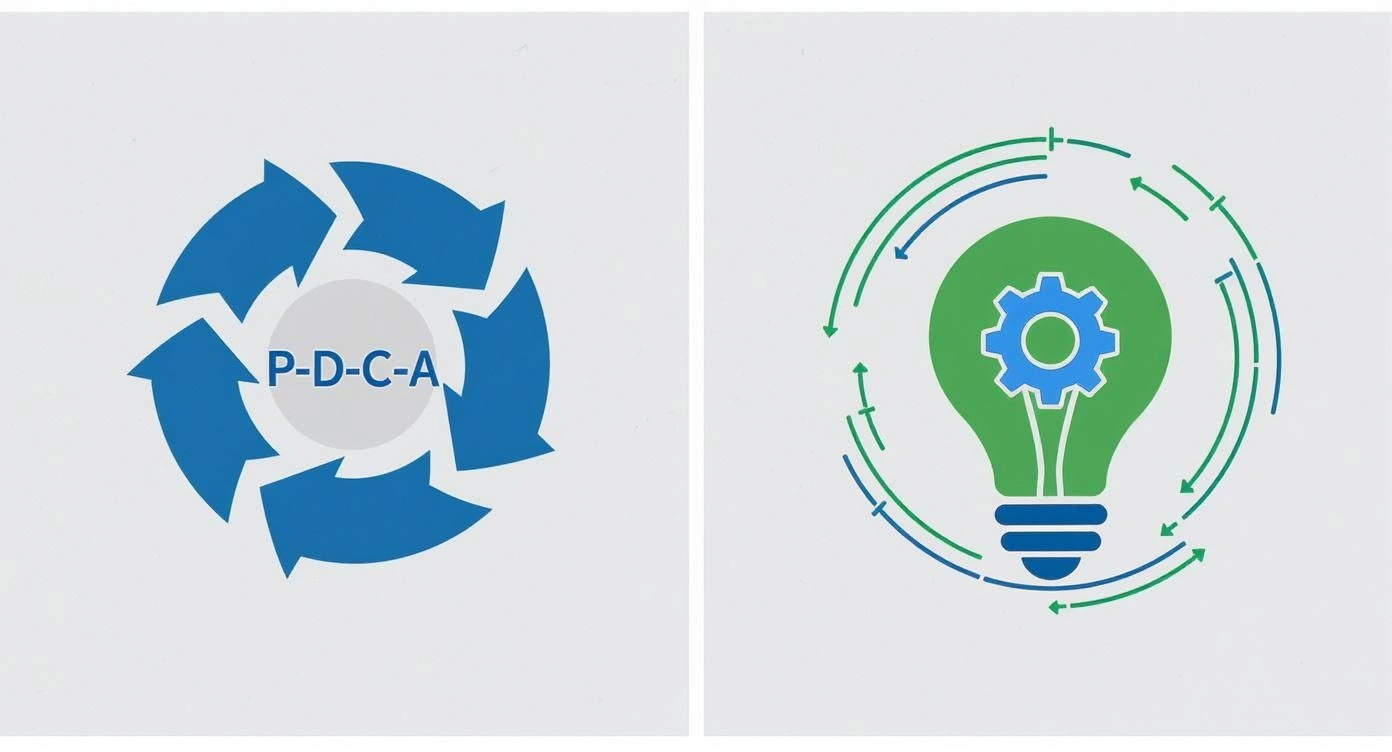
As the image shows, you can drive consistent gains through both structured cycles and a cultural commitment to always getting better.
A More Engaged Team and Happier Customers
A fantastic byproduct of this approach is the positive shift in team morale. When people are trusted and given the autonomy to improve their own work, they feel more valued and engaged. This fosters a proactive and positive environment where everyone is genuinely invested in the company’s success.
This isn’t just a private-sector phenomenon, either. Continuous improvement has become a cornerstone of public sector reform right here in Australia. Recent progress reports show that 84.6% of performance metrics were hitting their targets, a clear indicator of how effective these small-scale, consistent reforms can be.
Ultimately, all of these internal improvements culminate in the most important outcome of all: happier, more loyal customers who become your strongest advocates.
Using AI and Automation to Accelerate Improvement

So far, we’ve looked at continuous improvement as a very human-driven effort. And it is. But modern technology can be an incredible partner on this journey. Think of artificial intelligence and automation not as replacements for your team, but as powerful tools that amplify their ability to find and solve problems.
Imagine the sheer volume of digital information your business generates every day. Things like sales figures, customer feedback, website clicks, and production logs. For a human, sifting through all of that to find meaningful patterns is like trying to find a specific grain of sand on a beach. It’s an almost impossible task.
This is where AI shines. It can analyse enormous datasets in moments, spotting subtle inefficiencies or emerging trends that a person would almost certainly miss. This gives your team a massive head start, pointing them directly to the areas crying out for attention.
Letting Technology Handle the Repetitive Work
Automation is the other half of this powerful duo. So many business processes are built on repetitive, manual tasks like copying data between systems or sending out standard follow-up emails. These jobs aren’t just tedious; they’re breeding grounds for human error. A single typo can create significant headaches down the line.
Automation takes these tasks completely off your team’s plate. By using software to handle the routine work, you immediately start to see benefits.
- Eliminate costly errors by ensuring tasks are performed identically, every single time.
- Speed up processes significantly , which frees up your people for more valuable work.
- Create a solid, consistent baseline from which you can measure and make further improvements.
The real goal of automation isn’t just about doing things faster. It’s about freeing up your team’s brainpower for what people do best: creative problem-solving, strategic thinking, and genuine innovation.
Making a Practical Shift
This isn’t just theory for big tech companies; even government bodies are putting technology to work. For instance, the Australian Bureau of Statistics is rebuilding its statistical tools in a cloud environment to deliver more timely and detailed economic data. It’s a clear example of applying these principles in the real world.
Getting started with these technologies can feel intimidating, but it doesn’t need to be a massive, disruptive overhaul. Often, the best first step is to focus on automated data processing. Cleaning up and organising the information you already have creates a reliable foundation for both your team and any future AI tools to work from.
Ultimately, bringing AI and automation into your continuous improvement efforts helps you make better decisions, faster. It’s about giving your team the tools they need to see the full picture and act on it with confidence.
How to Get Started with Continuous Improvement
https://www.youtube.com/embed/Wc6bI16xuko?feature=oembed
So, you’re feeling inspired to make a change? That’s the perfect mindset. Now, let’s channel that motivation into real, practical action with a guide any business can start using today.
The good news is that starting with continuous improvement doesn’t demand a massive budget or a revolutionary master plan. It really just comes down to being willing to take that first small step.
The trick is to sidestep the feeling of being overwhelmed. Instead of trying to overhaul the entire company at once, pick one manageable area and focus your energy there. This approach makes the whole process feel less intimidating and helps build momentum for what comes next.
Your First Three Steps
Ready to dive in? Here’s a simple plan you can put into action this week. The aim here is to make your first attempt feel straightforward and to build confidence with a quick, tangible win.
- Pick One Small Problem: Seriously, don’t try to solve world hunger on day one. Think about a minor but persistent frustration that bugs your team. Maybe it’s a weekly meeting that always runs over, a confusing spreadsheet, or a clunky step in your customer onboarding process.
- Involve Your Team: Get the people who actually deal with this issue day in and day out into a room. Ask them for their thoughts on how to fix it. You’ll be amazed by the practical insights they offer, and bringing them in early gives everyone a sense of ownership.
- Test One Idea: From all the suggestions, choose the most promising one. Then, use a simple Plan-Do-Check-Act cycle to try it out on a small scale. This isn’t about finding the perfect solution right away; it’s about learning what actually works in practice.
The most important thing to remember is that continuous improvement is a journey made of small steps, not one giant leap. Each tiny adjustment you make contributes to building a stronger, more resilient business over time.
Ready to accelerate that journey? Our expert AI consultants can help you find and integrate the right tools to make your improvement efforts faster and more effective.
Still Got Questions?
Even after getting the hang of the core ideas, a few practical questions almost always pop up when businesses start to seriously consider what continuous improvement looks like on the ground. Let’s tackle some of the most common ones so you can move forward with a clearer picture.
How Is This Different From a Standard Project?
It’s a great question, and the distinction is crucial. Think of a project like building a deck. There’s a definite start point, a set of plans, a construction phase, and a clear finish line when the deck is complete. Once it’s done, it’s done.
Continuous improvement, however, is more like tending a garden. It never truly ends. You’re constantly weeding, watering, pruning, and looking for small ways to help it thrive through the seasons. It’s an ongoing philosophy of incremental refinement, not a one-and-done task with a finish line.
Can Continuous Improvement Really Work in a Service-Based Business?
Absolutely. It’s a common misconception that these ideas only apply to manufacturing floors. The reality is, if you have a process, you have an opportunity to improve it.
A law firm can refine its client intake process, a digital marketing agency can optimise its campaign reporting workflow, and a cafe can find a better way to manage morning rush orders. The principles are universal because every business, regardless of industry, is a collection of processes. The goal is always the same: make things run smoother, faster, and better for everyone involved.
The real question isn’t if your industry can benefit from continuous improvement, but rather, which process will you improve first? If it’s a repeatable task, it holds potential.
How Do I Get My Team to Actually Buy Into This?
This is often the biggest hurdle, and the secret is to make it about them, not just the business. Forget grand, top-down announcements about a new “corporate initiative.” That’s a surefire way to get eye-rolls.
Instead, start small. Find a single, nagging problem that frustrates your team on a daily or weekly basis and focus all your initial energy on solving that one thing. When your team sees that their feedback leads to real changes that make their jobs less stressful, they’ll start to see the value. Show them, don’t just tell them. Those small, early victories are what build the momentum you need for genuine, lasting buy-in.
At Osher Digital , we help businesses turn that initial momentum into a powerful engine for growth by embedding intelligent automation into their core processes. When you’re ready to see what’s possible, our AI consultants can help you map out the first steps.
Last updated on July 1, 2026
Free tool · 2 minutes
Automation ROI Calculator
See what a manual process is really costing you, and the payback on automating it.
Continue Reading
View all
Rented software was always a compromise. AI has ended it.
Off-the-shelf software made sense when custom cost $250,000. AI-assisted development changed the maths. Why we now build software around the business, AI-first, and connected to Claude and ChatGPT, starting at $15k.
Aug 6, 2026

n8n Outlook Automation: Where the Node Stops and Graph Begins
n8n Outlook automation breaks in predictable places: subfolders, attachments, shifting email IDs, plus the Graph API workarounds we run in production.
Mar 16, 2026

What Is a Workflow? Definition, Parts, and What Breaks
A workflow is the repeatable set of steps that takes a task from start to finish. Here is what a workflow is made of, and the parts that quietly break.
Mar 1, 2026
Sick of reading about automation?
Book a free 15-minute intro call. We’ll talk through what you’re trying to automate and whether we’re a good fit.