What Is Lean Six Sigma and How Does It Actually Work?
So, what is Lean Six Sigma? Imagine you’re trying to build something amazing, but you’re constantly tripping over clutter and your tools keep breaking. It’s frustrating. All that energy you want to put into the actual work gets wasted on just… managing the chaos. That’s what it’s like in a lot of businesses. Lean Six […]
By Matthew Clarkson · November 8, 2025
So, what is Lean Six Sigma?
Imagine you’re trying to build something amazing, but you’re constantly tripping over clutter and your tools keep breaking. It’s frustrating. All that energy you want to put into the actual work gets wasted on just… managing the chaos. That’s what it’s like in a lot of businesses.
Lean Six Sigma is just a super practical way to clear the clutter and fix the broken tools. It’s a team effort, really, combining two proven methods for making things run better. One part focuses on speed and getting rid of waste, while the other is all about quality and stopping mistakes from happening.
The Super-Powered Duo of Business Improvement
Let’s break it down with an analogy. I think better with analogies. Imagine you’re running a busy cafe. Your goal is simple: serve amazing coffee, and serve it fast.
This is where our two methodologies come into play.
The Lean Approach: Clearing the Path
First up is Lean. Think of Lean as the ultimate de-clutterer. Its entire mission is to hunt down and remove anything that doesn’t add value for your customer. Anything at all.
Lean looks at your cafe and asks really practical questions like:
- Why does the barista have to walk ten steps to get milk for every single latte?
- Why are we making huge batches of sandwiches that might not sell? That just seems… wasteful.
- Are customers waiting too long because of a clunky payment system?
Lean is obsessed with creating a smooth, efficient flow. It’s about speed and efficiency, clearing all the junk out of the way so you can work faster and smarter.
The Six Sigma Approach: Perfecting the Craft
Then, you have Six Sigma. This is your data-driven quality expert. It doesn’t guess where problems are; it uses hard numbers and statistical analysis to pinpoint the exact root causes of mistakes. It’s the detective of the duo.
Six Sigma’s goal is to make your process so consistent that it’s nearly perfect. The benchmark it aims for is a process where defects are incredibly rare… happening only 3.4 times per million opportunities.
Back at the cafe, Six Sigma isn’t just about making a good coffee. It’s about making every coffee perfect. It analyses why some coffees come out burnt, why the milk is sometimes steamed incorrectly, or why orders get mixed up. It uses data to find the cause and then puts a system in place to make sure it doesn’t happen again.
Lean vs Six Sigma at a Glance
Before we see how they work together, it’s helpful to see their individual focus. Each one brings something unique to the table.
| Aspect | Lean | Six Sigma |
|---|---|---|
| Main Goal | Eliminate waste and increase speed. | Reduce defects and variation. |
| Core Question | “What is slowing us down?” | “Why are we making mistakes?” |
| Approach | Visual and workflow-focused. | Statistical and data-driven. |
| Key Benefit | Drastically improved efficiency. | Unwavering quality and consistency. |
When you put these two together, you get Lean Six Sigma. It’s a combined approach that tackles problems from both sides, giving you the speed of Lean and the quality control of Six Sigma. This powerful combination helps you make your business faster, more reliable, and much more efficient. All at the same time.
Understanding the Core Principles of Lean and Six Sigma
Okay, so we know Lean is about speed and Six Sigma is obsessed with quality. But talking about it is one thing… how do they actually work? Let’s pull back the curtain and look at the practical ideas that drive each one.
You’ll find they’re surprisingly down-to-earth.
Lean Thinking: Unpacking the Toolkit for Speed
Lean is all about seeing your entire operation through the customer’s eyes. It forces you to constantly ask a deceptively simple question: “Is this step adding something the customer would willingly pay for?” If the answer is no, then in the world of Lean, it’s waste.
To spot that waste, Lean uses some really clever but straightforward tools. One of the most powerful is Value Stream Mapping.
It sounds technical, I know, but it’s really not. Think of it as drawing a detailed map of your process, starting from the moment a customer makes a request all the way to the point you deliver. You visually chart out every single step, every handover, and every delay. It’s a bit like tracing the journey of a pizza order, from the phone call to the driver knocking on the door.
This simple map suddenly makes the bottlenecks painfully obvious. You can see precisely where work gets stuck, where paperwork sits in a pile, or where someone is just waiting for information. It’s a truly eye-opening exercise that gets everyone on the same page about where the real problems are hiding.
Another crucial part of Lean is its relentless focus on eliminating the 8 Wastes. These are the common culprits that gum up the works and add absolutely no value for the customer.
- Defects: Simple mistakes that force you to do work over again. Think of a barista making the wrong coffee and having to start from scratch. So frustrating.
- Overproduction: Making more of something than is needed right now. It’s the bakery that makes 200 loaves of sourdough when they only sell 50 a day. The rest is waste.
- Waiting: Any idle time spent waiting for the next step in the process. This is the classic example of a team member tapping their fingers, waiting for a manager’s signature.
- Non-Utilised Talent: Failing to tap into the skills and insights of your team. This happens when managers don’t listen to the people who are actually doing the work day in and day out. They usually know what’s wrong.
- Transportation: Any unnecessary movement of products or materials. Imagine having to carry parts from one end of a workshop to the other, over and over again.
- Inventory: Having too much stuff on hand. Excess stock not only ties up cash but it also risks becoming obsolete.
- Motion: Unnecessary movement by people. This is the barista who has to walk back and forth across the cafe for milk, sugar, and lids instead of having everything within arm’s reach.
- Extra-Processing: Doing more work than the customer requires. For example, creating a detailed 20-page report when a one-page summary is all that’s needed.
By systematically hunting down these wastes, Lean clears the path for work to flow smoothly and, most importantly, quickly.
Six Sigma: The Data-Driven Pursuit of Perfection
Now let’s switch gears to Six Sigma. If Lean is about clearing the path for speed, Six Sigma is about perfecting the journey itself. It’s far less about visual maps and much more about hard data.
The central idea behind Six Sigma is reducing variation. Variation is the enemy of quality. It’s the reason one coffee from your favourite cafe is perfect and the next one is just… meh.
You see, customers don’t just want good quality; they want predictable quality. They need to trust that every single time they interact with your business, the experience will be consistently excellent. Six Sigma uses statistical analysis to understand exactly why that variation happens and then systematically root out its causes.
It doesn’t rely on guesswork or gut feelings. It demands proof. A Six Sigma team wouldn’t just assume the coffee machine is old. They’d measure everything: the temperature of the milk, the grind size of the beans, the time it takes to pull a shot. They’d then analyse that data to find the precise variable that’s causing those inconsistent results.
By digging into the numbers, Six Sigma ensures that any improvements are based on solid evidence, not just assumptions. This data-driven approach is what makes the changes stick. It’s about building processes so reliable they produce near-perfect results, time and time again.
Your Improvement Roadmap: The DMAIC Framework
https://www.youtube.com/embed/TzPPuvciE-Y
All the theory is great, but how do you actually do it? This is where Lean Six Sigma really comes to life. It’s not just a collection of abstract ideas; it’s a practical, step-by-step roadmap for solving real-world business problems.
This roadmap is called DMAIC (pronounced ‘De-may-ick’), and it’s the engine that powers every improvement project.
It might sound a bit technical, but I promise it’s just a logical sequence of steps that stops you from guessing at solutions and hoping for the best. DMAIC stands for Define, Measure, Analyse, Improve, and Control. Let’s walk through each phase as if we were running a project together.
Define: What Is Actually Wrong?
The first phase, Define , is arguably the most critical. Why? Because if you don’t correctly identify the problem, you’ll waste an enormous amount of time and resources solving the wrong thing. We’ve all been there… running around putting out fires without ever figuring out what started them.
This phase is all about getting crystal clear on the issue.
Let’s imagine you run a local cafe. You have a gut feeling that customers are waiting too long for their coffee, and you’re noticing some frustrated looks. In the Define phase, you wouldn’t just say, “We need to be faster.” That’s too vague. It doesn’t help anyone.
Instead, you’d craft a specific problem statement: “Our average customer wait time from order to pickup is currently 7 minutes between 8 AM and 10 AM, leading to customer complaints and a potential 15% drop in repeat business.”
See the difference? It’s specific, measurable, and sets a clear target for improvement.
Measure: How Big Is The Problem, Really?
Next up is the Measure phase. This is where you swap gut feelings for hard data. After all, you can’t manage what you don’t measure.
For our cafe, this means getting out a stopwatch. You’d get your team to meticulously time every step of the coffee-making process for a full week. How long to take the order? How long to grind the beans? To steam the milk? How long does the finished coffee sit on the counter before being picked up?
By collecting this data, you establish a baseline. It gives you a true, unbiased picture of the current state, not just what you think is happening. This data becomes the single source of truth for the rest of the project.
Analyse: What’s The Root Cause?
Now for the detective work. The Analyse phase is where you dive into the data you’ve collected to find the root cause of the problem. Not just the symptoms.
Looking at your cafe’s data, you might discover that the biggest bottleneck isn’t the fancy coffee machine. It’s the time the barista spends walking back and forth to the milk fridge, which is tucked away on the other side of the room. It seems like such a small thing, but over dozens of orders, those extra seconds add up to a massive delay.
This is a crucial insight. Without this analysis, you might have spent thousands on a new, faster machine, which wouldn’t have solved the real problem at all.
Improve: How Do We Fix It?
With the root cause pinned down, it’s time for the Improve phase. This is the creative part where you brainstorm, test, and implement solutions that directly tackle the issue you uncovered.
For our cafe, the fix could be incredibly simple. What if we moved a small bar fridge right next to the coffee machine? It’s a low-cost, easy-to-implement idea.
But you don’t just roll it out and assume it works. You test it. You’d run the new setup for a few days and measure the wait times again. Did they go down? If the data shows a significant reduction, you’ve found your fix. This iterative process of testing and validating is what ensures your changes actually deliver results.
Control: How Do We Make The Gains Stick?
Finally, we arrive at the Control phase. This is all about making sure your hard-earned improvements don’t just disappear after a few weeks. How do you ensure the problem stays fixed for good? Because that’s the real test.
In our cafe example, this could involve a few simple actions:
- Updating the standard operating procedures to make the new layout permanent.
- Training all new staff on the more efficient workflow.
- Putting a simple chart in the back room to track average wait times each week, so you can spot if things start to slip.
The Control phase is what turns a one-time fix into a new, better way of working. It locks in your gains and creates a system for monitoring performance so that old, inefficient habits don’t creep back in.
This visual captures the flow perfectly: you map out your process, find what’s holding you back, and then methodically improve it.
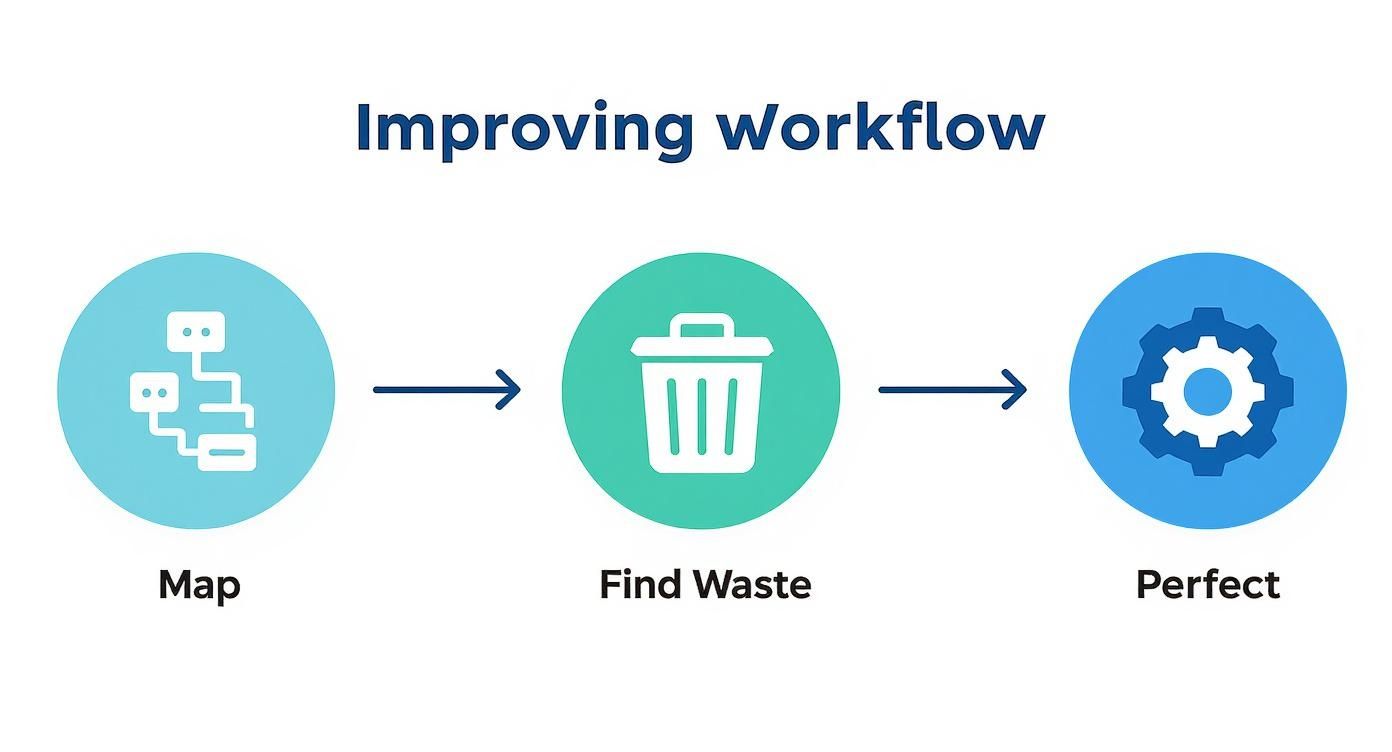
This process flow highlights how Lean Six Sigma moves from understanding the current situation to systematically removing waste and optimising the system. To see how modern technology can automatically discover these process maps from your digital data, you can learn more about what is process mining in our detailed guide. It’s a powerful way to accelerate the Measure and Analyse phases of any project.
How Australian Businesses Are Driving Real Results
It’s one thing to talk about frameworks in theory, but what does this look like on the ground, right here in Australia? The real magic isn’t in the textbook definitions… it’s seeing how Aussie businesses are using these principles to make genuine, measurable improvements.
And this isn’t just a game for the big end of town. It’s happening everywhere.
Let’s look at the real-world impact. We’re seeing success stories pop up all over the country, from organisations of all shapes and sizes that have put these ideas to work.
From the Factory Floor to the Hospital Ward
Picture a manufacturing plant in Western Sydney. For years, they were grappling with material waste and production delays that were silently eating away at their bottom line. By applying Lean Six Sigma, they mapped out their entire production process, step by step, and uncovered bottlenecks they never even knew were there. The result? A significant reduction in waste and a healthy drop in operating costs.
But this isn’t just a story for the factory floor.
Over in Melbourne, a busy public hospital was facing chronically long waiting times in their outpatient clinic. It was a source of frustration for patients and burnout for staff. Using Lean Six Sigma principles, they meticulously redesigned the patient journey from check-in to consultation. They streamlined how information was captured and passed between teams, which managed to slash wait times and dramatically improve the patient experience. It’s a perfect example of how focusing on process can have a profoundly human impact.
Making Government Services Work for People
Even government departments are getting on board. We all know how dealing with bureaucracy can feel like wading through treacle. Well, public sector agencies are now using the core ideas of Lean Six Sigma to simplify complex procedures, cut down on paperwork, and ultimately deliver better, faster services to everyday Australians.
It’s all about making things simpler and more effective for the people they serve. A powerful goal.
For decades, Lean Six Sigma has become a cornerstone of process improvement, especially within the Aussie manufacturing sector where it first gained traction. One study found that Australian businesses adopting these methods saw their process-related costs fall by an average of 10% to 20% within the first year alone. You can read the full research on its impact in Australian business here.
This isn’t some abstract business school theory that only works on paper. It’s a practical toolkit that delivers tangible, bottom-line results for real companies right across Australia.
This approach is a key part of building a culture of continuous improvement, which is central to any truly successful business. For a deeper dive into creating this kind of environment, our guide to building an operational excellence framework connects the dots between the tools and the bigger cultural picture.
So, from cutting scrap on a production line to making a hospital visit less stressful, the proof is in the outcomes. Lean Six Sigma is helping Australian organisations solve real, everyday problems.
The Tangible Benefits You Can Actually Expect
Alright, let’s get down to brass tacks. You’ve wrapped your head around the theory and the frameworks, but what’s the actual payoff? What real-world results can you expect to see on the ground in your business?
The most immediate and obvious benefit is financial. It’s simple, really. When you eliminate waste, fix clunky processes, and drastically reduce errors, you just spend less money. It’s all about plugging the leaks in your budget… the ones you might not even know you have.
The Financial Upside
The financial gains for Australian businesses aren’t just theoretical; they’re well-documented, with companies reporting massive returns. A 2025 report revealed that local businesses applying Lean Six Sigma often see a return on investment between 300% and 500% within the first two years alone. Take a Sydney-based insurer, for example. They applied these principles to their claims process and managed to slash the average turnaround time from 12 days down to just 7. That’s a staggering 42% improvement. You can discover more about these Australian findings and explore the data for yourself.
To truly grasp what this could mean for your own operations, it helps to map out the potential savings against the required investment. You can check out our cost-benefit analysis template to start crunching your own numbers.
Beyond the Bottom Line
But honestly, the impact goes far beyond just the money. Think about your customers for a moment. When your internal processes are smooth, reliable, and predictable, you deliver a better product or service. And you deliver it more consistently.
That consistency builds something far more valuable than short-term savings. It builds loyalty.
It’s the difference between a customer who buys from you once and a customer who trusts you, comes back time and again, and tells their friends about you. That kind of trust is priceless.
And finally, let’s not forget your team. Nobody… and I mean nobody… enjoys working in a chaotic system where they feel powerless to fix things. It’s completely draining. Lean Six Sigma gives your employees the tools to solve the very problems that frustrate them every single day.
This is incredibly empowering. It boosts morale, drives engagement, and helps foster a culture where people genuinely care about making things better. That’s a ripple effect that touches every part of your organisation, making it stronger from the inside out.
Getting Started with Lean Six Sigma
So, you’ve read this far and you’re probably thinking, “This could be the answer to those persistent problems we just can’t seem to shake.” That’s the right headspace. But the next logical question is often a bit daunting: where do I actually start?
Let’s map out some practical first steps. Before diving into process maps or statistical analysis, your first move is securing buy-in from leadership. Any meaningful, sustainable change needs champions at the top; without their support, you’ll find yourself fighting an uphill battle.
Understanding the Training Levels
Once you have that executive backing, the conversation will likely turn to the different “Belt” levels. Don’t let the martial arts terminology throw you off. It’s just a straightforward way to classify different tiers of training and expertise within the methodology.
Here’s a simple breakdown of what those belts mean:
- Yellow Belts: These are your team members with a foundational grasp of the core concepts. They’re equipped to be valuable participants in projects, especially when it comes to gathering data and providing on-the-ground insights.
- Green Belts: Think of these people as the project workhorses. Green Belts typically lead smaller improvement initiatives within their own functional areas, often balancing these responsibilities with their regular day-to-day role.
- Black Belts: These are your dedicated project leaders, mentors, and change agents. This is usually a full-time position focused on tackling the big, complex, cross-departmental challenges that can have a major impact on the business.
The single most important piece of advice I can offer is this: Start small. There’s no need to boil the ocean and attempt a company-wide transformation from day one. That’s a surefire path to frustration and burnout.
Instead, pick one clearly defined, notoriously frustrating process. Every business has one… the one that’s a constant source of complaints. Focus all your initial energy on applying the DMAIC framework to that single pain point.
Achieving that first small win is about so much more than just fixing one problem. It builds confidence, proves the value of the method, and creates the momentum you’ll need to tackle bigger challenges down the line.
If you’re ready to embed this kind of data-first thinking into your core operations, working with an AI agency can help you properly integrate these process improvements and fast-track your results.
Answering Common Questions About Lean Six Sigma
When people first encounter Lean Six Sigma, a few questions almost always pop up. Let’s tackle some of the most common ones you might be wondering about.
Is This Just for Big Manufacturing Companies?
Not at all. While its roots are firmly planted on the factory floor, Lean Six Sigma’s principles are incredibly versatile. I’ve seen them deliver incredible results in service industries… think banking, healthcare, software development, and even government departments.
Ultimately, if your organisation has processes, it has room for improvement. The key is adapting the tools to fit your specific environment, not trying to force a manufacturing model where it doesn’t belong.
Do I Need to Be a Statistics Whiz?
You definitely don’t need a PhD in statistics to get started. Many of the core tools are surprisingly straightforward, relying on simple charts and graphs to make problems visible. It’s a very visual methodology.
When a project gets into more complex statistical analysis, that’s where specialised experts like Black Belts come in. They have the deep statistical skills needed for heavy lifting. But everyone on the team can grasp the fundamental goals of reducing waste and eliminating errors.
What’s the Difference Between a Green Belt and a Black Belt?
It’s best to think of them as different levels of expertise and project leadership.
A Green Belt is typically a team member who works on Lean Six Sigma projects part-time, usually focusing on improvements within their own department. They have a solid grasp of the core concepts and tools.
A Black Belt , on the other hand, is often a full-time role dedicated to process improvement. They lead larger, more complex projects that can span multiple departments and also serve as mentors and coaches for the Green Belts on their teams.
At Osher Digital , we believe in making processes work smarter, not harder. If you’re ready to embed this kind of clear, data-driven thinking into your operations, partnering with an AI agency can help you integrate improvements and accelerate your results.
Last updated on July 1, 2026
Continue Reading
View all
n8n Outlook Automation: Where the Node Stops and Graph Begins
n8n Outlook automation breaks in predictable places: subfolders, attachments, shifting email IDs, plus the Graph API workarounds we run in production.
Mar 16, 2026

What Is a Workflow? Definition, Parts, and What Breaks
A workflow is the repeatable set of steps that takes a task from start to finish. Here is what a workflow is made of, and the parts that quietly break.
Mar 1, 2026

Aussie Guide to Marketing Automation for Small Business
Imagine having an extra team member who works around the clock, remembers every customer's name and history, and never once asks for a day off. That is the real power of marketing automation, and it is a complete game changer for small businesses. At its core, marketing automation is just software designed to handle routine […]
Dec 11, 2025
Sick of reading about automation?
Book a free 15-minute intro call. We’ll talk through what you’re trying to automate and whether we’re a good fit.