Building an Operational Risk Management Framework That Actually Works
The term “operational risk management framework” sounds a bit dry, doesn’t it? Like something cooked up in a corporate boardroom that has very little to do with your day-to-day reality. But what if I told you it’s actually one of the most practical tools you can have? Think of it as a game plan that […]
By Matthew Clarkson · November 6, 2025

The term “operational risk management framework” sounds a bit dry, doesn’t it? Like something cooked up in a corporate boardroom that has very little to do with your day-to-day reality.
But what if I told you it’s actually one of the most practical tools you can have? Think of it as a game plan that gives your team a clear, repeatable way to handle all the little (and big) things that go wrong in business. It’s what moves you from constantly fighting fires to actually steering the ship.
Navigating the Daily Storms of Business Risk

Running a business can feel like juggling flaming torches. I know it does. One minute, you’re dealing with a critical supplier delay that’s threatening a deadline. The next, a core system goes down right in the middle of your busiest time of day. Without some kind of structure, you’re just stuck in a loop of crisis management. Always reacting, never leading.
A good framework doesn’t eliminate the storm. But it gives you a rudder, a map, and a crew who knows exactly what to do when the waves get high.
This whole approach is about turning that unpredictable chaos into manageable challenges. It’s about preventing those small, annoying issues from spiralling into genuine disasters that can really hurt you.
We’ve all seen those waves that can rock the boat:
- Supply chain hiccups that sneak in hidden costs and painful delays.
- That one piece of software that decides to fail, crippling everyone’s productivity.
- Sudden staff turnover that leaves these huge, damaging gaps in knowledge.
- Regulatory changes that seem to come out of nowhere, catching you completely off-guard.
Each one can feel like it’s crashing right over your best-laid plans. It’s exhausting.
The Core Challenges of Operating Without a Plan
When you’re flying blind in operations, you usually end up with the same old headaches:
- You can’t see the weak spots. The cracks in your processes only show up after something has already broken. And by then, it’s too late.
- Your responses are all over the place. Solutions get made up on the fly, which leads to inconsistent and often pretty ineffective outcomes. It depends entirely on who is on shift that day.
- Communication just falls apart. Without a clear protocol, critical information gets lost between teams, which almost always makes a bad situation ten times worse.
Getting ahead of these things is the whole point. It saves you countless hours of frantic scrambling down the line.
Why a Framework Acts Like a Compass
A solid framework gives you a clear, documented path for spotting, assessing, and dealing with risk. It’s not about creating rigid, suffocating rules. It’s about creating a reliable guide for your team.
- Proactive planning means fewer nasty surprises and builds real confidence across the organisation.
- Consistency across teams builds trust and helps everyone make decisions faster when it really counts.
- Measurable insights help you track what’s working, what isn’t, and adjust your strategy based on reality, not guesswork.
Think of it as your operational pre-flight checklist. Simple as that.
When you know what turbulence to expect and you have a plan for it, you can steer clear of the biggest storms.
In the next sections, we’re going to break down how to actually build this thing, piece by piece. So you can handle any operational challenge with a steady hand.
Aim for Some Early Wins
Look, don’t try to boil the ocean. You’ll just get overwhelmed. Start small. Focus on a single department or one process where you know there are obvious pain points.
- Map the process: Get a whiteboard and visually lay out every single action and decision point. I promise you, this alone will immediately show you where things are most likely to go wrong.
- Find the quick fixes: Look for simple controls, checklists, or small communication tweaks that can plug the most obvious gaps right away.
Getting these small victories builds momentum. It shows everyone else in the business that this isn’t just more corporate nonsense; it actually works.
Remember, the goal is progress, not perfection. Adopting that mindset will help you get this framework up and running with far less friction.
By charting your operational risks in a structured way, you’re fundamentally changing how your business learns and adapts. It’s the difference between surviving by chance and thriving by design.
Up next, we’ll dive into the core components that make an operational risk management framework tick. You’ll see the essential pillars and how each one plays a vital role in keeping your operations firmly on course.
What an Operational Risk Framework Actually Is
So, what exactly are we talking about here? Let’s cut through the jargon.
An operational risk management framework is your company’s structured game plan for dealing with things that can go wrong on the inside. This isn’t about huge economic shifts or a competitor’s surprise launch. Not at all. It’s about the everyday machinery of your business.
Your people. Your processes. Your systems.
Basically, it’s the playbook that answers all those tough ‘what if’ questions before they blow up in your face. What if your lead developer quits two weeks before a major release? What’s the plan if your logistics system crashes during the busiest sales period of the year? These are operational risks, and trust me, they’re lurking in every single business.
A framework gives you a structured way to systematically find those weak spots and map out a clear, pre-agreed way of handling them. It’s about building a resilient system so you’re not just reacting to chaos all the time.
Think of It Like a Fire Safety Plan
You wouldn’t run an office by just hoping a fire never breaks out. That would be completely nuts, right?
Instead, you have a plan. Smoke detectors give you an early warning. Fire extinguishers are put in strategic spots to handle small flare-ups before they spread. Clearly marked exits and a designated meeting point make sure everyone knows exactly what to do in a crisis.
That’s precisely what an operational risk framework does for your business. It’s not about being pessimistic. It’s about being prepared. It’s about having the right tools and procedures in place so a small problem doesn’t cascade into a massive failure. This proactive approach is a big part of what people call operational excellence. You can dive deeper into this idea in our guide on building an operational excellence framework.
You can’t get rid of every single risk… that’s just not realistic. But you can know what your biggest ones are, understand their potential impact, and have a smart, rehearsed plan ready to go.
It’s the difference between a panicked scramble when something breaks and the calm execution of a plan you’ve already thought through.
Even the big guys live by this. The Reserve Bank of Australia, for example, details its own comprehensive risk management framework in its annual reports. This isn’t just for huge banks; the principles scale to any business that values stability. You can see how they approach it by reading the RBA’s risk management overview.
It’s More Than Just Defence
It’s so easy to see this kind of framework as just a defensive shield. And while it definitely protects your business, its real power is in how it lets you move forward with more confidence. When you have a clear picture of your potential weak spots and solid plans to manage them, you can take on smarter, more calculated risks.
For example, you might be more willing to invest in new tech or expand into a new market if you have a robust framework ready to handle the operational hiccups that could pop up. To get a fuller picture, it’s helpful to see how this fits with related stuff, like developing a modern compliance risk management framework, which adds another essential layer of control.
Ultimately, this is about building a business that doesn’t just do well when everything is perfect. It’s about creating an organisation that’s resilient enough to thrive even when things go wrong. It’s about building an operation that’s strong, stable, and ready for whatever comes next.
The Building Blocks of a Strong Framework
So, where do you even start building one of these things? I know the idea can feel a bit massive, but when you break it down, the process is surprisingly logical. This isn’t about creating some monstrous, bureaucratic document. It’s about embedding a clear, repeatable cycle into your business that helps you stay ahead of problems.
Let’s walk through the core parts. Think of them less as rigid, one-off steps and more like interconnected, ongoing habits for your organisation.
Finding the Hidden Cracks
First up is Risk Identification. This is where you and your team basically get in a room and brainstorm everything that could plausibly go wrong. Seriously. No idea is a bad idea at this stage.
The goal is to get a complete picture. Think about gaps in your processes, potential system failures, human error… even vulnerabilities with your key suppliers. A critical part of any solid operational risk framework is following regulatory requirements and Australian workplace safety standards. These aren’t just boxes to tick; they represent very real risks to your people and your business.
What happens if a critical piece of machinery fails? What if a major client’s data is entered incorrectly? No potential issue is too small to consider right now.
The scariest risks are often the ones nobody ever bothered to name. Getting them out in the open is the first, and most important, step towards taming them.
Sorting the Monsters from the Annoyances
Once you have that long list, it’s time for Risk Assessment. You’re no longer just staring at a terrifying page of potential disasters. Now, the job is to figure out which ones are the truly scary monsters and which are just minor, frustrating annoyances.
For each risk you’ve identified, you need to ask two simple questions:
- How likely is it that this will actually happen? Is it a near certainty or a one-in-a-million shot?
- If it does happen, how bad will the damage be? Will it be a tiny hiccup or something that could genuinely threaten the business?
This whole process is about prioritisation. It forces you to focus your limited time, budget, and energy on the threats that could cause the most harm. Not all risks are created equal, and this step makes sure you’re fighting the right battles first.
Creating Your Action Plan
This brings us to Risk Mitigation. This is where thinking turns into doing. It’s your game plan for tackling the big risks you’ve just prioritised.
The solutions can vary wildly. Sometimes, it involves creating new checklists or approval steps to minimise human error. Other times, it might mean investing in backup systems, delivering targeted staff training, or tightening up your vendor management best practices to make sure your suppliers aren’t a weak link in the chain.
Occasionally, the right move is to just accept the risk. You might figure out that the cost of completely getting rid of a minor risk far outweighs the potential damage it could cause. And that’s a perfectly valid strategic choice… as long as you make it with your eyes wide open.
This infographic gives a simple view, showing how the framework protects the core pillars of people, processes, and systems.
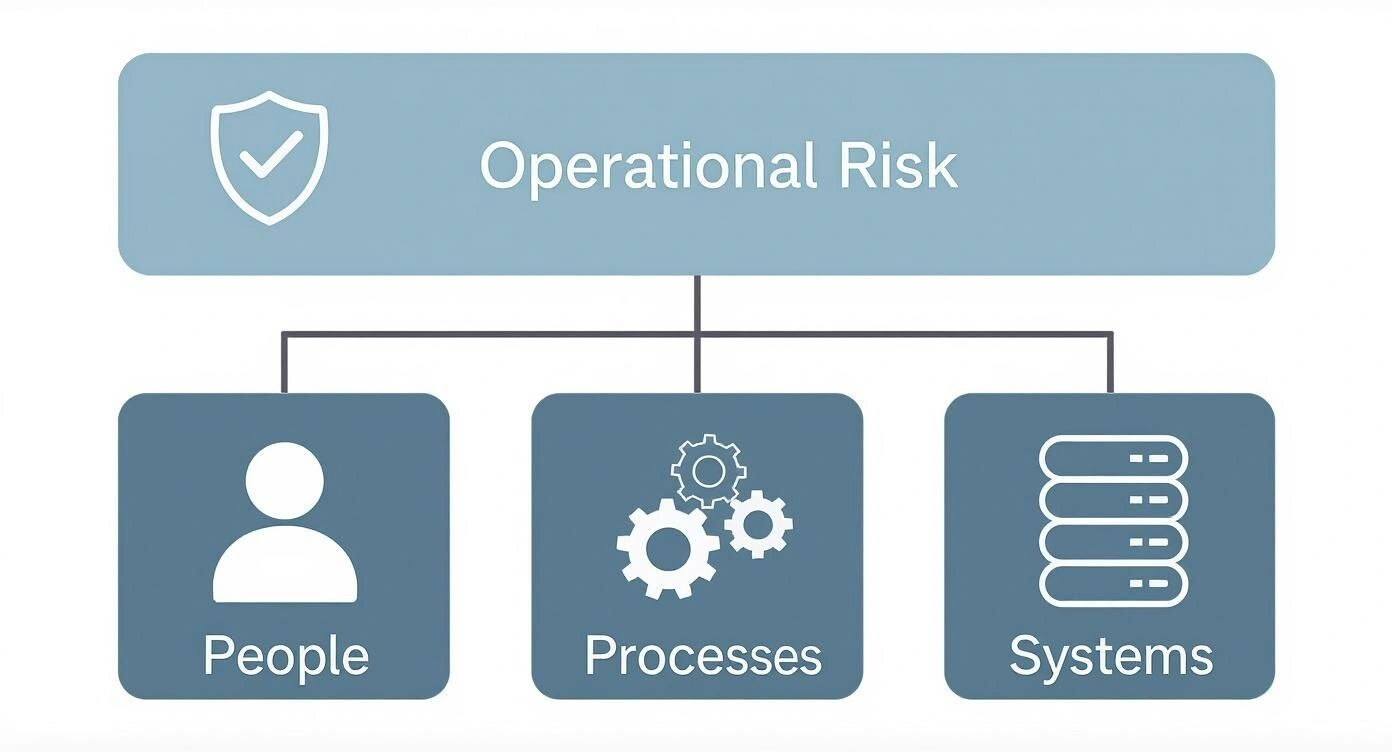
As you can see, the framework acts like an overarching shield, making sure that each part of your operation is considered and protected.
Keeping Your Finger on the Pulse
Finally, we have Monitoring and Reporting. This part is so, so important. An operational risk management framework isn’t a ‘set and forget’ project you finish once and then file away. It’s a living, breathing part of your business rhythm.
You need to check in regularly. Are your mitigation plans actually working? Have new risks popped up since your last review? Are old risks becoming more or less of a big deal?
This involves setting up simple ways to track key risk indicators and establishing a straightforward reporting process. This ensures that leadership always has a clear, up-to-date view of the company’s risk profile, which allows for smarter, more informed strategic decisions. It keeps the entire process grounded in the reality of your day-to-day operations.
Why This Framework Is Worth the Effort
I get it. Looking at all these components and processes probably seems like a mountain of work, especially when your to-do list is already overflowing. Is it genuinely worth the effort?
Yes. Absolutely. And the benefits go way beyond just ticking a compliance box.
The most immediate payoff is having fewer nasty surprises completely derail your week. Or your month. When you’ve already taken the time to think through what could go wrong, you and your team are just better prepared to handle it. The panic fades because a plan, even a simple one, already exists.
But the real value runs much deeper than just dodging crises.
Moving from Guesswork to Guidance
A clear operational risk management framework gives your team the confidence to make better, more consistent decisions. They aren’t just guessing what to do when something unexpected happens. They have a playbook.
This consistency is gold. It means that no matter who is on shift or which department is involved, the response to a known risk will be predictable and effective. This removes so much friction and second-guessing from your daily operations, letting people act with conviction.
When your team has a clear set of guidelines, they can focus their energy on solving the problem, not on figuring out the process.
This shift from reactive scrambling to proactive problem-solving builds a calmer, more controlled environment for everyone.
Building Trust Inside and Out
Think about it from a customer’s perspective. Or a partner’s. When they see a business that handles disruptions smoothly and professionally, it builds incredible trust. It sends a powerful signal that you’re running a well-managed, reliable organisation that takes its responsibilities seriously.
This isn’t just a “nice-to-have”. In a competitive market, reliability is a huge differentiator. Customers stick with businesses they can count on, especially when things don’t go perfectly. An effective framework is a tangible sign of your commitment to stability and quality.
This applies internally, too. When employees see a structured approach to managing problems, it boosts their confidence in the company’s leadership. They feel more secure knowing there’s a plan in place to protect the business and, by extension, their jobs.
A Competitive Edge and a Regulatory Necessity
For some industries, this isn’t even a choice. For businesses in the financial sector, for instance, a robust framework is a non-negotiable regulatory requirement. New standards like APRA CPS 230 are placing an even greater emphasis on operational resilience, setting clear expectations for how institutions manage these risks. To learn more, you can read detailed insights about the new standard on Regulation Tomorrow.
But even if it isn’t mandatory for your industry, you should see it as a powerful competitive advantage.
Imagine two businesses get hit by the same unexpected supply chain disruption.
- Business A has no framework. They scramble, teams blame each other, communication breaks down, and customers are left in the dark for days. It’s a mess.
- Business B has a framework. They activate their pre-agreed plan, notify key stakeholders immediately, switch to a backup supplier, and keep customers informed.
Which business do you think comes out stronger? The one that can weather the storm is the one that survives and ultimately thrives. That resilience is what an operational risk management framework is all about. It’s an investment in your company’s future.
Putting Your Framework into Action
Alright, theory is one thing. Making this real is what actually counts. It’s easy to talk about frameworks and processes, but how do you get one off the ground without it turning into a bureaucratic nightmare?

Your very first move has nothing to do with flowcharts or spreadsheets. It’s about people. You need genuine buy-in from your senior leadership team. This can’t be some side project owned by a single department; it needs to be seen and felt as part of the company’s core culture.
Without that top-down support, you’re just pushing a very heavy rock uphill.
Start Small to Win Big
Don’t try to map every single risk across the entire business on day one. I’ve seen teams try that. It’s overwhelming, and you’ll almost certainly lose momentum before you get anywhere meaningful.
Instead, pick one critical process to focus on. Something tangible.
- Customer Onboarding: What are the common points of failure when bringing a new client into the fold?
- Order Fulfilment: Where do delays or errors typically creep in between a sale and the delivery?
- Payroll Processing: What happens if the person who runs payroll is suddenly unavailable for a week?
Walk through the chosen process step-by-step with the people who actually do the work every day. They know where the real gremlins are hiding. Identify the risks, assess them together, and create a few simple, practical mitigation plans. This initial exercise becomes your proof of concept.
Document for Usefulness, Not Complexity
As you go, document everything. But please, resist the urge to create a hundred-page manual that nobody will ever read. Seriously. That document just becomes a risk in itself, sitting on a server gathering digital dust.
The goal is to create something genuinely useful, not something complex that just ticks a box. Use simple flowcharts. Write in plain language. If it takes more than a few minutes for someone to understand a process map, it’s too complicated.
For instance, really understanding a workflow is a huge part of this, and some businesses even use specific techniques for it. You can learn more about getting a clear picture of your workflows in our article explaining what process mining is. It’s a powerful way to see what’s really happening versus what you think is happening.
The best operational risk management framework is one that people actually use. A simple, living guide is infinitely better than a perfect, ignored masterpiece.
This hands-on approach also helps you stay agile. The way we think about operational risk management in Australia has evolved significantly , moving away from static documents towards more dynamic, responsive systems. Regulators and industry leaders are increasingly focused on building true resilience, not just compliance paperwork. You can discover more insights about this shift in thinking on the APRA website.
Make It Relevant to Your Team
And here’s the most important part… train your people. This is non-negotiable.
Don’t just send out an email with a link to a shared document. Sit down with your teams and walk them through it. Show them how this new framework actually makes their jobs easier, not harder.
Explain how it protects the company, their roles, and helps prevent those chaotic, stressful “fire drill” days they all hate. When people understand the ‘why’ and see how it directly benefits them, they’re far more likely to embrace it.
Make it relevant to their world. Connect the dots between a risk on a spreadsheet and a real-world headache they’ve personally experienced. That’s how you turn a theoretical framework into a powerful, practical tool for everyone.
Your Next Steps Toward Building Resilience
https://www.youtube.com/embed/z7dQXX74WDc?feature=oembed
We’ve covered a lot of ground. By now, I hope it’s clear that an operational risk management framework isn’t some abstract, overly complicated thing cooked up by consultants. It’s just a structured, common-sense way to prepare for the inevitable hurdles and hiccups any business will face.
Your journey can begin with something surprisingly straightforward. A simple conversation.
Start a Conversation
No, really. Just ask your team what they’re worried about. What are the day-to-day issues that keep them up at night? Which process feels like it’s being held together with nothing more than sticky tape and good luck?
That’s your starting point. Not some hundred-page document, but a genuine, honest chat about where the real vulnerabilities are.
The most powerful insights often come from the people on the front lines, not from a boardroom strategy session. Their worries are your first, most important risk register.
Remember, the goal is progress, not perfection. It’s far too easy to get stuck trying to design the ‘perfect’ system right out of the gate. But a simple, clear framework that people actually use is infinitely more valuable than a complex one that gathers digital dust on a server.
Make It a Living Part of Your Business
The real secret is to keep it practical, keep it relevant, and most importantly, keep it alive. This isn’t a one-and-done project. It has to become part of the regular rhythm of your business—something you discuss, review, and refine as the company evolves.
Making this investment is one of the most effective things you can do to safeguard the business you’ve worked so hard to create. It’s about fostering a culture of preparedness, not one of constantly fighting fires. It’s about building genuine, lasting resilience from the inside out.
And if you feel you need a partner to help navigate the technical and compliance side of things, our AI agency is here. We can help you build an operational risk management framework that’s not just a document, but a truly effective tool for your business.
Common Framework Questions Answered
Alright, let’s tackle a few of the common questions that always seem to pop up when people start digging into building an operational risk management framework. It’s completely normal to have these floating around in your head.
What’s the Difference Between Operational Risk and Other Risks?
This one comes up all the time, and it’s a great question because the lines can seem blurry at first.
Imagine your business is a professional kitchen. Strategic risk is the big-picture bet you make—like deciding to open a fine-dining French restaurant in a town that only wants pizza. If the core strategy is flawed, you’re in trouble. Financial risk , on the other hand, is about the money—the price of your key ingredients suddenly skyrocketing, wrecking your profit margins.
Operational risk is what happens inside the kitchen during service. It’s a key chef calling in sick during the dinner rush, the main oven breaking down, or a waiter dropping a tray of food. It’s the risk of things going wrong in the actual ‘doing’ of your business… the breakdown of your day-to-day processes, people, and systems.
How Often Should We Review Our Framework?
This is definitely not a one-and-done task you can tick off a list and forget about. Your business isn’t static, so your risk framework can’t afford to be either.
A good rule of thumb is to schedule a thorough, deep-dive review at least once a year. This is your chance to pull everything apart, see what’s working, and identify what’s become outdated or irrelevant.
But—and this is a big but—you also need to revisit it any time there’s a significant change in your business.
These trigger events could be things like:
- Implementing a major new software system.
- A significant team or leadership restructure.
- Entering a new market or launching a new product line.
Your operational risk management framework needs to evolve right alongside your business. Think of it as a living guide, not a dusty manual on a shelf.
Do We Need Special Software for This?
Honestly? You don’t need it to get started. Don’t let the idea of sourcing and paying for expensive software become a reason for delaying the important work.
You can absolutely begin with well-organised spreadsheets and shared documents. The most important thing is to get the thinking and the processes right first. A fancy tool won’t fix a broken process; it will just highlight the flaws more efficiently.
However, as your business grows and your risk profile becomes more complex, dedicated Governance, Risk, and Compliance (GRC) software can be a massive help. It automates tracking, makes reporting much simpler, and gives you a single source of truth so nothing important falls through the cracks.
My advice? Start simple. Only begin looking into specialist software when your manual process starts to feel clunky and inefficient.
At Osher Digital , we help businesses build robust operational systems that are ready for whatever comes next. If you need a partner to help integrate technology and build a framework that drives real resilience, our AI agency is here to help you get it right.
Last updated on July 1, 2026
Continue Reading
View all
n8n Outlook Automation: Where the Node Stops and Graph Begins
n8n Outlook automation breaks in predictable places: subfolders, attachments, shifting email IDs, plus the Graph API workarounds we run in production.
Mar 16, 2026

What Is a Workflow? Definition, Parts, and What Breaks
A workflow is the repeatable set of steps that takes a task from start to finish. Here is what a workflow is made of, and the parts that quietly break.
Mar 1, 2026

Aussie Guide to Marketing Automation for Small Business
Imagine having an extra team member who works around the clock, remembers every customer's name and history, and never once asks for a day off. That is the real power of marketing automation, and it is a complete game changer for small businesses. At its core, marketing automation is just software designed to handle routine […]
Dec 11, 2025
Sick of reading about automation?
Book a free 15-minute intro call. We’ll talk through what you’re trying to automate and whether we’re a good fit.