What is System Integration? A Quick Guide to Boosting Your Efficiency
System integration is all about connecting your different software and applications so they can share information and work together as one big, happy team. It’s about breaking down the digital walls between your departments so data can flow freely, automating tasks and making your whole business run a lot smoother. What is System Integration? I […]
By Matthew Clarkson · November 15, 2025

System integration is all about connecting your different software and applications so they can share information and work together as one big, happy team. It’s about breaking down the digital walls between your departments so data can flow freely, automating tasks and making your whole business run a lot smoother.
What is System Integration?
I bet you’ve felt the pain of disconnected systems. You know the feeling. It’s that marketing platform that just won’t talk to your sales CRM. Or the finance software that lives on its own little island, forcing your team to manually copy and paste data for hours.
It’s tedious. It’s slow. And it’s a massive, hidden drain on your business’s resources and momentum. That’s the exact problem system integration is designed to fix.
Tearing Down the Digital Walls
System integration is about making all your separate software and apps work like a single, cohesive team. This isn’t just about plugging in technology; it’s about connecting the very heart of your business operations.
Think of your business as an orchestra.
Each instrument, your CRM, your accounting software, your inventory system, is brilliant on its own. But if they’re all playing from different sheet music, the result is just noise. A chaotic mess.
System integration is the conductor who gets every instrument to follow the same score. The result? A harmony that’s far more powerful than what the individual parts could ever create alone.
This process involves building the digital pathways that let data move automatically from one system to another. It’s here that the underlying plan, what the experts call the system architecture, becomes absolutely critical. This blueprint dictates how information will flow logically and seamlessly across your entire organisation.
When you get this right, the benefits are immediate and tangible:
- A Single Source of Truth: Everyone in the business works from the same, up-to-date data. No more conflicting reports or outdated spreadsheets causing confusion.
- Improved Efficiency: Repetitive, mind-numbing tasks like manual data entry between systems are automated, freeing up your team for more valuable work.
- Better Decision-Making: With a complete, unified view of your operations—from marketing and sales to finance and delivery—you can make smarter, more informed strategic choices.
It’s about turning a collection of standalone tools into a powerful, unified business machine. And in the next few sections, we’ll explore exactly how that happens.
The Main Types of System Integration
So, you get the core idea: system integration is like a conductor making sure all your separate software instruments play together in harmony. But what does that actually look like in practice? It’s not a one-size-fits-all solution, but a set of different approaches for different business problems.
Think of it like a toolbox. You wouldn’t use a sledgehammer to hang a picture frame, would you? The same logic applies here. Let’s unpack the main types of system integration, so you can see which approach best solves the specific operational headaches you’re facing.
This simple concept map shows how integration acts as a central hub, connecting key business functions like Marketing, Sales, and Finance to create a unified operation.
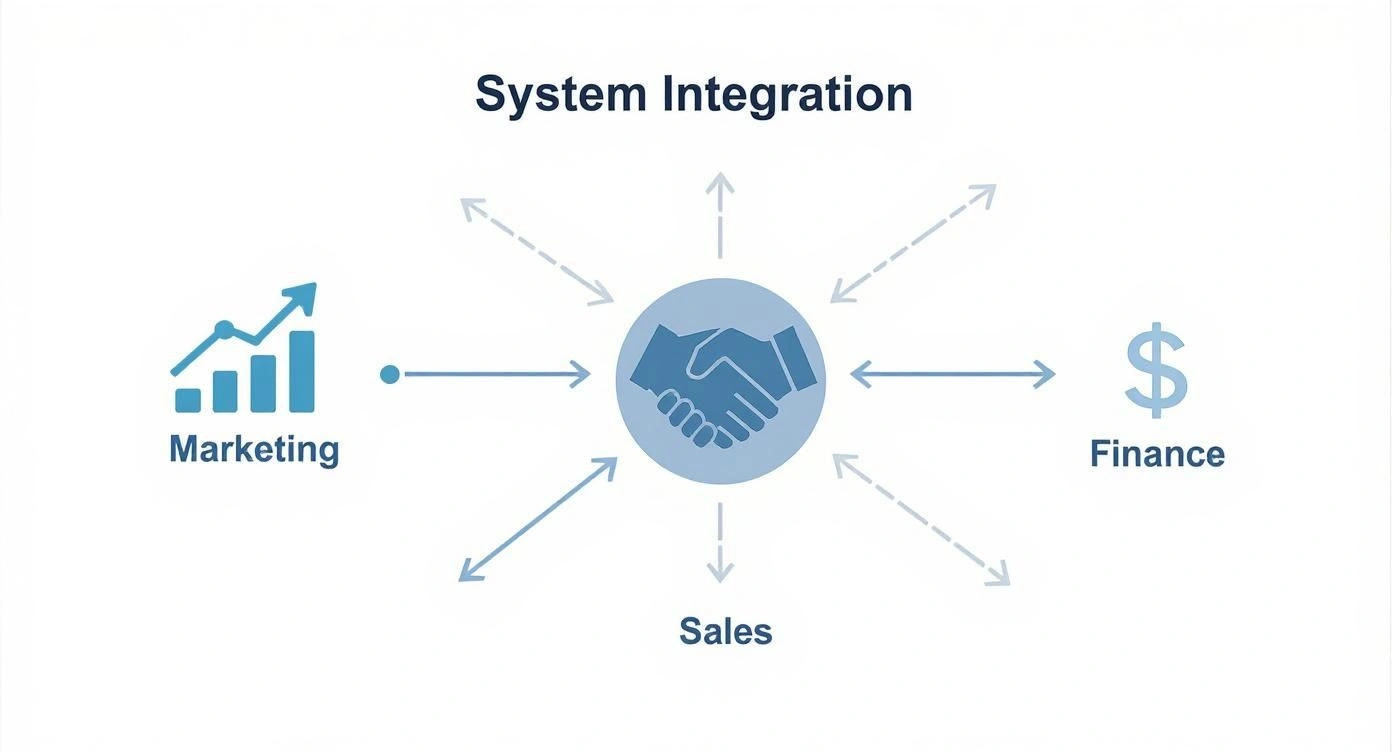
Ultimately, the goal is to stop these departments from working in their own little bubbles. It’s about getting them to share information automatically for the good of the entire business.
API Integration
This is probably the most common type you’ll hear about. Think of an API (Application Programming Interface) as a strictly controlled messenger that lets two different software applications talk to each other. It’s like giving them a dedicated phone line with very clear rules on what they can ask for and what information they can share.
A classic example is a payment gateway on an e-commerce site. When you enter your credit card details, your website doesn’t handle the sensitive data itself. Nope. Instead, it securely sends the information via an API to a gateway like Stripe. The gateway processes the payment and sends a simple “success” or “fail” message back. The whole thing is instant, secure, and completely automated.
Data Integration
While API integration is often about actions, data integration is all about the information itself. Its one and only purpose is to gather data from all your different systems—your CRM, your marketing platform, your accounting software—and bring it all together in a single, central spot like a data warehouse.
You’ve probably felt the pain this solves. The sales team pulls a report from their system, the marketing team pulls another from theirs, and the numbers don’t line up. It creates confusion and wastes hours of everyone’s time trying to figure out what’s what.
Data integration creates a single source of truth. When everyone in the business trusts the data they’re looking at, you can stop arguing about the numbers and start making genuinely informed decisions.
This is the bedrock of reliable business intelligence. If you want to dive deeper into this specific area, we have a complete guide on what is data integration that covers the topic in more detail.
Process and Workflow Integration
Now we’re getting into something really powerful. This type of integration moves beyond just sharing data; it automates entire business processes that span multiple departments and systems. It’s about linking a sequence of tasks that would otherwise involve countless manual handovers. It’s a game-changer.
Consider this everyday business workflow:
- A new customer makes a purchase on your website.
- That action automatically triggers an invoice to be created in your accounting software (e.g., Xero or MYOB).
- At the same time, an order notification is sent to your inventory system to begin the pick, pack, and ship process.
- Finally, the customer’s profile in your CRM is updated with their purchase history.
One event sets off a domino effect across the business, with no human intervention needed. No one is manually copying details, sending “please process” emails, or updating spreadsheets. This is how you build a truly efficient operation, freeing up your team to focus on work that actually requires their expertise.
The Tangible Business Benefits of Integration
Alright, let’s get to the important part: what’s in it for you? It’s one thing to talk about connecting systems in theory, but it’s the real-world business results that truly matter. System integration isn’t just a tech project for your IT department; it’s a powerful strategy that makes your entire business run smoother, smarter, and more profitably.
We’re talking about turning a technical solution into measurable improvements you can see and feel across the board. Think happier staff, delighted customers, and a much healthier bottom line.

Driving Huge Efficiency Gains
Think about all the time your team spends on manual, repetitive tasks. Copying customer details from an email into the CRM. Manually raising invoices from sales orders. Or chasing down spreadsheets from three different departments just to build one simple report.
It’s a massive time sink. And frankly, it’s soul-crushing work that nobody enjoys.
Integration automates all of this. It’s like hiring a super-fast, perfectly accurate assistant who works 24/7 without ever needing a coffee break. When your systems talk to each other, data moves automatically, workflows trigger themselves, and your team is freed up to focus on the work that actually requires a human brain—like talking to customers or thinking strategically.
Making Smarter, Faster Decisions
How confident are you in the data you use to make big decisions? If you’re like most businesses with disconnected systems, the answer is probably… “not very”. When data lives in separate silos, you’re always working with an incomplete, often conflicting, picture of reality.
You’re essentially guessing.
System integration changes the game by creating a single, reliable source of truth. When your sales, marketing, and finance data all flow into one place, you can finally trust the numbers. This means you can:
- See the full customer journey: Understand exactly how a lead found you, what they’re interested in, and their entire purchase history without jumping between five different tabs.
- React quickly to market changes: Spot trends as they happen, not a month later when someone finally compiles the report.
- Forecast with confidence: Make accurate predictions about future sales and revenue because you’re working with clean, consolidated data.
This isn’t a small thing. Fully integrated companies are four times more likely to see a return on new technology investments within a month. Even more telling, 77% of these businesses report outperforming their peers, showing a direct link between connected systems and a real competitive edge. You can explore more of these findings about business growth in Australia.
Improving the Customer and Employee Experience
This is a big one. When your systems are connected, everyone benefits. Your sales team can have a much warmer, more relevant conversation with a lead because they can instantly see all their recent marketing interactions.
Your support team can solve problems faster because they have a complete, unified view of a customer’s history. No more asking “can you remind me of your order number?” for the third time. This creates a seamless, professional experience that makes customers feel seen and valued.
And let’s not forget your own team. When you eliminate the daily frustrations of fighting with clunky, disconnected software, you improve morale. People are happier and more engaged when they can do their jobs effectively instead of wrestling with technology.
Ultimately, system integration is about creating flow. A flow of information that empowers your people, a flow of processes that eliminates waste, and a flow of value that keeps your customers coming back.
How System Integration Works in The Real World
Theory is one thing, but seeing how integration plays out in day-to-day business is where its value really clicks. This is where the abstract ideas become tangible, measurable improvements.
Let’s move beyond the diagrams and definitions to see how connecting systems actually works for teams on the ground.
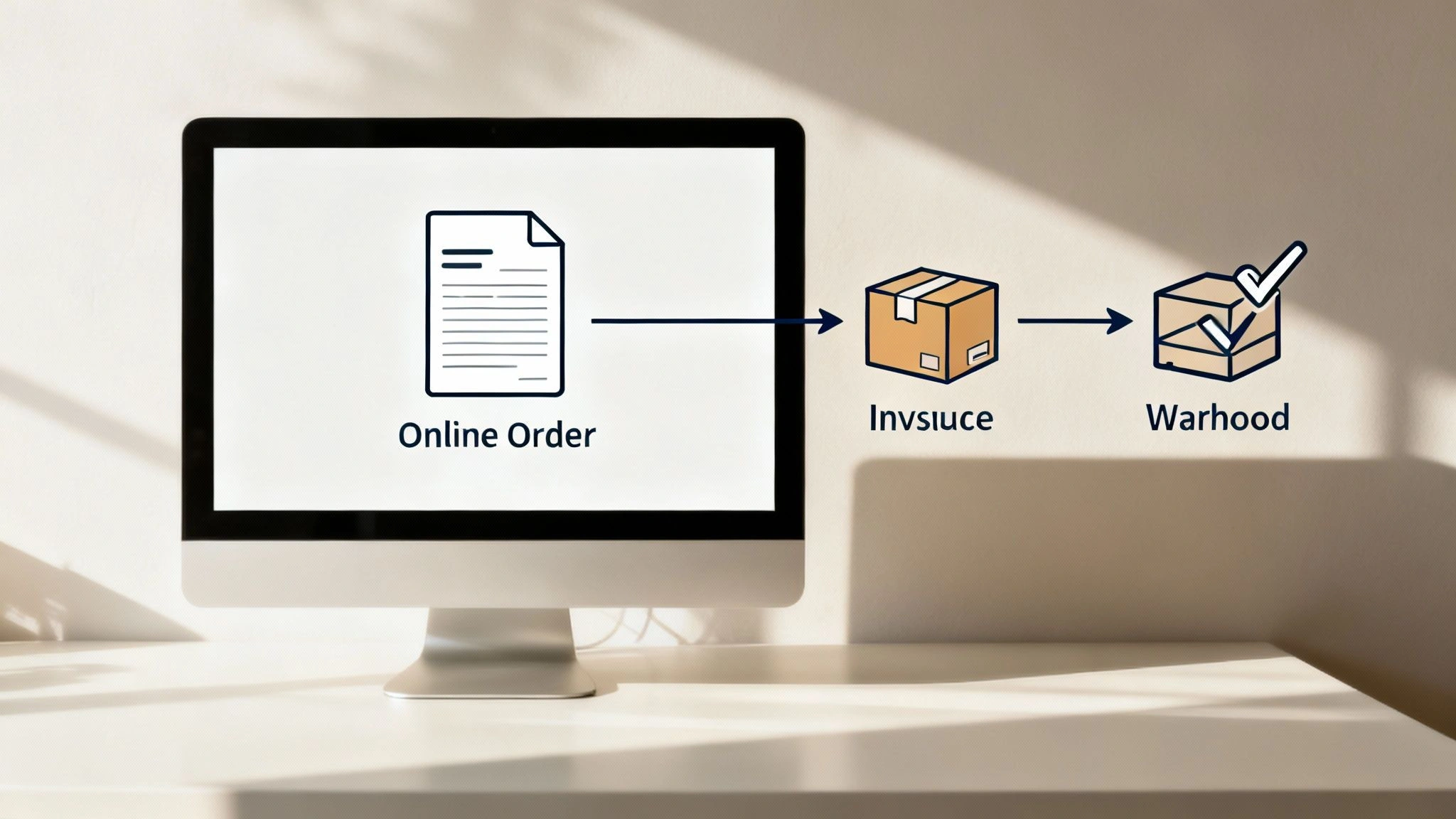
Think of these as snapshots from real businesses, showing how a connected tech stack changes the game for sales, marketing, and finance.
A Day in The Life of an Integrated Sales Team
Picture a typical salesperson, let’s call her Sarah. Before integration, her workflow was a mess of disconnected tabs. She’d hunt for lead activity in the marketing platform, manually log call notes in the CRM, then try to find old purchase records in a clunky spreadsheet.
It was inefficient and, worse, incomplete. She never had the full story on who she was talking to.
Now, with her company’s CRM and marketing automation platform properly integrated, Sarah’s workflow is unified. She sees a lead’s entire history on a single screen—the e-book they downloaded yesterday, the webinar they attended last week, the emails they’ve opened.
This transforms her call from a cold interruption into a timely, relevant conversation. She can talk about what the prospect is actually interested in, leading to a far more productive discussion and a much higher chance of success.
This is the reality of a 360-degree customer view. It’s not just a buzzword; it’s about giving your team the context needed to build genuine relationships and close deals faster.
Smarter Marketing with Real-Time Data
Now, let’s look at the marketing team. They’re in the middle of a major digital campaign, spending money across several channels. Without integration, they’d be flying blind, waiting days or even weeks to manually pull reports from each platform to figure out what’s working.
By the time they get the data… the budget is already spent. It’s too late to act.
When their analytics tools, ad platforms, and CRM are all talking to each other, the story is completely different. They get a live feed of campaign performance. If a particular ad creative is underperforming, they can pause it immediately and shift the budget to a winner.
This agility to optimise in real time is what separates good campaigns from great ones, stretching every dollar for maximum ROI. Making smart decisions with live data is a core benefit, and you can dig deeper into this by Mastering Marketing Automation Integrations.
Finance Without The Manual Headaches
Finally, consider the finance department, where integration can eliminate a staggering amount of manual work and costly human error.
Take an e-commerce company, for example. In a disconnected setup, every online purchase triggers a painful manual process: someone has to create an invoice in the accounting software, then update the inventory system, and finally reconcile the payment later on. It’s a bottleneck just waiting for a mistake to happen.
With well-executed integration, the entire process becomes seamless and automatic.
- A customer’s purchase on the website automatically generates a paid invoice in an accounting tool like Xero.
- The inventory management system is instantly updated, reflecting the correct stock level.
- The payment is automatically matched against the invoice during bank reconciliation.
This frees the finance team from the grind of repetitive data entry. Instead, they can focus their expertise on high-value activities like strategic financial analysis and forecasting, guiding the business forward.
Navigating Common Integration Challenges
It would be dishonest to say that connecting all your business software is always a simple flick of a switch. It’s not. Like any truly meaningful upgrade to your operations, system integration can have its hurdles.
The real trick is knowing what they are before you start.
This isn’t about scaring you off. It’s about giving you a clear-eyed view of the landscape so you can plan your route and avoid the common potholes that trip people up. Let’s have an honest look at what those are.
The Problem with Old Tech
One of the biggest headaches is dealing with older, legacy systems. You know the ones I’m talking about. That ancient accounting software or that custom-built database that’s been chugging along since the early 2000s.
These systems are often the backbone of the business, but they were never designed to talk to modern cloud tools. They don’t have nice, neat APIs just waiting to be connected. Getting them to share their data can feel like trying to teach a cat to fetch. It’s possible… but it requires patience and a clever approach.
The challenge isn’t just technical; it’s about bridging a gap between different generations of technology. You have to find a way to translate the old language into the new one without losing anything important in the process.
This often means you need a specialist who understands how to build those bridges, which brings us to the next point.
Keeping Costs and Timelines in Check
Let’s talk about the elephant in the room: budget. An integration project, if not managed with a tight grip, can easily spiral. The costs and timelines can creep up, especially when unexpected complexities arise… which they almost always do.
This is a very real risk. In fact, the Australian system integration market is seeing challenges with rising project costs and extended implementation timelines. It’s a common story, often made tougher by shortages in specialised cloud and AI integration talent. Despite this, the government’s focus on digital connection keeps driving demand for these skills. You can read more about the trends in the Australian integration market if you’re curious.
So, how do you avoid this?
- Start small: Don’t try to integrate everything at once. Pick one high-impact, low-complexity connection to start with.
- Get a clear quote: Make sure any partner you work with gives you a detailed scope of work. What’s included, and more importantly, what isn’t?
- Plan for the unexpected: Add a buffer to your timeline and budget. It’s better to have it and not need it than the other way around.
The All-Important Human Element
Finally, you can have the best technology in the world, but if your people aren’t on board, the project is doomed. System integration isn’t just an IT project; it’s a business change project.
It changes how people work.
Getting different departments, each with their own priorities and ways of doing things, to collaborate effectively can be a challenge in itself. You need to get buy-in from everyone, from the executive team down to the people who will be using the new, connected systems every day.
This means communicating the ‘why’ behind the project. It’s not about replacing people; it’s about freeing them from boring, repetitive tasks so they can do more valuable work. If you’re looking for more strategies on this, we’ve put together a guide on overcoming common system integration challenges.
A Simple Roadmap for Getting Started
So, you’ve seen the benefits, understand the potential roadblocks, and are probably wondering… what now? It’s easy to get a bit overwhelmed at this point, but honestly, kicking things off is simpler than you might think. You don’t need some monumental, year-long plan.
What you need is a roadmap. A straightforward, step-by-step guide to take you from “this sounds like a good idea” to actually getting it done. The aim here is to make meaningful progress, not to achieve perfection on day one.
https://www.youtube.com/embed/qistcC7_bEo?feature=oembed
Start With Your Biggest Headache
Before you even glance at any technology, ask yourself a simple question: What is the most annoying, time-sucking problem in our business right now?
Is it your sales team complaining they can’t see what marketing is doing with new leads? Is it the finance team burning the first week of every month manually pulling together reports? Find that single, most painful point of friction.
That’s where you begin. Don’t try to boil the ocean. Solving one high-impact problem first is the best way to build momentum and prove the value of integration to everyone else.
Audit Your Current Toolkit
Next, get a handle on the software you’re already paying for. You can’t connect the dots if you don’t even know where the dots are.
Just make a simple list:
- What’s in your sales stack? Think CRM, proposal software, and so on.
- What are your marketing tools? Your email platform, analytics, social media schedulers.
- How does finance operate? The accounting software, expense tracking apps, payroll systems.
This doesn’t need to be a dense technical document. A clear inventory of your main applications is all you need. You’ll probably see pretty quickly which systems are operating on their own isolated islands.
Define What Success Looks Like
Once you have your problem and a list of your tools, you need to set a clear, measurable goal. “Improving efficiency” is far too vague and won’t get you anywhere.
Try something more concrete, like this:
“We want to automatically create a new invoice in Xero every time a deal is marked as ‘won’ in our CRM. This should save the finance team an estimated 10 hours per month.”
Now that’s a specific, achievable goal. It has a definite outcome and a benefit you can actually measure. This kind of clarity is absolutely critical, especially when you need to get buy-in from other departments. One of the biggest mistakes businesses make is treating integration as an afterthought, which a recent report found often leads to messy, fragmented results. You can read more about why embedding integration early is so critical.
Choosing the Right Partner or Platform
With a clear goal in hand, you can finally start looking at solutions. Your choice will usually fall into one of two camps: a do-it-yourself integration platform (like Zapier for simpler tasks) or a specialised integration partner for the more complex, mission-critical jobs.
Here are a few vendor-agnostic things to keep in mind:
- Does it connect to the systems you actually use? This is the absolute baseline. If it doesn’t, it’s a non-starter.
- Can it grow with you? Think about the future. Will it be able to handle more sophisticated workflows as your business needs evolve?
- What does the support look like? Because things can and do go wrong. When they do, you’ll want solid help on standby.
Taking these small, manageable steps turns a big, intimidating concept into a straightforward, achievable project. If you’d like a hand figuring out this roadmap, our team at Osher, a leading AI agency, specialises in creating these kinds of smart connections. We’re always happy to help.
So, What’s the Real Takeaway on Connecting Your Business?
When you boil it all down, system integration isn’t just a technical exercise tucked away in an IT project plan; it’s a fundamental business strategy. The whole point is to demolish the invisible walls that have grown between your departments, fostering a genuinely unified organisation that works smarter, not just harder.
Connecting your systems is about so much more than just pushing data from point A to point B. You’re actually creating a seamless, uninterrupted flow of information across the entire company.
This free flow of data empowers every single person to do their best work. It gets rid of those soul-crushing manual tasks nobody wants to do and, most importantly, leads to a massively better experience for your customers. In today’s market, that’s a non-negotiable advantage.
Make no mistake, this is a journey, not a sprint. It demands careful planning and some tough decisions along the way. But for any business serious about growth and staying relevant, it’s a journey you simply have to take.
If you’re fed up with fragmented data, clunky workarounds, and that persistent feeling that your teams are capable of so much more, it’s probably time to get serious about your integration strategy.
Need a hand mapping out the next steps or navigating the complexities? Our team at Osher, a leading AI agency, specialises in creating these powerful, business-defining connections. We’d genuinely love to chat about how we can help.
Frequently Asked Questions
It’s completely normal for questions to pop up when you’re wading into the world of system integration. Let’s face it, it can seem pretty dense at first glance.
We’ve heard them all over the years. Here are our answers to a few of the most common queries we get, explained in straightforward terms.
How Long Does a Typical System Integration Project Take?
This is the classic “how long is a piece of string?” question. Honestly, the timeline can vary dramatically.
A straightforward project, like linking two modern cloud applications using an existing connector, might only take a matter of days. You’d be surprised how quickly some things can be hooked up. On the other end of the spectrum, a complex overhaul involving multiple legacy systems, custom coding, and extensive data mapping could easily stretch over several months.
Our advice? Always try to break the project into smaller, manageable phases. This approach lets you score some valuable wins early on and build momentum.
Is System Integration Only for Big Companies?
Not at all—that’s a common misconception. While large enterprises certainly have sprawling systems that demand integration, it’s often small and medium-sized businesses that see the most dramatic benefits.
Thanks to modern iPaaS (Integration Platform as a Service) tools, connecting essential apps like Xero, Shopify, and HubSpot has never been more affordable or accessible. The goal is universal, regardless of your company’s size: work smarter, boost efficiency, and make better, data-backed decisions.
Can We Do This Ourselves, or Do We Need to Hire Someone?
This really boils down to two things: your team’s in-house technical skills and their available time.
Some simpler, point-to-point integrations can absolutely be tackled internally, especially with the user-friendly platforms available today. However, for more complex or business-critical projects that touch your core operational systems, bringing in a specialist integration partner is often the wiser move.
An experienced partner has seen it all before. They know where the common pitfalls are and how to navigate around them, which can save you a phenomenal amount of time, money, and frustration down the line.
At Osher , creating these smart, business-defining connections is what we do. If you need a hand figuring out your next steps, our AI agency is always ready for a chat.
Last updated on July 1, 2026
Free tool · 2 minutes
Automation ROI Calculator
See what a manual process is really costing you, and the payback on automating it.
Continue Reading
View all
A Simple Guide to Data Integration
Imagine your business data is a collection of puzzle pieces, but they’re all stored in different boxes. Your sales figures are in one box, customer feedback is in another, and your stock levels are tucked away in a third. Data integration is the art of bringing all those scattered pieces together to reveal the complete […]
Dec 18, 2025

Customer Data Integration: Build a Unified View with Real-World Examples
Customer data integration is all about creating a single, trustworthy source of truth for every customer. It’s the process of pulling together information from all your scattered business systems, like your sales software, marketing platform, e-commerce site, and support desk, to build one complete picture. This makes sure everyone, from sales to support, is working […]
Dec 13, 2025

What Is Data Integration
On the surface, “data integration” might sound like another bit of corporate jargon. A bit dry, right? But let’s cut through the noise and get to what it really means for you and your business. So What Is Data Integration? Think of it like trying to solve a puzzle where you’ve got pieces scattered everywhere. […]
Nov 11, 2025
Sick of reading about automation?
Book a free 15-minute intro call. We’ll talk through what you’re trying to automate and whether we’re a good fit.