AI Driven Decision Making for Australian Enterprises
Unlock growth with AI driven decision making. Our guide for Australian enterprises covers strategy, governance, & implementation for smarter, faster decisions.
By Matthew Clarkson · July 17, 2026

Most leadership teams are still making important calls with a patchwork of spreadsheets, gut feel, and yesterday's reports. Demand shifts, a supplier slips, a customer segment behaves differently, and by the time someone notices, the window to act has narrowed. That used to be accepted as normal operational friction. It shouldn't be.
In Australia, the practical case for AI driven decision making has moved well past experimentation. The local ecosystem now includes 1,533 AI companies, 41% of small and medium enterprises are adopting AI, and Australia's data analytics market was valued at AUD 2.00 billion in 2024 and is forecast to reach AUD 19.08 billion by 2034, according to the Australian AI ecosystem report. That tells you something important. This isn't a fringe capability anymore. It's becoming part of how serious businesses operate.
Leaders feel this most clearly in functions where speed and consistency matter. Hiring is a good example. If you want a grounded look at where AI can help without handing over judgment, this guide to mastering AI in recruiting is useful because it shows how decision support can improve a workflow that often gets bogged down by volume and inconsistency.
The harder question isn't whether AI belongs in decision-making. It's where it belongs, how much authority it should have, and what kind of governance keeps it useful rather than risky. You can see the shape of that journey in real operational programs and case studies from Australian delivery work, where the value usually comes from tightening a messy process, not from adding another dashboard.
Moving Beyond Guesswork in Business
Monday morning. The leadership team is reviewing last week's numbers. Sales softened in one region, customer service queues blew out, and inventory is building in the wrong warehouse. Everyone has an explanation. Few of them are working from the same evidence, and by the time the reports are consolidated, the best window to act has already narrowed.
That is the true cost of guesswork. It is rarely one dramatic mistake. It is a steady pattern of late calls, uneven judgment, and missed opportunities across everyday decisions.
For Australian businesses, the challenge is even more practical than theoretical. Models trained on generic overseas data often miss local demand patterns, regulatory settings, seasonal cycles, and customer behaviour. A recommendation engine that looks convincing on paper can still make poor calls in a market shaped by Australian pricing pressures, state-based operating differences, and smaller data pools. Good AI decision-making starts with local context, then adds human review where the cost of a wrong call is high.
The strongest use cases are usually ordinary and repetitive. Which accounts show early churn risk. Which orders should be expedited. Which claims deserve escalation. Which applicants merit a closer look. In hiring, for example, mastering AI in recruiting is a useful reminder that the goal is not to hand judgment to a model. The goal is to sort high-volume inputs faster so people can focus on exceptions, bias checks, and final decisions.
Practical rule: Start with recurring decisions that affect margin, service levels, or risk, and already force staff to triage manually.
What leaders are buying is faster, more consistent decision support inside the workflow. A good system surfaces signals earlier, recommends an action, and leaves an audit trail a manager can challenge. It works more like a well-set dashboard in a fleet vehicle than a self-driving car. The driver stays responsible, but the blind spots get smaller.
That approach also makes implementation more realistic. Few enterprises need full automation on day one. They need a human-in-the-loop setup that improves decision speed without creating governance headaches. You can see that pattern in Australian AI implementation case studies across delivery and operations, where the gains usually come from fixing a specific bottleneck, not chasing a grand transformation story.
The commercial upside is straightforward:
- Less rework: Fewer avoidable errors picked up late
- Less lag: Teams act on current signals instead of waiting for monthly reporting
- More consistency: Similar cases get similar treatment across teams and locations
- Better focus: Managers spend time on exceptions, not routine sorting
That is how businesses move beyond instinct-led planning. They keep human accountability, use local data that reflects the Australian market, and apply AI where it improves the quality and speed of repeat decisions.
What Is AI Driven Decision Making Really
Think of AI driven decision making as an expert co-pilot, not an autopilot. An autopilot takes over. A co-pilot helps the person in charge see more, weigh options faster, and avoid obvious mistakes. The captain still lands the plane.
That's the most useful mental model for executives. Good AI systems don't replace leadership. They organise noisy information, highlight likely scenarios, and give reasons that a human can challenge.
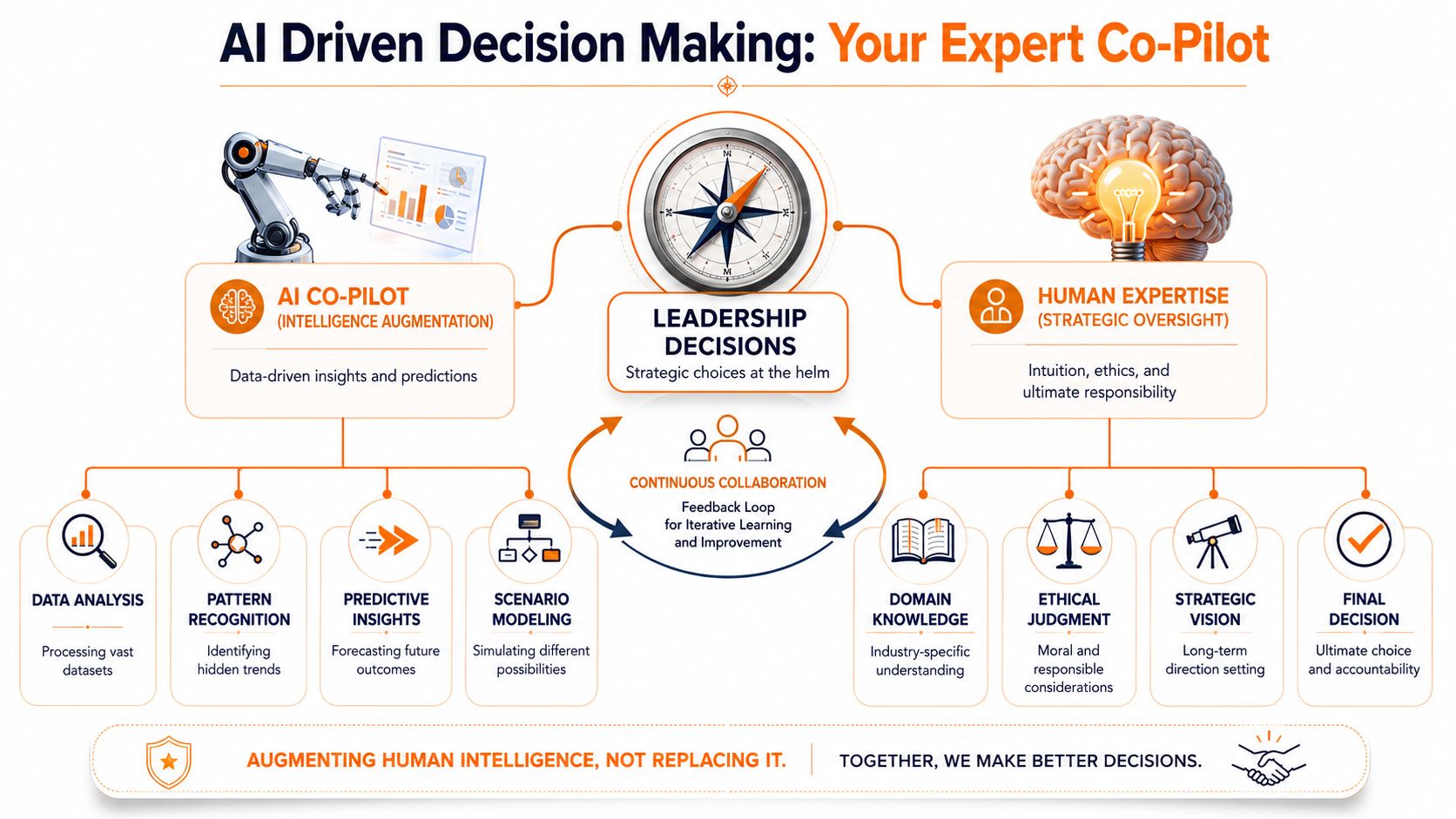
Co-pilot versus simple automation
Basic automation follows a rule. If invoice is overdue, send reminder. If stock falls below threshold, raise order. That's useful, but it's not the same thing.
AI driven decision making sits a step higher. It asks questions like:
- What's most likely to happen next
- Which cases are normal and which are exceptions
- What action is recommended, and why
- How confident is the recommendation
That difference matters because leaders usually don't struggle with obvious cases. They struggle with ambiguous ones.
Why the AI-SDM idea matters
A better way to frame this has emerged in the AI-Supported Shared Decision-Making model. It treats AI as a “reasoning facilitator” rather than an autonomous decision maker, with an emphasis on specific explanations and transparent insights that support human expertise while preserving context and autonomy, as outlined in the AI-SDM framework discussion.
That language is more practical than it sounds.
In plain terms, your system shouldn't just say, “Approve this customer”, or “Escalate this claim”. It should help the human understand why that recommendation surfaced. If the explanation is weak, the recommendation is weak.
Good AI support feels like a sharp analyst sitting beside your team, not a sealed box issuing instructions.
The test that separates useful from dangerous
Ask three questions of any AI decision tool:
| Question | Why it matters |
|---|---|
| Can a manager understand the recommendation? | If not, they'll either ignore it or trust it blindly |
| Can a person override it? | Accountability still sits with the business |
| Does it improve a real decision point? | If it doesn't change behaviour, it's just software theatre |
Many projects drift off course because teams buy a model when they really need a decision process. The model becomes the shiny engine. Nobody checks whether it's connected to the wheels.
The Real Business Value for Your Enterprise
If AI driven decision making only produced interesting insights, most leadership teams would ignore it. It gets budget because it changes operating performance.
Across Australian enterprise programs, AI deployments have delivered approximately 35% efficiency improvements, decision-making cycles accelerating by up to 75%, and average operating cost reductions approaching 40%, according to analysis of AI use in Australian enterprises. Those numbers matter because they map directly to problems executives already own: too much manual effort, too much lag, and too much cost in exception-heavy workflows.
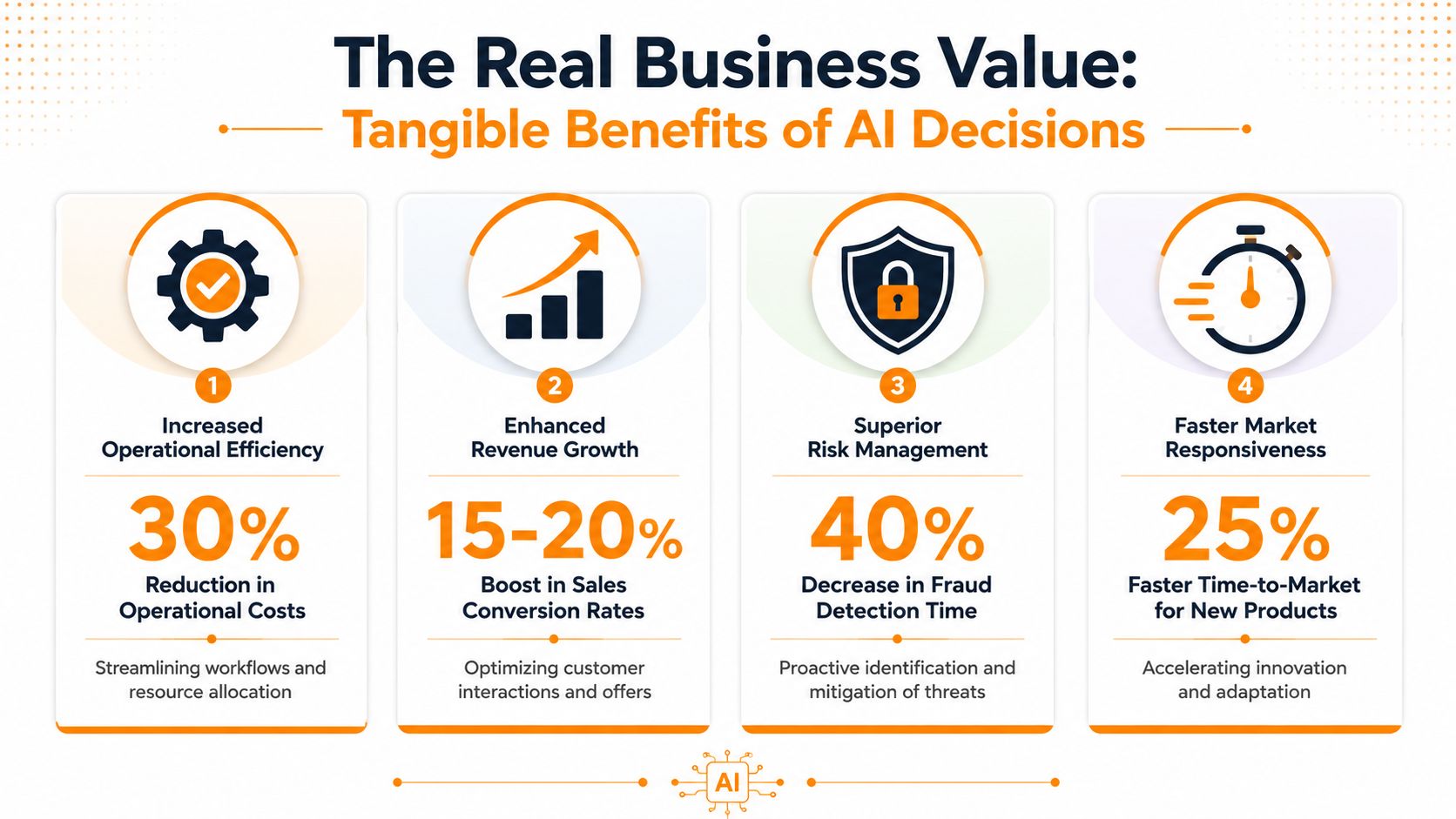
Where the value shows up first
The fastest wins usually come from decisions that happen daily and gradually build up.
- Operations and logistics: Prioritising orders, routing exceptions, and spotting disruption earlier
- Finance: Flagging anomalies, improving approvals, and reducing manual review queues
- Sales and service: Recommending next best actions and triaging inbound demand
- Back-office processing: Classifying documents, extracting key data, and directing work to the right team
A lot of this depends on clean inputs and good workflow design. For teams dealing with fragmented files, forms, and system handoffs, automated data processing services are often part of the groundwork because bad inputs produce bad recommendations.
Why speed matters as much as accuracy
Many leaders focus on prediction quality and miss the larger gain. In practice, faster decision cycles often create more value than a marginal lift in precision.
If a pricing team gets a useful recommendation early, they can act while there's still opportunity. If risk teams spot a pattern before a queue blows out, they contain the issue rather than cleaning up afterwards. If customer operations can identify which cases need a person and which do not, they protect both service quality and cost.
Here's a useful walkthrough of the wider topic in business terms:
What works and what doesn't
What works:
- Embedding AI inside a process rather than bolting it onto reporting
- Giving teams clear intervention points so humans handle the edge cases
- Measuring cycle time and cost around a specific workflow
What doesn't:
- Buying broad platforms before defining the decision
- Treating every recommendation as equally important
- Assuming one model can serve every department
Bottom line: The value doesn't come from the model being clever. It comes from the business making better calls sooner, with less manual drag.
Building Your Governance Framework
A governance gap usually shows up after the first bad call. A claims team follows an AI recommendation, a customer disputes the outcome, and leadership is left answering basic questions. Why did the system suggest this, who approved it, and why was there no review step for an edge case?
Good governance prevents that scenario. It works like guardrails on a motorway. The point is not to slow every decision. The point is to keep speed from turning into avoidable risk.
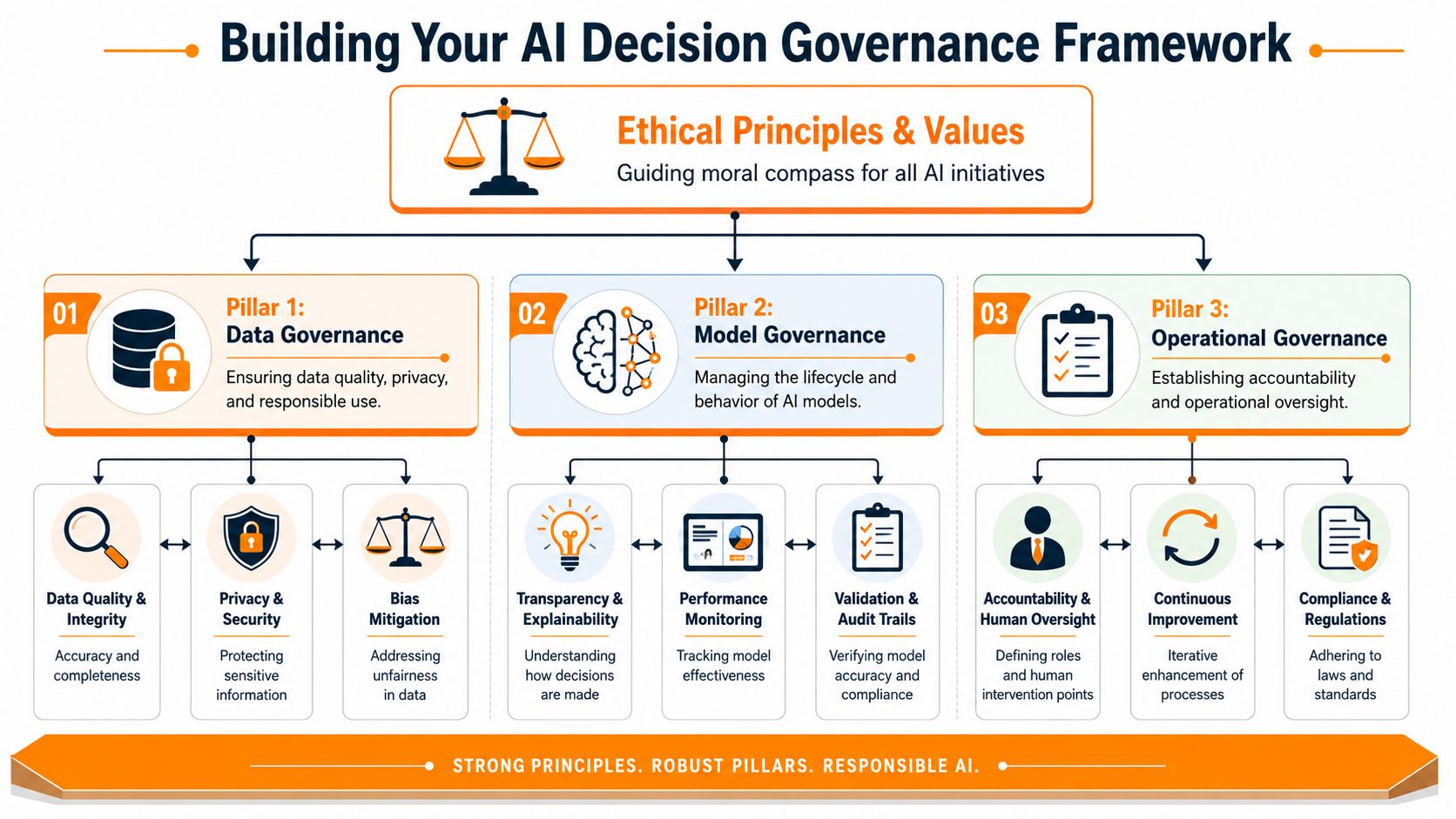
The three pillars that matter
In practice, governance for AI decision-making rests on three areas. If one is weak, the whole system becomes harder to trust.
Data discipline
Governance starts with the data, especially in Australia where business conditions, customer behaviour, regulation, and service patterns often differ from US or UK training environments. A model trained on overseas assumptions can still produce polished outputs, but polished is not the same as useful.
Check:
- Data quality: Are the records complete, current, and reliable
- Data suitability: Does the dataset reflect the decision context, including local business rules and customer conditions
- Data rights: Do you have a clear basis to use this data for this purpose
Localisation matters here. If an Australian lender, insurer, retailer, or public sector team uses generic external data without adapting it to local context, the model can miss risk signals that experienced staff would catch quickly.
Model oversight
Models need active supervision across their full working life. That includes documenting the use case, test conditions, known failure points, approval thresholds, and the point where a person reviews or overrides the recommendation.
Human-in-the-loop design should be deliberate, not symbolic. High-risk decisions need stronger review gates. Lower-risk decisions can move faster with exception handling. That trade-off is what separates sensible automation from black-box automation.
The Australian Digital Transformation Agency gives leaders a practical reference point. Its lifecycle approach across Discover, Operate, and Retire sets out expectations for ethical risk assessment, bias mitigation, monitoring, and human oversight in the DTA technical standard for responsible AI adoption.
Operational accountability
Every AI-assisted decision needs a named owner in the business. Someone has to decide what good performance looks like, what failure looks like, who gets alerted, and when the system should be paused.
Committees still have a role, but ownership cannot stop at a steering group. Operations, risk, legal, and frontline leaders all need defined responsibilities. Otherwise problems sit in the gap between teams.
A practical operating model usually includes:
- Before launch: Define the decision scope, risk level, escalation path, and human review points
- During operation: Monitor output quality, drift, complaints, exceptions, and override rates
- At retirement: Remove outdated models cleanly so old rules and unsupported logic do not remain in production
For leaders who want a broader commercial view, ThirstySprout's expert AI insights offer a useful companion read on governance habits that hold up in real delivery environments.
Some organisations also bring in AI governance and implementation consultants to set decision rights, review workflows, and model accountability across business and technical teams.
Governance is the discipline that keeps AI useful, explainable, and safe when the pressure is real.
A Pragmatic Roadmap to Implementation
Most AI projects fail before the model fails. They fail because the business picked the wrong problem, skipped the workflow redesign, or tried to scale before anyone had proof.
A better path is simple. Assess, pilot, then scale.
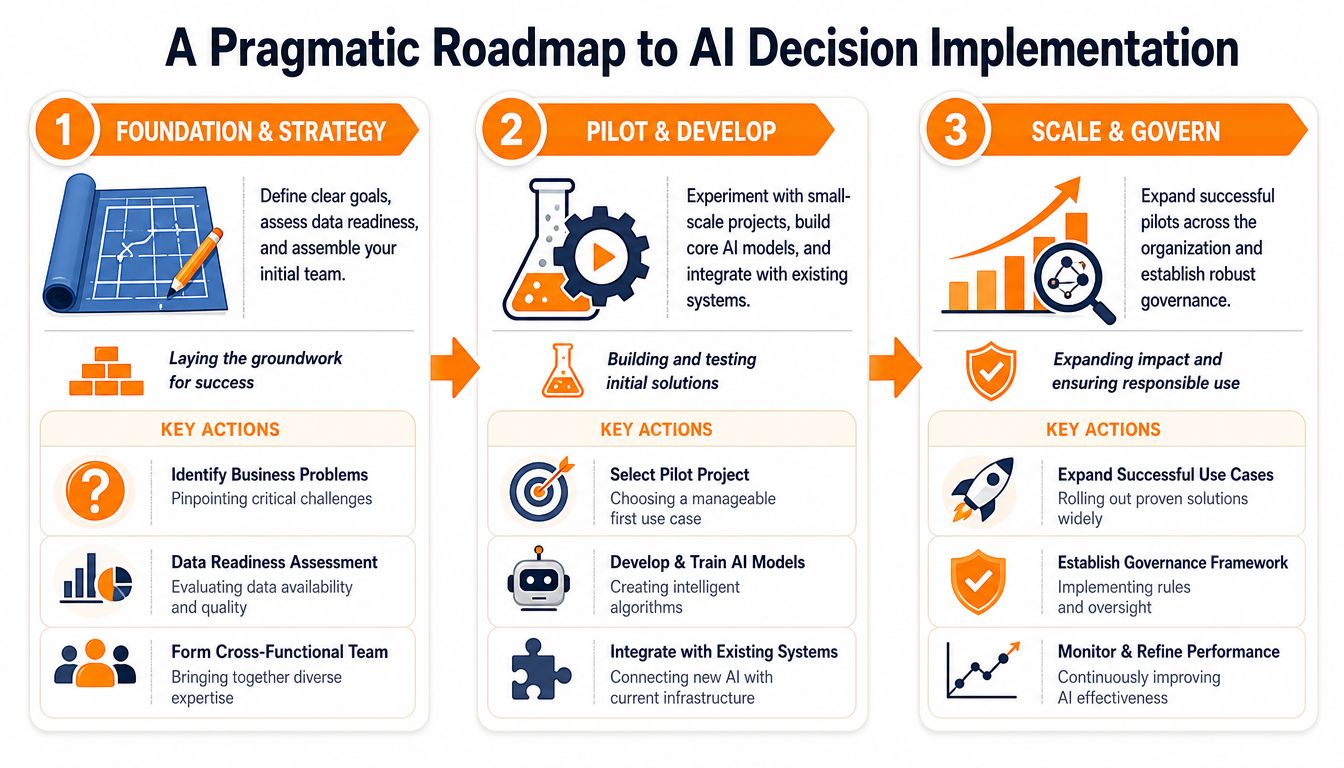
Stage one is finding the right decision
Don't start with the model. Start with the moment where a person currently has to sort, judge, prioritise, route, approve, or escalate work.
The best early use cases usually share a few traits:
| Good starting signal | Why it matters |
|---|---|
| High volume | Repetition creates measurable gains |
| Clear outcome | You can judge whether the recommendation helped |
| Messy manual handling | There's friction to remove |
| Manageable risk | Teams can learn without putting the business in danger |
Examples include inbound triage, document classification, service routing, pricing support, forecasting support, and exception handling in finance or operations.
Stage two is a controlled pilot
A pilot should be small enough to learn from and serious enough to matter. If it touches a real workflow but has a clear human review point, that's usually the right shape.
What to include:
- A baseline: How the process works today
- A decision owner: Who accepts or rejects recommendations
- A narrow scope: One team, one workflow, one decision type
- A review rhythm: Regular checks for quality, drift, and user behaviour
This is also where tool choice matters. Some businesses can configure existing platforms. Others need more customized support, especially where legacy systems and cross-functional handoffs are involved. In those cases, a provider such as Osher Digital may be used to connect automation, AI agents, and system integrations around a specific workflow rather than forcing a generic platform into place.
Stage three is scaling without losing control
Scaling is where enthusiasm can outrun discipline. A pilot that works in one function can break when exposed to different data, new users, or another business unit's process quirks.
Implementation cue: Scale the governance and training with the workflow, not after it.
At scale, leadership teams need to answer:
- Which decisions remain human-led
- Which decisions can be AI-assisted by default
- Which exceptions trigger escalation
- How performance is monitored over time
That is how you build a capability instead of collecting disconnected tools.
Common Pitfalls and How to Sidestep Them
The biggest mistake I see is simple. Leaders assume a strong global model will work cleanly in an Australian context. It often won't.
That matters because business decisions are shaped by local customers, local regulation, local operating patterns, and local edge cases. A system trained elsewhere may look polished in a demo and still make poor calls in production.
The localisation problem most teams miss
A critical point raised in an Australian discussion on evidence and deployment is that models trained in other regions “won't necessarily be replicated here”, and valid decisions require thorough Australian-specific evidence and well-designed trials, particularly where bias can harm marginalised groups, as noted in this Australian-focused webinar discussion.
Healthcare makes this easy to understand, but the principle applies much more broadly. A risk model, customer prioritisation model, or service recommendation engine can all misfire if the assumptions embedded in the training data don't reflect local reality.
Five traps that cause avoidable trouble
- Off-the-shelf overconfidence: Teams trust vendor claims before testing on local business data
- Black-box acceptance: Users can't explain outputs, so they either ignore them or follow them blindly
- Poor data hygiene: Duplicate records, missing fields, and inconsistent labels poison results
- No frontline buy-in: The people using the system weren't involved in shaping the workflow
- No human intervention point: Edge cases fall through because nobody owns the final call
A better operating habit
Run AI decision tools the way you'd hire a senior adviser. Check their background, test their judgement in your environment, and don't give them unchecked authority on day one.
That means:
- Trial locally: Use Australian-specific data wherever possible
- Inspect explanations: Ask why the recommendation was made
- Define override rules: Make it easy for staff to challenge outputs
- Listen to users: If teams don't trust the system, find out why
- Review harm, not just accuracy: A technically sound result can still be operationally or ethically wrong
A model that performs well elsewhere is only a candidate. It is not proof.
Your Next Move in AI Decision Making
A leadership team approves an AI initiative, the pilot works, and then progress stalls. Operations does not trust the recommendations. Legal wants clearer accountability. Data issues surface once the model meets real customer records. The gap is rarely the model itself. It is the operating model around it.
AI driven decision making becomes valuable when it improves a specific business decision in a way the organisation can sustain. In Australian firms, that usually means starting with local data, clear decision rights, and a human review point for higher-risk calls. A model can rank options in seconds. Your team still needs to decide where judgment stays with people, where automation is acceptable, and who is accountable when the recommendation is wrong.
Start narrower than the strategy deck suggests.
Pick one recurring decision with a measurable business cost, such as lead prioritisation, claims triage, stock allocation, or service escalation. Check whether the data reflects Australian customers, regulations, and operating conditions. Then test the model inside the workflow, not in isolation. That is how teams find the practical issues early, including missing fields, unclear override rules, and recommendations that are technically sound but hard to act on.
Senior leaders should ask three questions before expanding any program. What decision are we improving. Who owns the final call. What result will tell us this is worth scaling. If those answers are vague, the project will drift into experimentation without operational value.
If your team has moved past "should we use AI" and is now asking "where do we start safely and get results," begin with a decision inventory, a data quality review, and a simple human-in-the-loop policy. That gives the business a workable starting point and a clearer path to execution.
Osher Digital helps Australian organisations modernise the decisions buried inside everyday operations. From automation and AI agents to system integration and workflow redesign, the focus is on making business processes faster, clearer, and easier to manage at scale. If you want a practical roadmap for AI decision-making in your environment, explore Osher Digital.
Last updated on July 17, 2026
Free tool · 1 minute
AI Agent Idea Generator
Describe a painful process and get concrete AI agent concepts for your industry.
Continue Reading
View all
Master Your AI Readiness Assessment for 2026
Is your business ready for AI? Our AI readiness assessment helps you measure data, tech, & process maturity to build a realistic roadmap for 2026.
Jul 29, 2026

What Is Conversational AI and How Enterprises Use It
Learn what is conversational AI, how it works under the hood, and where Australian enterprises are actually using it to cut costs and scale service.
Jul 29, 2026

What Is Semantic? A Comprehensive Guide for 2026
What is semantic and why does it matter for your business? Understand semantic tech, from AI to search, for enterprise automation.
Jul 17, 2026
Sick of reading about automation?
Book a free 15-minute intro call. We’ll talk through what you’re trying to automate and whether we’re a good fit.