Master Your AI Readiness Assessment for 2026
Is your business ready for AI? Our AI readiness assessment helps you measure data, tech, & process maturity to build a realistic roadmap for 2026.
By Matthew Clarkson · July 29, 2026

You're probably in a familiar spot. Someone on the leadership team has asked where AI fits, a few vendors have shown polished demos, and now the pressure is on to “do something useful” without breaking the systems that already run the business.
That's where most AI conversations get shaky. The strategy deck looks fine. The pilot idea sounds sensible. But underneath, the sales data lives in one system, finance trusts another, operations still depend on spreadsheets, and the warehouse platform was never built with AI in mind. Trying to layer AI on top of that is a bit like fitting a new engine into a car with worn wiring and a leaking fuel line. The engine isn't the main problem.
A solid AI readiness assessment gives you a practical starting point. Not a hype score. Not a glossy innovation label. A grounded view of whether your data, systems, people, and workflows can support AI in production.
Are You Really Ready for AI?
A common pattern plays out like this. The CEO wants faster reporting. The COO wants fewer manual handoffs. The board wants a clear story on risk. IT gets asked to evaluate AI tools, but nobody has pinned down whether the business is ready to support them once the pilot ends.
That gap matters more than many organizations realise.
According to the Cisco 2024 AI Readiness Index for Australia, only 65% of Australian boards are receptive to AI, down from 82% the previous year. That same index says 75% of leadership teams are receptive, also down from 82% in the inaugural index. The practical takeaway is simple. Executive enthusiasm and board confidence are not the same thing, and when those two groups drift apart, AI projects stall in approval, funding, or governance review.

The real blocker usually isn't the model
In established businesses, AI rarely fails because the use case was absurd. It fails because the operating environment wasn't ready. Teams discover halfway through that customer records don't match across systems, approval workflows are inconsistent, and nobody agrees which report is the source of truth.
Practical rule: If your team can't describe how a process moves from system to system today, don't expect AI to improve it tomorrow.
That's why a readiness assessment has to go deeper than strategy statements. It should inspect the plumbing. Data flows, system dependencies, process bottlenecks, access controls, and handoffs between teams. If you need a clear way to document those handoffs before assessing AI potential, a business process audit is often the missing first step.
What readiness actually looks like
A business can be excited about AI and still be unprepared. Both things can be true at once. Readiness means you can answer questions such as:
- Data confidence: Can you trust the records feeding the use case?
- Workflow clarity: Is the target process stable enough to automate or augment?
- System fit: Can your core platforms exchange data without brittle manual workarounds?
- Decision ownership: Does someone own policy, approvals, and exception handling?
If those answers are vague, the assessment has already done its job. It's shown you where to stop guessing.
What to Measure in Your AI Readiness Assessment
Treat the assessment like a house inspection before renovation. You don't start by choosing paint colours. You check the slab, the wiring, the pipes, and whether the walls can carry the load.
For an AI readiness assessment, five areas deserve attention. They overlap, but they should be scored separately. A business with a strong strategy can still have weak data. A business with capable engineers can still have poor governance. Mixing everything into one overall impression hides the core work.
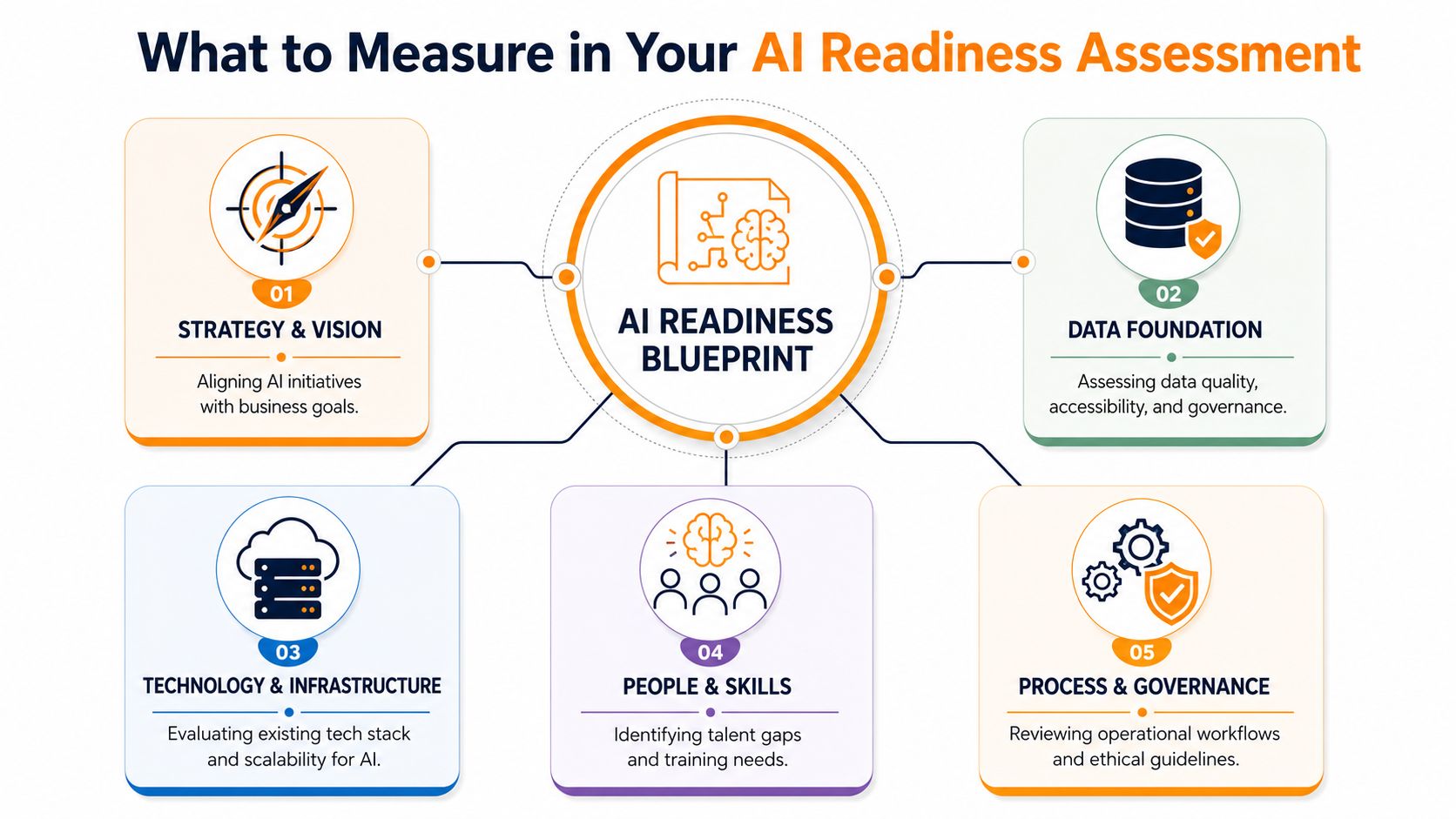
Start with data
Data is the foundation. If it's fragmented, duplicated, stale, or hard to access, every AI project becomes more expensive and less reliable.
The most important benchmark in this area comes from OvalEdge's guidance on measuring AI readiness. It says the single biggest factor for success is data readiness, with 90% or more of critical data accessible via a unified platform as a key metric. It also says that if a business scores below 80% on data quality, it's generally not ready for serious AI implementation because poor data leads to inaccurate models and unreliable automation.
If your team needs a useful companion piece on evaluating data for AI adoption, that article is worth reading alongside your own internal audit. It helps frame the difference between “we have lots of data” and “we have usable data”.
Then inspect the machinery around it
Technology and infrastructure come next, but many assessments become too shallow at this stage. It's not enough to list your platforms. You need to know how they connect, where they break, and whether they can support production workloads without manual babysitting.
That includes:
- Integration paths: APIs, exports, middleware, and batch jobs.
- Operational reliability: Failure points, retries, logging, and monitoring.
- Scalability: Whether the current stack can cope when a pilot becomes part of daily operations.
For businesses with messy reporting pipelines or repeated manual reconciliation, automated data processing often becomes relevant before any AI layer should be added.
Processes, people, and governance decide whether AI sticks
A weak process can ruin a strong technical build. If staff handle exceptions differently across teams, an AI agent won't know which rule to follow. If approvals exist only in someone's inbox, automation hits a dead end.
Use these checks:
Process
- Low readiness: Workflows depend on tribal knowledge.
- High readiness: Steps, owners, inputs, and exception paths are documented.
People
- Low readiness: Teams are anxious, unclear on use cases, or lack basic AI literacy.
- High readiness: Business users understand where AI assists and where humans stay in control.
Governance
- Low readiness: No clear policy for approval, audit, privacy, or acceptable use.
- High readiness: Decision rights are defined and traceable.
| Dimension | Key Question | Low Score (1-2) Example | High Score (4-5) Example |
|---|---|---|---|
| Data | Can teams access trusted data for the use case? | Customer data sits across spreadsheets and disconnected systems | Critical data is unified, governed, and easy to retrieve |
| Technology & Infrastructure | Can current systems support integration and scale? | Legacy apps require manual exports and fragile workarounds | Core systems connect reliably through stable integrations |
| Process | Is the workflow documented and repeatable? | Staff complete the same task differently across departments | Inputs, steps, approvals, and exceptions are clearly mapped |
| People & Skills | Can the team use and support AI in daily work? | Users rely on one specialist and avoid the tools | Teams understand roles, limits, and practical use cases |
| Governance | Are rules for risk, approval, and oversight defined? | No owner for AI policy, audit, or data access | Policies, responsibilities, and review paths are in place |
Good assessments don't ask whether the business “likes AI”. They ask whether the business can run AI safely and repeatedly.
A Step-by-Step Methodology for Your Assessment
Most organisations don't need a drawn-out consulting marathon to get a useful answer. A practical assessment can move quickly if the scope is disciplined and the right people are in the room.
According to this Australian AI readiness assessment checklist, a practical assessment typically takes 1–2 weeks and most organisations score between 40% and 60% on their first attempt. That's not a bad result. It's a realistic baseline for a business that has some useful assets but also some obvious gaps.
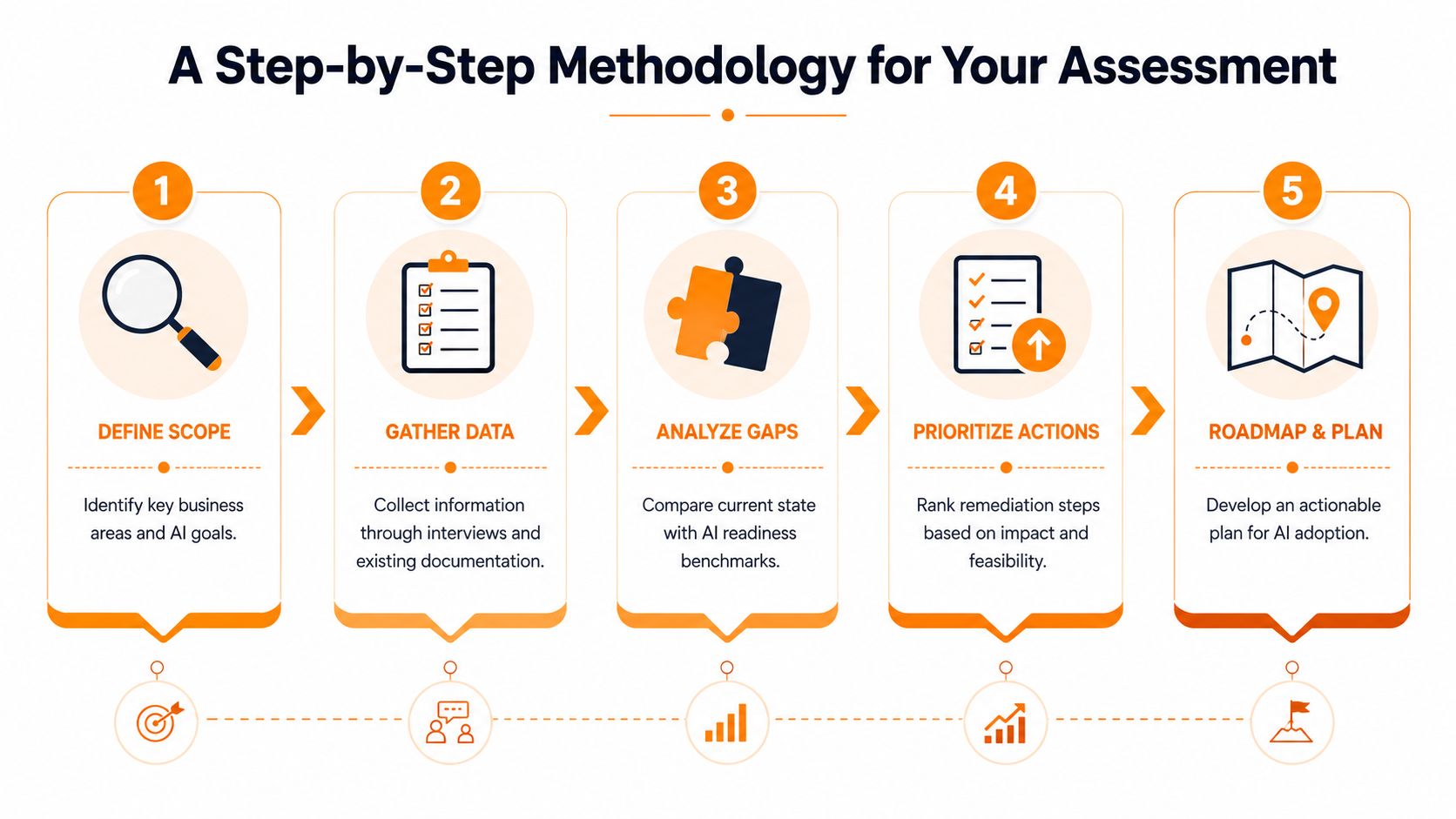
Phase one defines the battlefield
Start small enough to be honest. Don't assess the entire enterprise if the main question is whether AI can improve order processing, reporting, or customer support.
Pick one or two workflows where value is visible and system dependencies are known. Then assemble a cross-functional group. That usually means someone from IT, someone from operations, one business owner for the process, and a person who understands data access and reporting.
This phase should answer:
- What business problem matters now
- Which systems are involved
- Who owns the process and the outcomes
- What “production ready” would look like
Phase two collects evidence, not opinions
Once the scope is set, gather evidence from the systems and from the people who use them. Interviews matter, but system artefacts matter more. Process maps, access logs, workflow documents, exception reports, and sample records all reveal where reality differs from assumptions.
A good information-gathering pass usually includes:
- Stakeholder interviews: IT, operations, finance, compliance, and frontline users
- System review: CRM, ERP, ticketing tools, spreadsheets, warehouses, and integration layers
- Data sampling: Look at completeness, consistency, duplication, and timeliness
- Workflow tracing: Follow one transaction end to end, including approvals and exceptions
A useful outside perspective on AI enablement for growth leaders can help teams think beyond experimentation, but the internal evidence still has to come first.
Later in the process, it can help to brief stakeholders with a simple visual explainer:
Phase three scores gaps and sets priorities
At this point, patterns usually become obvious. Maybe the process is stable but the source data is messy. Maybe the data is fine but the approval chain is undefined. Maybe one team is ready while another still depends on email and spreadsheets.
Score each dimension separately. Keep the scoring plain. A good score should tell a manager what to fix next, not impress anyone with complexity.
One of the biggest mistakes in an AI readiness assessment is averaging away the problem. A strong strategy score doesn't cancel out weak operational plumbing.
Three outputs matter most at the end:
- A dimension-by-dimension scorecard
- A short list of blockers by severity
- A roadmap sequenced by dependency
That roadmap is where the assessment starts earning its keep. It turns vague ambition into a build order.
Turning Your Assessment Score into a Clear Action Plan
A score on its own isn't useful. It becomes useful when it tells you what should happen next, what must wait, and what shouldn't be attempted yet.
The cleanest way to interpret results is to map them against a maturity ladder. According to Leapsome's overview of AI readiness assessment maturity levels, organisations typically sit across five levels: ad-hoc, emerging, established, advanced, and optimized. It also notes that reaching “established” at a score of 3 out of 5 is the minimum threshold before scaling AI beyond a single department. Teams at the lower levels should first build foundations such as governance policies and pilot projects.
Read the score by weakest dependency
Don't start with the highest opportunity. Start with the weakest dependency that can derail the opportunity.
For example:
- A low data score points to cleanup, standardisation, and access work before model design.
- A low process score means the workflow itself needs tightening before automation.
- A low people score means training and operating model decisions come before rollout.
- A low governance score means risk ownership and policy decisions can't be deferred.
At this point, many teams get impatient. They want the impressive use case first. But if the underlying process is unstable, the AI layer makes the instability faster.
Use an impact and effort lens
A practical plan separates what builds momentum from what builds long-term capability. Both matter. They just belong in different lanes.
| Action Type | What It Looks Like | Why It Matters |
|---|---|---|
| Quick wins | Fixing one repetitive reporting workflow with stable inputs | Builds trust and exposes integration issues early |
| Foundation work | Defining governance, cleaning key data sets, documenting process rules | Reduces risk and supports future use cases |
| Strategic builds | Reworking cross-system workflows or modernising a brittle legacy dependency | Enables scale across multiple departments |
A useful rule is to avoid “hero projects”. If a proposed AI initiative needs every system cleaned, every policy approved, and every team retrained before value appears, it's probably too big for the current maturity level.
Match actions to maturity, not excitement
If your organisation is still ad-hoc or emerging, the right move is usually narrow and controlled. Pick one department. Define one use case. Set human review rules. Measure where handoffs break.
The best first action plan is often boring on paper. That's usually a good sign.
By the time a team reaches established maturity, the conversation changes. You're no longer proving that AI can work. You're deciding where it should be repeated, standardised, and governed consistently.
Practical Fixes for Common AI Readiness Gaps
Most readiness gaps are fixable. The trick is not to attack everything at once. A good remediation playbook fixes one constraint at a time, starting with the constraint that blocks the next sensible use case.
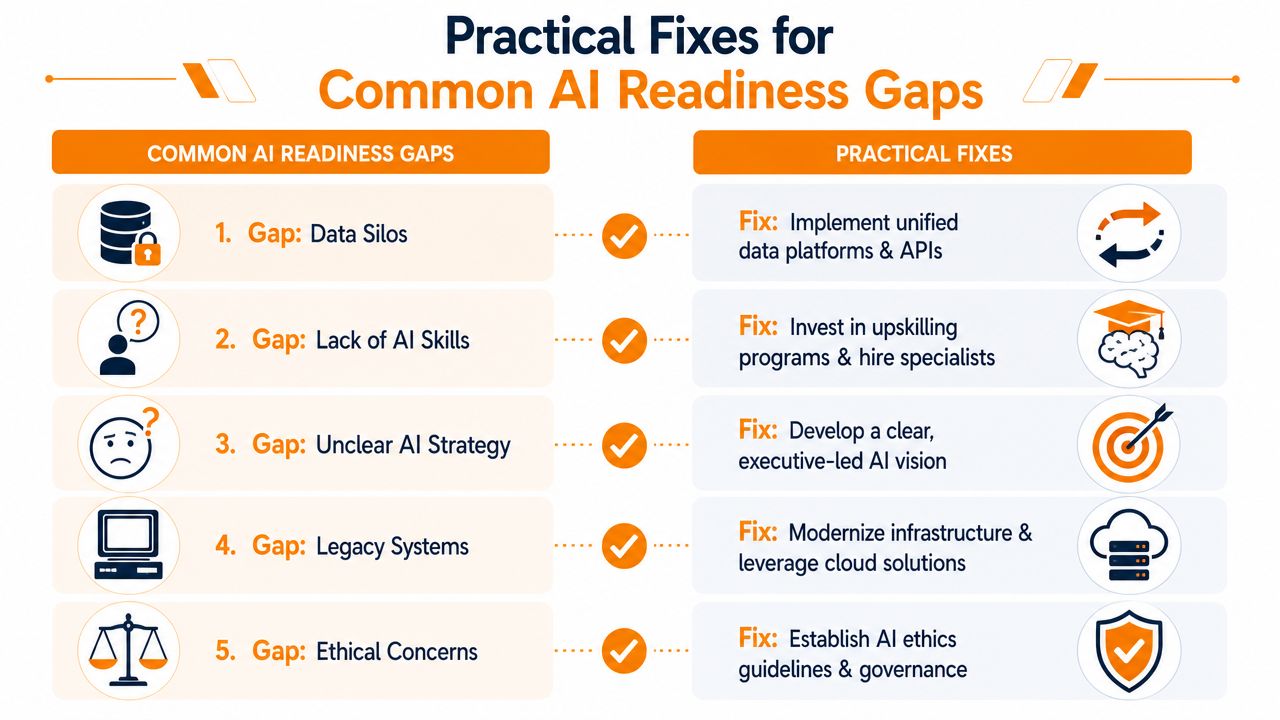
The urgency here is real. The AI Adopt Centre's readiness guidance highlights that 68% of AI initiatives in Australia fail to scale due to insufficient data infrastructure and fragmented governance. That points straight at the two areas businesses most often underinvest in because they aren't flashy.
Fix the data bottleneck first
If the same customer, order, or product appears differently across systems, stop there. Don't build a clever AI layer on top of contradictory records.
Use a targeted sequence:
- Audit one critical domain: Sales, support, finance, or inventory
- Define a source of truth: One agreed system or curated layer for the use case
- Standardise fields: Naming, status values, timestamps, and ownership
- Reduce manual transfer points: Replace spreadsheet shuffling where possible
If your stack is evolving and you're comparing platform options, guidance on selecting a Databricks consulting partner can be helpful as part of a broader architecture review. The point isn't to chase one vendor. It's to choose a setup that can support governed data movement and practical integration.
Repair process chaos before adding automation
Many businesses think they have a technology problem when in fact they have a process problem. Staff know how to “get it done”, but every person takes a slightly different route.
That's dangerous for AI. The model or agent needs consistent rules.
Try this remediation play:
- Map one workflow end to end
- Mark every approval, handoff, and exception
- Identify where staff rely on judgement versus policy
- Separate standard cases from edge cases
- Automate only the repeatable part first
This isn't glamorous work, but it stops the common failure mode where AI handles the easy path and then collapses the moment something unusual happens.
Lift team capability and governance together
Low skills and weak governance often show up together. Teams either become overly cautious and block progress, or they experiment freely without enough guardrails.
Fix both at the same time:
- Run a small literacy programme: Focus on one team and one practical use case
- Define human-in-the-loop rules: Who reviews outputs, who approves actions, who handles exceptions
- Create lightweight policies: Data access, auditability, acceptable use, and escalation
- Nominate owners: Someone must own the workflow, the technical implementation, and the risk posture
The businesses that move well don't wait for perfect conditions. They reduce uncertainty in the areas that matter most, then they test in production-friendly slices.
Your Next Steps on the Path to AI Adoption
A good AI readiness assessment doesn't give you a trophy. It gives you a map. That map shows where your systems can support AI now, where your workflows need repair, and where your data or governance will cause trouble if you ignore them.
The smartest next move is usually modest. Pick one or two fixes with clear operational impact. Clean a key data flow. Document a messy approval path. Pilot AI in a workflow that already has stable inputs and visible pain. Learn from that, then widen the circle.
If the assessment exposes deeper integration issues, don't treat that as bad news. It's better to find those constraints before an AI rollout than after a pilot has created expectations the systems can't support. That's especially true in medium and large organisations where legacy applications, manual reconciliations, and split ownership can undermine progress.
When you need outside help to turn findings into an implementation plan, experienced AI consulting support can shorten the path from diagnosis to execution.
If your assessment shows promise but the path forward is tangled by legacy systems, data silos, or brittle workflows, Osher Digital can help you turn that complexity into a practical rollout plan. Their team focuses on automation, integration, and AI-driven operational improvement across sales, finance, and data environments, with a vendor-agnostic approach that keeps the solution aligned to the business rather than the tool.
Last updated on July 29, 2026
Free tool · 1 minute
AI Agent Idea Generator
Describe a painful process and get concrete AI agent concepts for your industry.
Continue Reading
View all
What Is Conversational AI and How Enterprises Use It
Learn what is conversational AI, how it works under the hood, and where Australian enterprises are actually using it to cut costs and scale service.
Jul 29, 2026

AI Driven Decision Making for Australian Enterprises
Unlock growth with AI driven decision making. Our guide for Australian enterprises covers strategy, governance, & implementation for smarter, faster decisions.
Jul 17, 2026

What Is Semantic? A Comprehensive Guide for 2026
What is semantic and why does it matter for your business? Understand semantic tech, from AI to search, for enterprise automation.
Jul 17, 2026
Sick of reading about automation?
Book a free 15-minute intro call. We’ll talk through what you’re trying to automate and whether we’re a good fit.