Sked Social Review: Who It Suits and Who It Doesn’t
Sked Social review for 2026: who the platform suits, who it doesn’t, real USD/AUD pricing, and how it compares to Later, Hootsuite, and Buffer.
By Matthew Clarkson · June 20, 2024
Updated May 2026. Re-audited for on-page SEO. Primary keyword re-anchored across headings; FAQ schema added.
Most software reviews try to be everything to everyone. They list features, hedge on the negatives, and conclude with something like “great for businesses of all sizes.” That kind of review is useless when you actually need to decide whether to put a tool on your credit card. So here is a Sked Social review with a position.
At Osher Digital, we are a Brisbane-based automation consultancy and we have helped clients pick, integrate, and occasionally rip out social media scheduling tools across the past several years. We have seen Sked Social work brilliantly for some teams and quietly underwhelm for others. This review is the criteria we use to tell the difference. For context on Meta’s own scheduling tools (the free alternative many teams skip considering), see Instagram for Business and the Meta Business Suite scheduler.
Short version: Sked is excellent if you are Instagram-first, visual-heavy, and value the grid-preview workflow. It is less compelling if you treat Instagram as one channel among many or if you are a low-volume operator who would rather pay $20 USD a month than $80.
Sked Social Review: The 30-Second Verdict
Sked Social is a paid Instagram-centric social media scheduling platform that has expanded to cover Facebook, X, LinkedIn, YouTube, TikTok, and Pinterest. It is one of the strongest Instagram tools on the market, especially for visual planning and Story automation. It is also more expensive than its general-purpose competitors at equivalent feature tiers.
Who should put it on the company card:
- Visual-heavy brands where Instagram is the lead channel: e-commerce, hospitality, beauty, travel, food, lifestyle, fitness.
- Agencies running multiple Instagram-led client accounts where the grid preview pays off in client-facing review meetings.
- Teams that publish Stories and carousels at volume, where the bulk-upload and auto-publish features cut real hours.
Who should look elsewhere:
- B2B teams where LinkedIn is the lead channel. The Instagram-first orientation does not pay off and you can find more LinkedIn-native tools.
- One-person operators on a tight budget. Buffer at $5 to $15 USD per month or even native scheduling tools from Meta cover the basics.
- Anyone needing deep social listening, influencer marketing, or community management workflows. Those are different categories of tool.
What Is Sked Social
Originally launched as Schedugram in 2014, the platform was one of the first to offer reliable Instagram scheduling at a time when Meta’s own tools were not up to it. After the 2020 rebrand it has positioned itself as an all-rounder, but the product DNA is still Instagram. That shows up in the interface (grid preview as the default view), the feature roadmap (Stories auto-publish, carousel-aware editing, shop product tagging), and the documentation.
The other supported channels (Facebook, X, LinkedIn, YouTube, TikTok, Pinterest) work, but they feel like they were added on rather than designed for. If you are using Sked for LinkedIn-only publishing, you are paying Instagram-tool prices for LinkedIn-tool features.
Sked Social Review: What It Gets Right
The Instagram Grid Preview
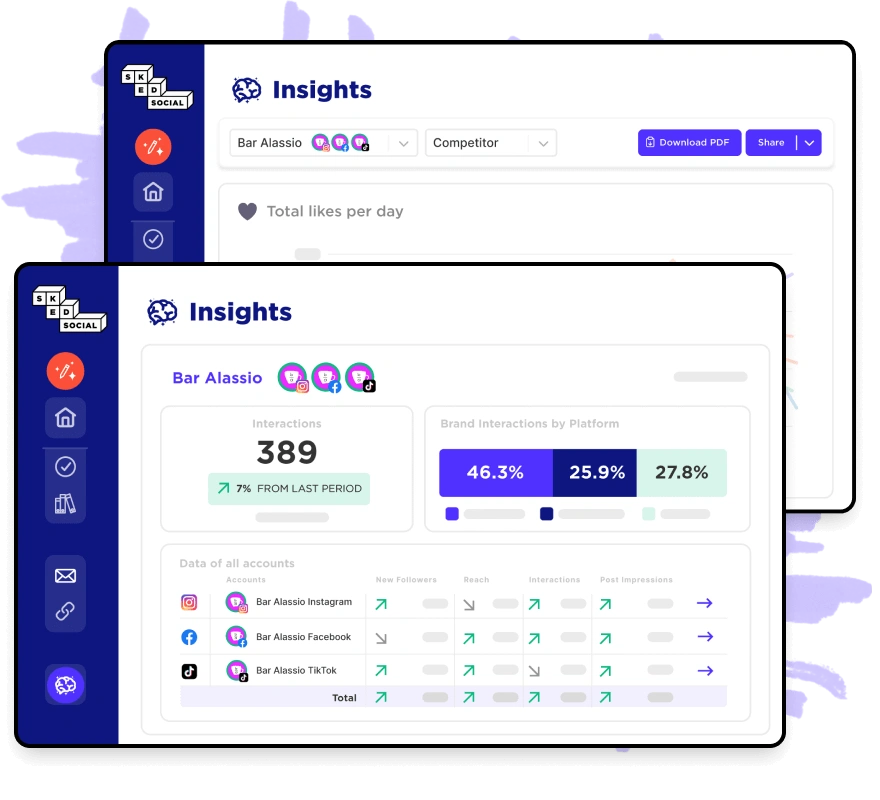
The grid view that shows you how your feed will look after scheduled posts publish is the single most useful feature for any brand where the feed aesthetic matters. Hospitality, fashion, and product brands plan campaigns around how the next nine posts will look together. Dragging and rearranging the grid until it works visually is faster in Sked than in any general-purpose scheduler.
Stories Auto-Publish
Most tools schedule Stories as a notification: at the scheduled time, your phone buzzes and you have to manually open Instagram and post it. Sked actually publishes the Story automatically. For brands posting 4 to 8 Stories per day across multiple accounts, this is the difference between needing a person on Story duty all day and not.
Bulk Upload and CSV Import
If your content workflow ends in a spreadsheet of caption plus image plus scheduled time, you can import that spreadsheet into Sked rather than retyping every post. This sounds minor and turns out to save hours per week for content-heavy operations. Agencies bouncing between client folders feel this immediately.
Carousel Handling
Sked treats carousel posts as a first-class object. You can rearrange slides, apply per-slide adjustments, and preview the result before scheduling. Compared to general schedulers where carousels are an awkward afterthought, this matters for any brand using carousels as a core format (which is most of them in 2026, given Meta’s algorithmic favouritism toward the format).
Approval Workflows
Multi-step approval with comments and revision tracking is solid. For agencies submitting content for client sign-off, or in-house teams where Brand needs to bless creative before it ships, this works without forcing you into a separate review tool.
Sked Social Review: Where It Bites
Pricing vs Buffer and Later
As of early 2026, entry-tier Sked starts around $60 USD per month for the Fundamentals plan, with most agencies landing on Essentials at roughly $160 USD per month. Buffer’s equivalent tier runs $5 to $50 USD per month. Later (Sked’s closest competitor) runs $25 to $80 USD per month at comparable feature tiers. If you are not using the Instagram-specific differentiators, you are overpaying.
Non-Instagram Channels Feel Secondary
LinkedIn-native features (newsletter publishing, document carousels, employee advocacy) are weaker than in tools built around LinkedIn. TikTok and YouTube Shorts publishing works but lacks the analytics depth of Sprout Social or Hootsuite. If your content mix is genuinely cross-platform with no lead channel, a generalist tool fits better.
Analytics Depth
Sked’s analytics suite covers the basics (reach, impressions, engagement, follower growth) and offers custom reports. It does not match Sprout Social’s depth, especially for brands wanting cross-platform attribution or competitive benchmarking beyond the five-account limit.
Mobile App Limitations
The mobile app is functional for last-minute approvals and quick edits but not for full content production. If your social manager works heavily from a phone, this is friction. The desktop experience is where Sked’s strengths actually live.
API Access Restrictions
Programmatic API access is gated to the top Enterprise tier. If you want to integrate Sked into your content production workflow via an automation tool like n8n, you are looking at a higher tier than the features alone would justify. Buffer and Later have more permissive API access at lower tiers.
Sked Social Pricing in 2026
Sked publishes pricing in USD. Roughly translated, you are looking at the following per-month bands as of early 2026 (verify on the Sked Social pricing page because tiers shift):
- Fundamentals. Around $60 USD ($92 AUD) per month. 3 social sets, 1 user. Good for a single brand or solo creator who absolutely needs the Sked Instagram features.
- Essentials. Around $160 USD ($245 AUD) per month. More accounts and users, analytics report builder, hashtag manager. The realistic agency or in-house mid-market starting point.
- Professional. Around $260 USD ($400 AUD) per month. Advanced analytics, more concurrent users, more accounts.
- Enterprise. Custom pricing. Includes API access, dedicated account management, and SSO. Justify it by working out whether you actually need the API tier and the white-glove support.
There is typically a free trial (no credit card required) on most tiers, which is the right way to evaluate this tool. Annual billing is usually 15 to 20 percent cheaper than monthly.
Sked Social vs the Alternatives
Sked Social vs Later
Closest competitor. Later is also Instagram-first, slightly more affordable at equivalent tiers, and has stronger link-in-bio (Linkin.bio) tooling. Sked is stronger on Story auto-publish and bulk upload. We typically recommend Later for solo creators and small brands, Sked for agencies and mid-market in-house teams. See our Sked vs Later comparison for the full breakdown.
Sked Social vs Hootsuite
Hootsuite is broader and more enterprise-leaning, with stronger social listening, social inbox, and team management. Sked is sharper for Instagram-led content production. If you need a single platform for inbound listening, customer service, and publishing across many channels, Hootsuite. If you need the best content production tool for Instagram-first work, Sked. Our Sked vs Hootsuite comparison goes deeper.
Sked Social vs Buffer
Buffer is significantly cheaper at the entry tier and has a strong free plan for one-person operators. It does not have the Instagram-specific tooling. If you are not Instagram-led, Buffer is the simpler choice. If you are, Sked’s features pay for the price gap.
Sked Social vs Sprout Social
Different categories. Sprout is an enterprise social management suite (listening, CRM, customer care, reporting). Sked is a content production and scheduling tool. Most large organisations end up running both: Sprout as the platform of record, Sked or Later as the production tool the social team actually lives in.
How We Actually Use Sked Social with Clients
When we are advising clients on tooling, the conversation runs something like this. What is your lead social channel? What is your monthly content volume? How many people review before publish? Do you need to integrate this with anything (an asset library, an approval tool, an analytics warehouse)?
Sked tends to win when the answers are: Instagram, more than 30 posts per month, more than two reviewers, and the integration list is short. It tends to lose when the answers are: LinkedIn, under 20 posts per month, single reviewer, or “we need this to talk to our DAM and our analytics warehouse via API.”
For clients who do go with Sked, we usually pair it with an automation workflow that pulls finalised content from a Notion or Airtable production pipeline, formats it for Sked import, and tracks performance back into the same source-of-truth. The grid preview is for the social team. The integration is for everyone else.
If you want help working out whether Sked or one of the alternatives fits your stack, book a call and we can run through it with you.
Who Sked Social Actually Suits
- E-commerce brands where the Instagram feed is the storefront. The grid preview, shoppable post tagging, and Story auto-publish all earn their cost.
- Hospitality, travel, and food brands where the visual aesthetic carries the marketing. Same logic.
- Agencies with five to fifty Instagram-led client accounts. The multi-account management plus approval workflow plus white-label reporting combine to save real hours per week per account.
- Influencer-led brands producing high-frequency Stories and reels where notification-only schedulers do not scale.
- Photographers, illustrators, and creators who treat Instagram as portfolio and need the grid preview as a design tool, not just a scheduler.
Who Sked Social Doesn’t Suit
- B2B teams with LinkedIn as the lead channel. The Instagram-first design does not pay off, and there are stronger LinkedIn-native tools.
- Solo operators on tight budgets. Buffer at the entry tier or Meta’s own Business Suite covers the basics for free or near-free.
- Teams that need deep social listening. That is Sprout Social, Brandwatch, or Talkwalker territory.
- Large enterprises with complex governance. Hootsuite Enterprise or Sprinklr usually win the procurement conversation.
- Teams who treat all platforms equally. The Sked Instagram-first design becomes friction in workflows where Instagram is not the priority.
Frequently Asked Questions
What is Sked Social?
Sked Social (originally Schedugram) is a paid social media scheduling and publishing platform built around Instagram. It supports other channels including Facebook, X, LinkedIn, YouTube, TikTok, and Pinterest, but the strongest features (grid preview, Story auto-publish, carousel handling) are Instagram-specific. It targets agencies, mid-market brands, and creators publishing at volume.
Is Sked Social worth it?
If Instagram is your lead channel and you are publishing more than around 30 posts per month with a review workflow, yes. The grid preview, Story auto-publish, and bulk upload features pay for the higher monthly cost compared to general-purpose tools. If Instagram is one channel among several with no strong lead, you are paying for features you do not need.
How much does Sked Social cost in AUD?
Sked bills in USD. As of early 2026, the entry Fundamentals tier sits around $60 USD ($92 AUD) per month. Essentials is around $160 USD ($245 AUD) per month and Professional around $260 USD ($400 AUD) per month. Enterprise is custom. Annual billing saves roughly 15 to 20 percent. Check the current Sked pricing page because tiers shift.
Is Sked Social better than Later?
Different sweet spots. Later is slightly cheaper, has a stronger link-in-bio tool, and is generally easier to learn. Sked has better Story auto-publish, stronger bulk upload, and more capable approval workflows. We recommend Later for solo creators and small brands and Sked for agencies and mid-market in-house teams. Either choice is defensible.
Does Sked Social auto-publish Instagram Stories?
Yes, and this is one of its strongest differentiators. Most schedulers can only send a notification at the scheduled time, requiring a human to manually publish. Sked actually publishes Stories on your behalf at the scheduled time. For brands posting Stories at volume, this removes a meaningful operational burden.
Can Sked Social handle multiple Instagram accounts?
Yes. The multi-account management is one of its stronger features, particularly for agencies. You can switch between accounts, use per-account permissions and approval flows, and run analytics reports per account or aggregated. The number of accounts you can connect scales with the pricing tier (typically 3 to 6 at Fundamentals, more at Essentials and above).
Does Sked Social have an API?
Yes, but API access is gated to the Enterprise tier. If you want to integrate Sked with a content production pipeline (Notion, Airtable, a DAM) via a workflow tool like n8n, plan for the Enterprise spend. For most mid-market clients, this is a deal-breaker for using Sked as the source-of-truth integration node and pushes them toward Later or Buffer which offer API access at lower tiers.
Does Sked Social work for B2B?
It works, but B2B teams tend to be LinkedIn-led, and Sked’s LinkedIn features are functional rather than market-leading. If your B2B social strategy is LinkedIn-first with secondary Instagram presence, you are paying for Instagram features you mostly do not use. For B2B teams with serious Instagram investment (creator-economy B2B, visual products), Sked still fits. For most other B2B teams, a LinkedIn-native tool or a generalist like Buffer is the better match.
If you want help working out whether Sked Social or one of its alternatives fits your stack, or integrating your chosen tool into a content production workflow, get in touch with our team. We build the workflow plumbing around tools like this for Australian brands and agencies.
Last updated on July 1, 2026
Free tool · 3 minutes
AI Readiness Assessment
Score how ready your business is for AI in a few minutes, with tailored next steps.
Continue Reading
View all
Advanced Salesforce Marketing Attribution: Technical Implementation Guide
A technical guide to implementing Salesforce marketing attribution for precise tracking of leads, opportunities, and campaign ROI.
Nov 1, 2025

TikTok Server-Side Tracking: Setup, Costs, and Match Rates
TikTok server-side tracking with sGTM and the Stape template: full setup, event mapping, costs, and what changes for your TikTok ad match rates.
Nov 1, 2025

How to Set Up Snapchat Server Side Tracking – A Step-by-Step Guide
Learn how to implement Snapchat server-side tracking using the stape.io GTM container templates. This guide covers setup, event tracking, and key benefits for optimising your Snapchat ad campaigns.
Nov 1, 2025
Sick of reading about automation?
Book a free 15-minute intro call. We’ll talk through what you’re trying to automate and whether we’re a good fit.