Workflow Orchestration: A Business Leader's Guide
Learn workflow orchestration with simple analogies. A guide for leaders on its architecture, ROI, implementation, & how it differs from automation.
By Matthew Clarkson · July 17, 2026

You can usually feel the problem before you can name it.
Sales updates the CRM. Finance exports data into a spreadsheet. Marketing runs campaigns in one platform and hands leads to another. Operations chase approvals in email. Each team works hard, and each tool does its job, but the whole business still feels clunky. Things slip through gaps. People double-handle work. Leaders spend too much time asking, “Where is this up to?”
That's where workflow orchestration becomes useful. Not because it's fashionable, but because it gives separate systems, teams, and tasks a shared rhythm. It helps the business move as one connected operation instead of a collection of busy islands.
What Is Workflow Orchestration?
Workflow orchestration is the coordination layer that makes a multi-step business process run in the right order, at the right time, across the right systems and people.
Think about a customer order. One action in one system often needs to trigger several others. A CRM record might need updating. Finance may need to issue an invoice. Operations may need to create a job. A warehouse or service team may need a notification. If each step depends on a person noticing the last one, delays and mistakes pile up quickly.
Workflow orchestration acts like the organiser behind the scenes. It doesn't just automate one task. It coordinates many tasks so the whole process finishes properly.

The business problem it solves
Most organisations don't struggle because their people are lazy or their software is poor. They struggle because the handoffs between tools and teams are messy.
A lead enters one system, but the quote team doesn't see it promptly. An invoice is raised, but reconciliation waits on a manual check. A report is due, but the data lives in several places and arrives in the wrong sequence. Workflow orchestration cleans up those handoffs.
Practical rule: If your process depends on people checking inboxes, chasing status, or copying data between systems, orchestration is usually worth examining.
This is also why the market is growing so quickly. The global workflow orchestration market was valued at USD 21.93 billion in 2026 and is projected to reach USD 36.45 billion by 2030, growing at a compound annual growth rate of 13.5%, which shows how central orchestration has become in modernising legacy workflows, according to workflow orchestration market analysis from Research and Markets.
Why it matters in Australia
Australia has already seen meaningful institutional use of orchestration. The AURIN project created a decentralised orchestration framework for urban researchers, showing how complex data tasks can be coordinated across systems at scale in an Australian context. That matters because it shows orchestration isn't just theory. It has practical value where data ingestion, transformation, validation, and delivery all need to happen reliably.
If you want a simpler companion read on adjacent ideas, this piece on how workflow automation transforms UK businesses is useful because it shows the kinds of operational friction that often push leaders toward orchestration.
Thinking Like an Orchestra Conductor
The easiest way to understand workflow orchestration is to stop thinking about software for a moment and think about music.
An orchestra can have brilliant musicians. A violinist may play perfectly. The percussion section may be flawless. But without a conductor, the result can still feel chaotic. People come in at the wrong moment. The tempo drifts. Strong individual performances don't become a strong shared performance.
That's what happens in many businesses. You might have a strong CRM, finance platform, data warehouse, and approval tool. Each one can do useful work. But unless something coordinates them, they won't produce a smooth business process.
The conductor, not the instrument
Workflow automation is like teaching one musician to play their part well. Workflow orchestration is making sure every player enters at the right moment and follows the same score.
That distinction matters because leaders often buy tools that automate isolated tasks and then wonder why the business still feels fragmented. A single automated email, form approval, or data sync is helpful. It isn't the same as managing the full chain of dependencies from start to finish.
For readers working with technical teams, this short guide to chaining actors is a practical way to visualise how one action can trigger the next in a coordinated sequence.
Orchestration compared with related terms
| Concept | Main Goal | Scope | Analogy |
|---|---|---|---|
| Workflow orchestration | Coordinate many steps across systems and teams | End-to-end, cross-functional | The conductor guiding the whole orchestra |
| Workflow automation | Automate a specific task or step | Narrow, task-level | One musician playing their part well |
| BPM | Manage and improve business processes at a higher operational level | Broad business process design and governance | The concert organiser planning the performance |
| RPA | Mimic human actions in software, often in older systems | Specific repetitive screen-based tasks | A stand-in player following a fixed routine |
Where people usually get confused
The confusion usually starts when businesses use these terms as if they're interchangeable.
Automation is not orchestration: Automating invoice creation isn't the same as coordinating invoice creation, approval, ledger updates, notifications, and exception handling.
RPA is not orchestration: An RPA bot can click through a legacy screen. It still needs something to tell it when to start, what data to use, and what happens next.
BPM is not orchestration: BPM often focuses on process design, policy, and improvement. Orchestration handles execution across connected systems.
Good orchestration doesn't replace automation tools. It tells them when to act, what to wait for, and what to do if something goes wrong.
That's why workflow orchestration becomes especially valuable as organisations grow. The more departments, systems, and exceptions you have, the more you need a conductor instead of a collection of solos.
Inside a Workflow Orchestration Engine
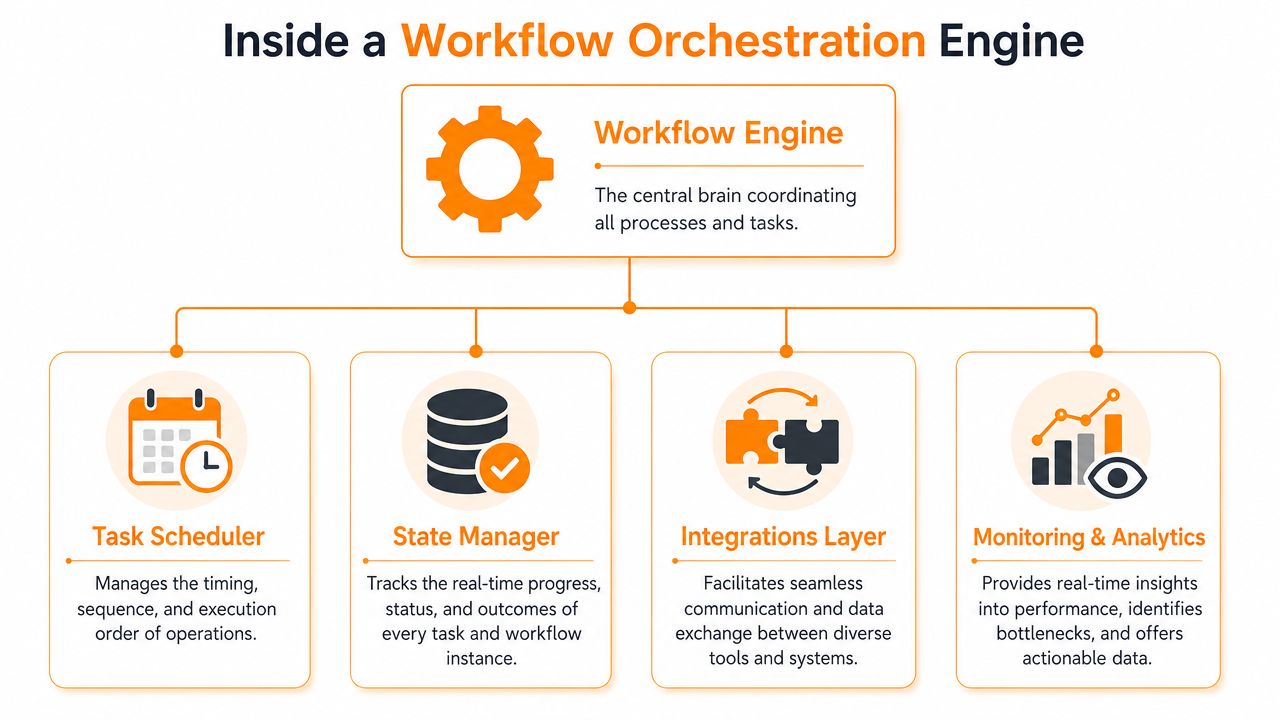
Under the bonnet, a workflow orchestration engine is less mysterious than it sounds. A simple way to think about it is as a kitchen.
The workflow definition is the recipe card. It lists the steps, the order, the ingredients, and the conditions. The engine is the chef who reads the recipe and makes sure the meal comes together properly. The connectors are the prepared ingredients that make it easier to work with different systems. The monitoring layer is the pass where you can see what's cooking, what's delayed, and what's done.
The parts that matter
Here's the plain-English version of what sits inside most platforms:
Workflow engine: The central brain. It decides what should happen next.
Task scheduler: The timing layer. It manages sequence and execution order.
State manager: The memory. It tracks what has finished, failed, paused, or is waiting.
Integrations layer: The translator. It helps systems exchange data and trigger actions.
Monitoring and analytics: The control room. It shows bottlenecks, failures, and performance patterns.
That combination is what makes workflow orchestration different from a simple timer or script.
Why event-driven matters
One of the most useful ideas in orchestration is event-driven coordination. A process doesn't always begin because the clock says so. It can begin because something happened.
The primary components of workflow orchestration include event-driven coordination that triggers workflows based on specific events like data arrival or job completion, rather than just schedules, and this helps teams track and forecast service level agreements across system boundaries, as explained in BMC's overview of workflow orchestration components.
That means a workflow can start when a contract is signed, when a file lands in a folder, when a job completes, or when a customer submits a form. It's more responsive and usually more reliable than waiting for someone to notice that the next step is due.
A related example appears in many modern delivery models, including robotic process automation, where a bot may handle one part of the job but still relies on orchestration to fit into the larger process.
Here's a visual explainer that helps make the moving parts easier to picture.
When leaders ask whether orchestration is “just scheduling”, the answer is usually no. Scheduling says when. Orchestration also manages dependencies, status, exceptions, and next-best actions.
Finding the Real ROI in Your Business
Most business cases for workflow orchestration are too narrow.
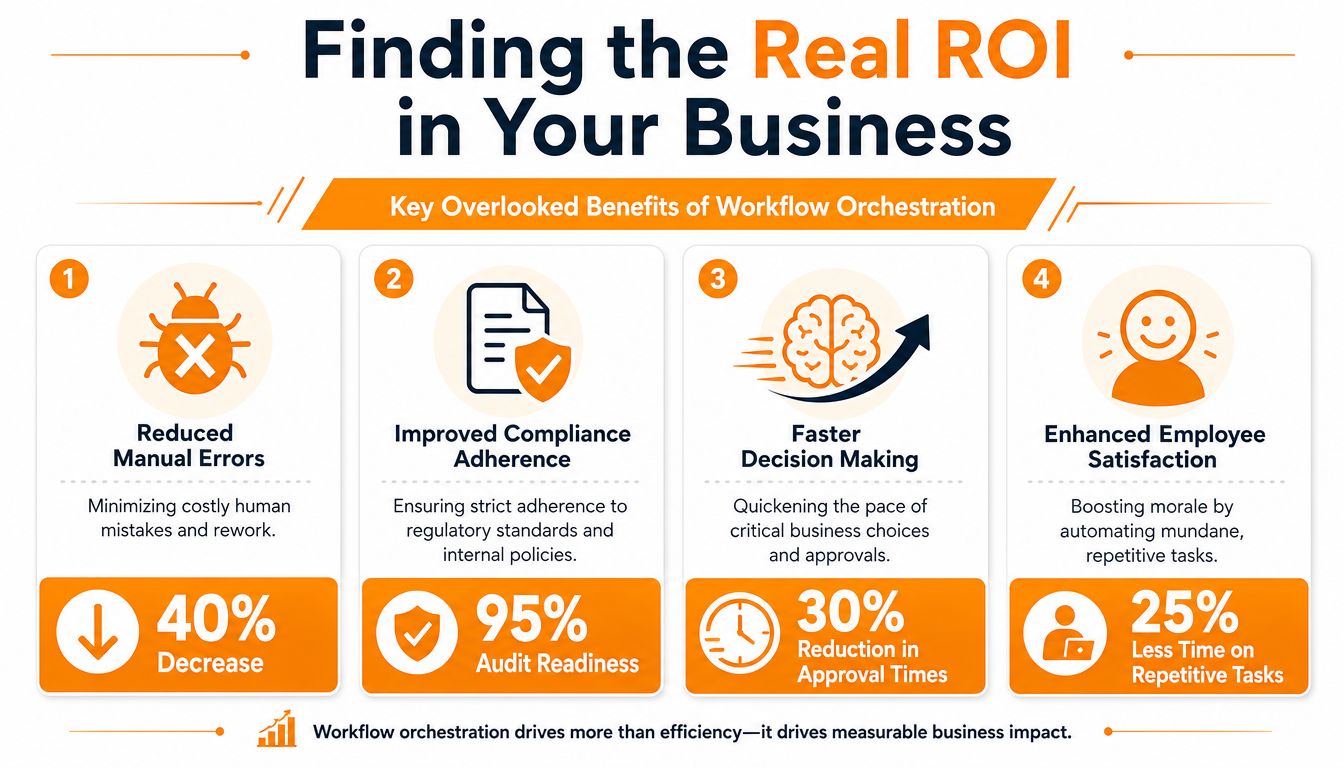
They focus on speed. Faster approvals. Faster data movement. Faster handoffs. Speed matters, but it's only part of the financial story. In many organisations, the larger payoff comes from fewer mistakes, cleaner data, better auditability, and less compliance risk.
That's the hidden ROI leaders often miss.
Where the money actually leaks
Consider a finance workflow. A manual process may still get the work done, but each handoff creates room for incorrect entries, duplicate records, missed approvals, or weak audit trails. The time spent fixing those problems often costs more than the original processing time.
The same pattern shows up in sales and marketing. A lead might arrive, but if the routing logic is inconsistent or the follow-up depends on manual checks, valuable opportunities can stall. In operations, poor sequencing can cause rework because one team starts before another team has completed a prerequisite step.
Research indicates that while orchestration automates handoffs, the real ROI for medium and large enterprises lies in the 30% reduction in accuracy-related costs and the mitigation of legal and compliance risks, according to Kissflow's discussion of workflow orchestration ROI.
A better way to build the business case
If you're preparing a case for investment, don't stop at labour savings. Look at the broader picture.
Error correction costs: What does it cost when records are wrong, duplicated, or incomplete?
Compliance exposure: What's the impact when approvals, timestamps, or audit trails are missing?
Decision delay: How much value is lost when managers wait for information to be assembled manually?
Rework across teams: How often do people redo work because upstream data was inconsistent?
A useful extension of this thinking is to look at adjacent workflows such as automated data processing, where the value often comes from cleaner, more dependable information rather than just raw speed.
Questions worth asking in the boardroom
| Business area | Weak manual pattern | Strong orchestration outcome |
|---|---|---|
| Finance | Staff reconcile mismatched records by hand | Systems validate, route, and log exceptions consistently |
| Sales | Leads sit in queues or go to the wrong owner | Leads route automatically based on rules and status |
| Compliance | Teams scramble to prove what happened | Audit trails exist by design |
| Operations | Work starts without prerequisite checks | Dependencies are enforced before downstream actions begin |
Boardroom test: If the process fails quietly and only gets noticed later in reporting, the ROI of orchestration is probably larger than the speed savings suggest.
Your Roadmap to Successful Implementation
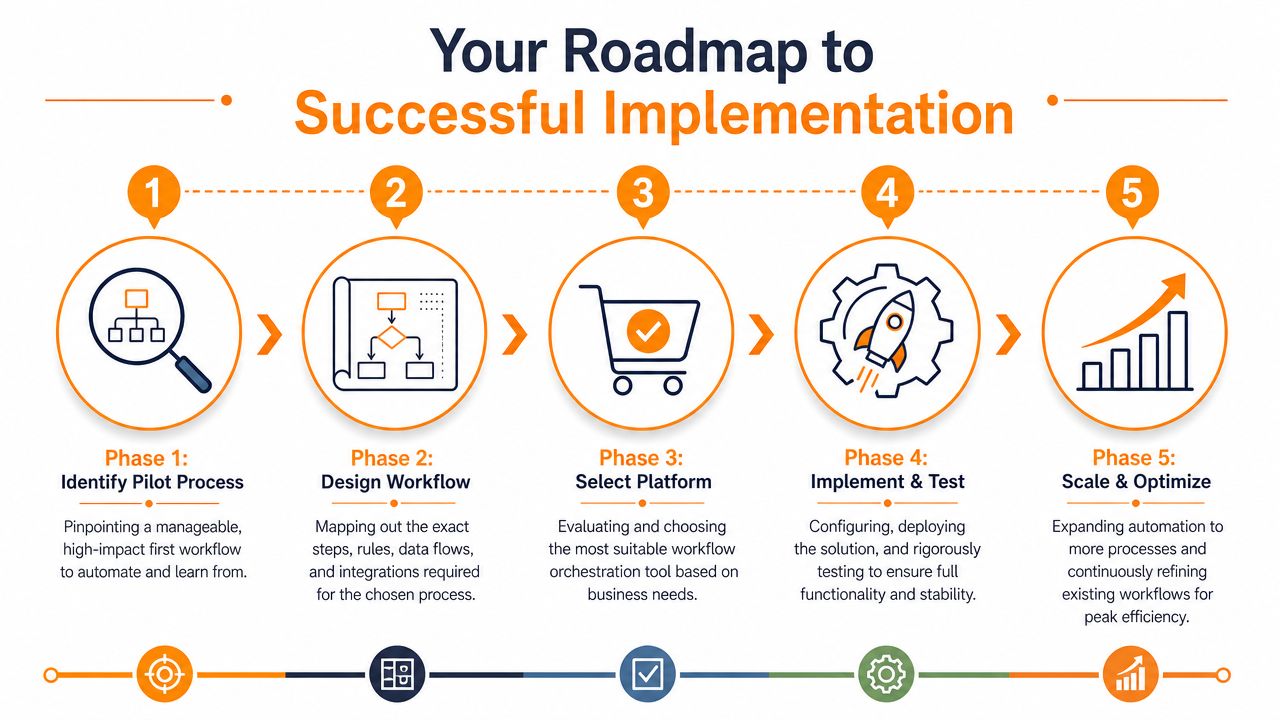
Good workflow orchestration rarely starts with a giant transformation program. It starts with one process that matters, one that's painful enough to fix and contained enough to manage.
That first win does two jobs. It proves value, and it teaches the organisation how to govern orchestration properly before complexity grows.
Start with a pilot that people care about
Pick a workflow with visible business impact and manageable scope. That could be customer onboarding, invoice approvals, lead routing, or a recurring data pipeline that regularly causes delays.
The key is to avoid choosing something tiny and irrelevant just because it feels safe. If the first project doesn't matter to the business, it won't build momentum.
Map the process before you buy the tool
Before selecting a platform, map the workflow.
List the systems involved: CRM, ERP, email, spreadsheets, databases, approval tools.
Identify human touchpoints: Who approves, checks, overrides, or reviews?
Define failure points: What happens if data is missing, delayed, or invalid?
Clarify business rules: What should happen in standard cases, and what should happen in exceptions?
This step often reveals that the problem isn't one task. It's the messy sequence between many tasks.
Governance is where most programs succeed or fail
As orchestration grows, one department can create rules that clash with another. Teams build useful automations locally, but the organisation loses consistency globally. That's where governance matters.
According to Gartner, as orchestration scales, the most common failure point is not the technology but the lack of strong governance models that prevent autonomy drift in complex, multi-departmental workflows, and establishing a centre of excellence is critical for successful scaling, as described in Flowable's discussion of workflow automation versus business orchestration.
A centre of excellence doesn't need to be bureaucratic. It gives the business a shared place to define standards, approve patterns, document best practice, and stop every team reinventing the wheel.
Strong governance should make local teams faster, not slower. The aim is shared guardrails, not centralised gridlock.
What to look for in a platform
Integration breadth: Can it connect to the systems you already use?
Exception handling: Can it manage failures cleanly instead of just stopping?
Visibility: Can leaders and operators see where workflows are stuck?
Scalability: Can the same approach support more processes later?
Usability: Can business and technical teams collaborate without constant translation?
The roadmap is simple in principle. Start small, map carefully, govern early, then scale with discipline.
Modernising Legacy Systems and AI Agents
Many organisations don't have the luxury of starting fresh.
They've got older finance platforms, desktop applications, on-premises databases, line-of-business tools, and years of process history tied to them. Replacing everything in one hit is usually too expensive, too risky, or too disruptive. Workflow orchestration helps because it can sit above those systems and coordinate them without demanding a full rebuild first.
The universal translator role
A practical way to think about orchestration is as a universal translator.
It can trigger an RPA bot to collect data from a legacy application, send that data to a cloud service for analysis, pass the result to a modern CRM, and then notify a human manager if an exception needs review. Old and new tools don't need to become the same thing. They just need a reliable way to work together.
That's especially relevant as more businesses experiment with AI agents. An AI agent may classify emails, summarise documents, or recommend actions. But it still needs a governed process around it. Someone has to decide when the agent is called, what data it can access, how outputs are validated, and what happens when confidence is low.
For organisations exploring these patterns, AI agent development sits naturally alongside orchestration because agents are most useful when they're part of a controlled workflow rather than acting in isolation.
Why the future is shifting from reactive to predictive
Older process models are reactive. Something breaks, and the team scrambles. Someone spots the failed handoff, the late data, or the incomplete job.
Workflow orchestration platforms are forecast by Gartner to achieve a 50% reduction in troubleshooting time by 2029 through GenAI integration, enabling predictive failure anticipation and performance-based optimisation suggestions, according to BMC's analysis of workflow orchestration trends.
That projection matters because it points to a different operating model. Instead of waiting for someone to detect a problem, the platform can increasingly help teams spot weak points earlier and suggest smarter paths forward.
The value of AI in orchestration isn't magic. It's better timing, better visibility, and better decisions around exceptions.
For CTOs, that makes workflow orchestration more than a process tool. It becomes part of the architecture strategy for linking legacy estates with newer AI-enabled services in a controlled, auditable way.
Start Orchestrating Your Business Growth
Workflow orchestration is easy to dismiss as another layer of software until you tie it to what leaders deal with every day. Delays between teams. Rework from bad data. Compliance headaches. Legacy systems that won't disappear. New AI tools that don't fit neatly into existing operations.
Handled well, orchestration gives the business a way to connect all of that with discipline.
The big idea is simple. Automation handles tasks. Orchestration handles the whole performance. That's why the strongest business case usually goes beyond speed. It includes cleaner data, fewer manual errors, better auditability, more reliable handoffs, and a more practical path for modernising older systems without ripping everything out at once.
KPIs that make sense
If you want to track success, use measures that reflect business reality:
Manual error rate: Are teams correcting fewer avoidable mistakes?
Approval turnaround: Are decisions moving with less friction?
Exception volume: Are fewer cases falling out of the normal process?
Order-to-cash cycle time: Is revenue moving through the business more smoothly?
Audit readiness: Can teams show what happened without last-minute scrambling?
Leaders looking at the next wave of orchestration patterns may also find core patterns for AI orchestration useful because it frames how coordinated AI systems need guardrails, sequencing, and oversight.
If your business still relies on scattered automations, heroic manual effort, and a lot of status chasing, workflow orchestration isn't a nice-to-have. It's one of the clearest ways to make growth less chaotic.
If you're ready to move from disconnected workflows to a coordinated operating model, Osher Digital can help you assess the right starting point, map high-impact processes, and design a practical implementation path. Their team works across automation, integrations, legacy modernisation, and AI-enabled operations with a vendor-agnostic approach. If you want expert support from experienced AI consulting specialists, that's a sensible next step.
Last updated on July 17, 2026
Free tool · 1 minute
AI Agent Idea Generator
Describe a painful process and get concrete AI agent concepts for your industry.
Continue Reading
View all
Master Your AI Readiness Assessment for 2026
Is your business ready for AI? Our AI readiness assessment helps you measure data, tech, & process maturity to build a realistic roadmap for 2026.
Jul 29, 2026

What Is Conversational AI and How Enterprises Use It
Learn what is conversational AI, how it works under the hood, and where Australian enterprises are actually using it to cut costs and scale service.
Jul 29, 2026

AI Driven Decision Making for Australian Enterprises
Unlock growth with AI driven decision making. Our guide for Australian enterprises covers strategy, governance, & implementation for smarter, faster decisions.
Jul 17, 2026
Sick of reading about automation?
Book a free 15-minute intro call. We’ll talk through what you’re trying to automate and whether we’re a good fit.