Rented software was always a compromise. AI has ended it.
Off-the-shelf software made sense when custom cost $250,000. AI-assisted development changed the maths. Why we now build software around the business, AI-first, and connected to Claude and ChatGPT, starting at $15k.
By Matthew Clarkson · August 6, 2026
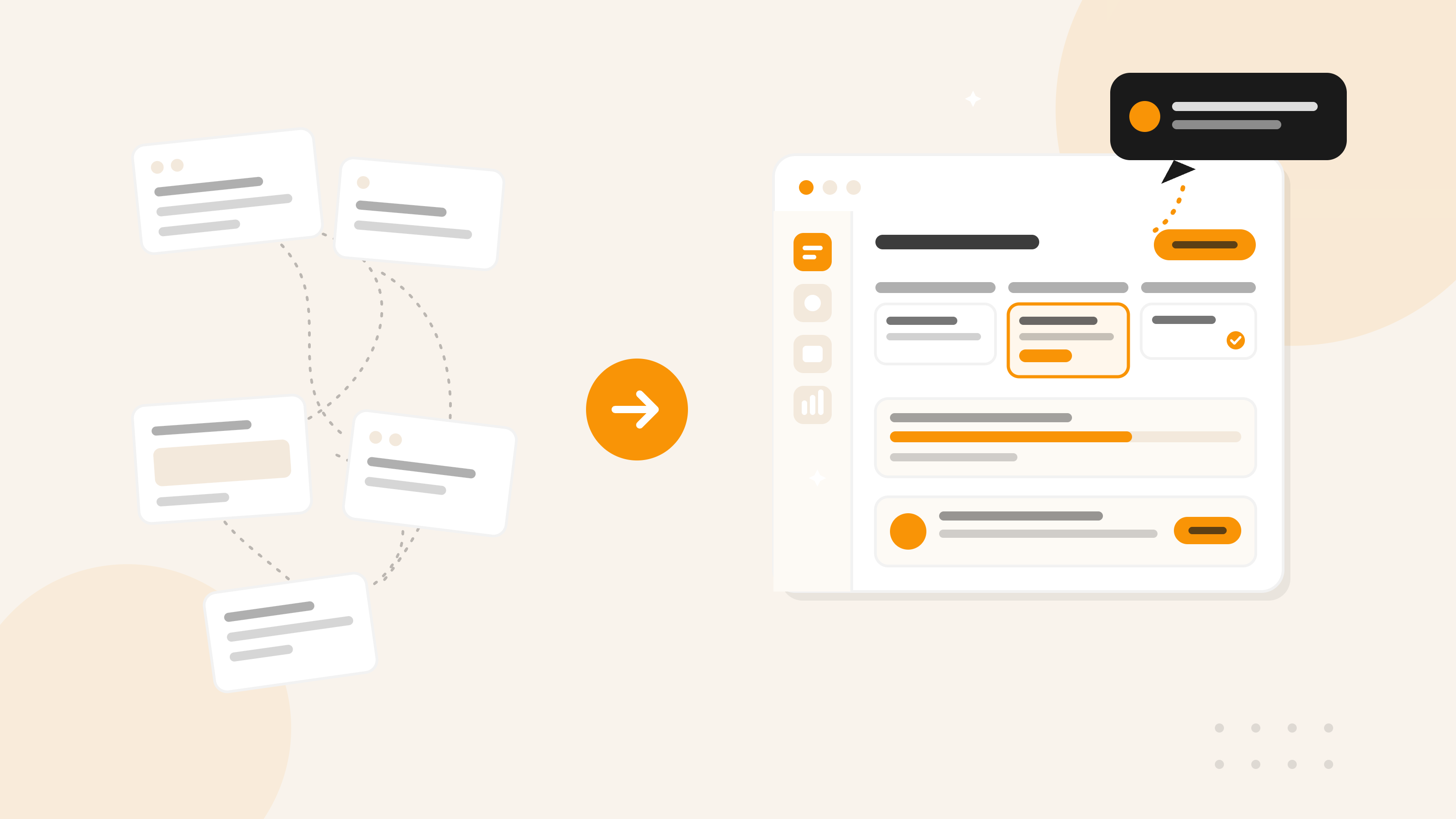
Walk into almost any Australian business and you can watch the same quiet ritual. Someone copies a number out of one system and types it into another. Someone exports a CSV, fixes it in Excel, and emails it to the person who imports it. A job gets updated in three places, and one of them is a whiteboard.
Nobody planned this. It grew, subscription by subscription, because every tool was almost right.
Why we all agreed to rent
For twenty years, renting software was the only sensible choice. Custom systems were a big-company game: $250,000 builds, twelve-month timelines, and a consulting bill that kept going after go-live. So the rest of us subscribed. A CRM here, a job tracker there, a form builder, a signing tool, a portal, and spreadsheets to bridge the gaps.
Renting came with terms we stopped noticing:
- Your business adapts to the software. The tool has stages, fields and words for the work. Yours are different. Yours lose.
- You pay per user, per month, forever. Hiring your twentieth staff member costs the same as your fifth, except in software, where growth is a penalty.
- The tools do not talk to each other. So you pay again, in connectors, middleware and the hours your team spends being the integration.
- Your data lives in the vendor's cloud, on their terms. Leaving means exporting what they let you export.
- The roadmap is not yours. The feature you need is in a queue behind ten thousand other customers.
Each compromise is small. Together they put a ceiling on how well a business can run, because the business is always bending to fit tools designed for the average of everyone.
What changed
AI-assisted development changed the arithmetic of building.
We have watched it from the inside. Our senior developers now ship in weeks what used to take a team most of a year. AI does the typing. Experienced people do the thinking, review every line, and stand behind the result. The output is ordinary, boring, well-tested code, produced at a speed that was science fiction three years ago.
That speed collapses the price. A complete custom system, one that runs quoting, jobs, scheduling and invoicing the way your business actually does them, now starts at $15,000 + GST. That number used to be the cost of the discovery workshop.
When building costs what a year of subscriptions costs, the old logic flips. The question stops being "which product is closest to what we do?" and becomes "why are we still describing our business to software that will never quite listen?"
Software built for the business, not near it
Over the past few years we have built a lot of different solutions for clients: AI agents, automations, integrations, portals, whole operating systems for service businesses. The single biggest lesson is not about any tool. It is that the technology underneath changes constantly. Platforms pivot, pricing doubles, APIs get deprecated, the tool you built around gets acquired and sunset.
When you rent your stack, every one of those changes is your emergency.
When you own it, almost none of them are. Custom software saves the heartache because you own the entire experience: the code, the data, the roadmap, the way a job moves from first phone call to money in the bank. A vendor's pivot becomes a line in someone else's newsletter instead of a migration project in your quarter.
We build these systems from modules that already run real Australian businesses: CRM, job management, scheduling, field apps that work offline, invoicing wired into Xero, AI report writing. One inspections business runs six teams through a system shaped exactly like their workflow, because it was built from their workflow. An arborist consultancy captures site data on phones with no reception and gets finished, branded reports drafted in minutes. None of that came off a shelf, because no shelf stocks it.
What AI-first actually means
Here is the part that makes this the future rather than a nostalgia trip about bespoke software.
Most products are adding an AI feature and a sparkle icon. That is AI bolted on. AI-first is structural, and it only really works when the software is yours:
The AI can operate the whole system. Every system we build ships with an MCP server, the open standard that lets AI assistants work inside other software. Connect Claude or ChatGPT and ask, in plain language: where is the Hendersons job up to? Draft follow-ups for every quote that has gone quiet. Summarise this client before my 2pm. The assistant reads with the same permissions as a staff member, writes only with approval, and every action is on the record. This is what our custom AI assistant builds do all day.
The AI lives inside the work. Reports draft themselves from captured data and never overwrite a sentence a human has edited. Documents get read by vision models and filed. An assistant sits beside every screen, already knowing what you are looking at.
Nothing is bolted on, because there is nothing to bolt onto. Your data, your permissions, your AI, one system. No third-party silo deciding which corners of your business the model is allowed to see.
Rented software will get AI features. But a vendor can only wire AI into the average business they imagine. Owned software wires it into yours.
Where off the shelf still wins
We say this on our own sales pages and it belongs here too: renting is still right for plenty of situations. If a standard tool genuinely fits how you work, use it. If you need something running this afternoon, subscribe. Commodity functions with no process of yours inside them, like email marketing, are not worth building.
Custom wins when the monthly licence bill keeps climbing, when your process does not fit anyone's template, or when the software effectively is the business. For a service business past a certain size, that describes the core of the operation.
The maths, on one line
Take your monthly software spend, multiply by the number of users, multiply by five years, and add the hours your team spends retyping data between tools. Put that number next to a fixed-price build starting at $15,000 + GST that you own outright, with no per-user fees, running in Docker on whatever host you choose.
For most businesses we audit, that comparison is not close. Our ROI calculator will give you your version of the number in about two minutes.
Where to start
Not with software. With a map. Most of our builds start with a one-day Business Process Audit: we follow the work from first enquiry to money in the bank, cost the bottlenecks, and hand you a build-ready report you own, whichever way you take it. If the honest answer is an off-the-shelf tool, the report says so.
And if the answer is that your business deserves software built for it, that is what we do: custom ERP software, AI-first, from $15,000 + GST.
The compromise era had a good run. You do not have to keep funding it.
Last updated on August 6, 2026
Free tool · 2 minutes
Automation ROI Calculator
See what a manual process is really costing you, and the payback on automating it.
Continue Reading
View all
n8n Outlook Automation: Where the Node Stops and Graph Begins
n8n Outlook automation breaks in predictable places: subfolders, attachments, shifting email IDs, plus the Graph API workarounds we run in production.
Mar 16, 2026

What Is a Workflow? Definition, Parts, and What Breaks
A workflow is the repeatable set of steps that takes a task from start to finish. Here is what a workflow is made of, and the parts that quietly break.
Mar 1, 2026
Aussie Guide to Marketing Automation for Small Business
Imagine having an extra team member who works around the clock, remembers every customer's name and history, and never once asks for a day off. That is the real power of marketing automation, and it is a complete game changer for small businesses. At its core, marketing automation is just software designed to handle routine […]
Dec 11, 2025
Sick of reading about automation?
Book a free 15-minute intro call. We’ll talk through what you’re trying to automate and whether we’re a good fit.